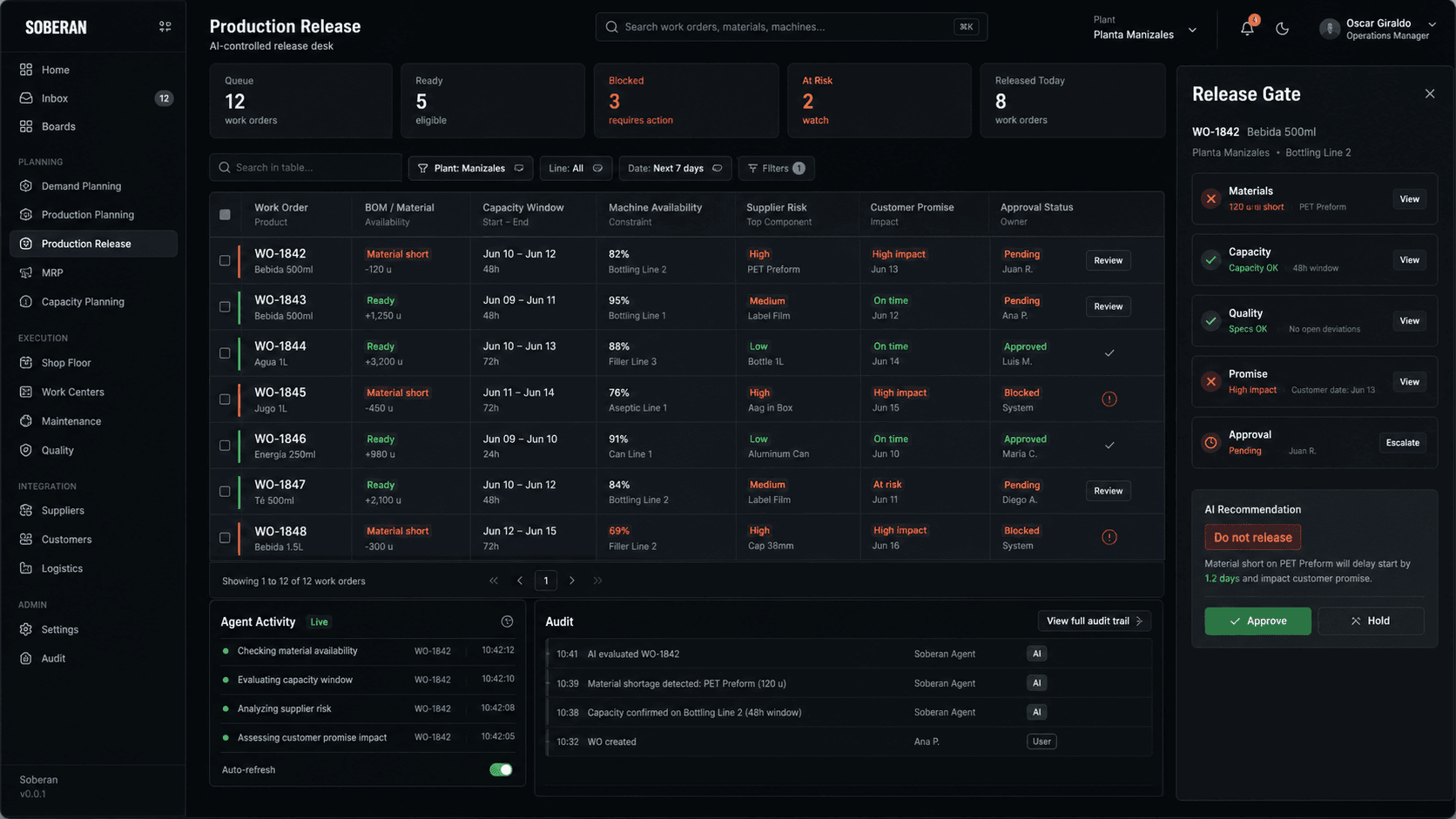
The answer: make production release the control point, not another planning suggestion
For SOBERAN buyers, the practical point of view is this: do not measure manufacturing AI by the number of schedules it can draft. Measure it by how safely it decides whether a work order is ready to release. A release decision touches BOM accuracy, component availability, machine capacity, labor assumptions, quality policy, supplier changes, maintenance risk, sales promises, and service expectations.
That is why the first AI agent should behave like a production release gate. It assembles the evidence, highlights the blocked constraint, recommends the next action, and records who approved the exception before ERP, procurement, CRM, or customer-service records change.
Concrete workflow to automate first
- Monitor planned and firm work orders by product, line, shift, BOM version, component availability, supplier status, machine constraint, quality hold, customer promise date, and value at risk.
- Before release, check whether required components are available, reserved, substituted, late from a supplier, held for quality, or needed by a higher-priority customer order.
- Validate the capacity window against line availability, changeover time, maintenance events, labor assumptions, tooling constraints, and active production priorities.
- Create a release packet with recommended action: release, hold, reschedule, split, substitute component, expedite supplier follow-up, reserve material, or escalate customer promise risk.
- Require human approval for customer-impacting delays, substitutions, quality-sensitive products, high-value orders, constrained materials, margin risk, and schedule changes beyond policy.
- After approval, update ERP work-order status, procurement tasks, inventory reservations, CRM promise notes, service context, supervisor queue, and audit history from the same decision record.
Competitor landscape
- 01
SAP Production Planning and Operations Agent
Production release agent inside SAP manufacturing and supply chainSAP describes a Production Planning and Operations Agent that lets planners release production orders while validating material availability, capacity, and scheduling constraints, with recommendations planners review and approve.
- Best for
- SAP-centered manufacturers that want manufacturing agents close to SAP Digital Manufacturing, ERP, supply chain data, and Joule governance.
- Note
- Mid-market operators should test how non-SAP supplier data, local plant workarounds, CRM promises, WhatsApp service escalations, and approval thresholds are represented before release.
- 02
Oracle Fusion Cloud SCM AI agents
Embedded agents across manufacturing, maintenance, logistics, and inventoryOracle announced AI agents across Oracle Fusion Cloud Supply Chain & Manufacturing, including manufacturing, maintenance, logistics, inventory, planning, procurement, and service workflows.
- Best for
- Organizations already standardized on Oracle Fusion Cloud Applications that want supply-chain agents embedded in existing Oracle workflows and security controls.
- Note
- Validate how the release decision connects to mixed ERPs, customer-facing CRM updates, plant-specific policies, and supplier follow-up outside Oracle.
- 03
Accenture, Avanade, and Microsoft Agentic Factory
Shop-floor intelligence for diagnostics and downtime responseAccenture and Avanade describe an agentic factory intelligence system with Microsoft that helps operators run status checks, diagnostics, guided troubleshooting, maintenance tickets, and spare-parts orders.
- Best for
- Manufacturers with Microsoft data, cloud, and factory programs that need frontline decision support and downtime reduction.
- Note
- This is strong for equipment and production-line response; SOBERAN buyers should still ask how work-order release, customer promise impact, ERP updates, and procurement exceptions are governed together.
- 04
SOBERAN
Production release gate across ERP, procurement, inventory, CRM, and serviceSOBERAN connects production priorities, BOM and inventory evidence, supplier follow-up, ERP status, CRM promise context, approval policy, and audit history so agents can prepare release decisions without hiding plant risk.
- Best for
- LatAm mid-market manufacturers that need AI to reduce planning latency while humans control substitutions, customer-impacting delays, constrained material, quality exceptions, and ERP updates.
- Note
- Use SOBERAN when the real pain is not a planning chart but the daily decision: can this order safely move to the floor now, and what changes if it cannot?
Operating model, governance, and KPIs
- Operating model: planning owns production priority, plant supervisors own line reality, procurement owns supplier commitments, inventory control owns material truth, quality owns release policy, sales operations owns customer promises, and finance owns cost thresholds.
- Governance: classify each release decision by material risk, capacity risk, quality risk, customer impact, margin exposure, supplier dependency, system confidence, approval requirement, and allowed ERP update.
- Data policy: define source precedence for BOM version, inventory on hand, reservations, open POs, supplier dates, line capacity, maintenance events, quality holds, customer due dates, and service escalation context.
- KPIs: release-cycle time, schedule adherence, material-shortage rate, late-start rate, changeover impact, expedite cost, customer-promise aging, rework caused by bad release, approval latency, and audit completeness.
- Risk to govern: agents can over-trust ERP inventory, miss undocumented plant constraints, recommend risky substitutions, bury customer impact, or create conflicting updates if production, procurement, CRM, and service work from different records.
- How SOBERAN fits: SOBERAN gives the agent one governed view of production, inventory, procurement, CRM, service, policy, approvals, and audit history so release decisions move faster without turning plant judgment into an invisible model output.
Sources and trend signals
- SAP at Hannover Messe 2026: Operationalizing Agentic AI to Drive Resilient, End-to-End ManufacturingPrimary SAP signal for production planning agents, production master data agents, material availability checks, capacity validation, scheduling constraints, and planner approval.
- Accenture and Avanade collaborate with Microsoft on Agentic FactoryPrimary Accenture signal for shop-floor agents that analyze production context, diagnose issues, recommend actions, and prepare maintenance or parts work while humans stay in control.
- Oracle AI agents for Fusion Cloud Supply Chain & ManufacturingPrimary Oracle signal for embedded agents across planning, procurement, manufacturing, maintenance, inventory, logistics, order management, and service.
- Microsoft: Manufacturing at the 2026 inflection pointHigh-authority platform signal that manufacturing AI is shifting toward orchestration across design, production, supply chain, service, data, governance, and auditability.
- McKinsey: The end of ERP as we know itAnalyst signal that agentic systems are moving beyond ERP task automation toward end-to-end process orchestration, while system-of-record control still matters.
- McKinsey: The AI assembly lineAnalyst signal that agentic AI is reshaping cognitive work in engineering, supply chain planning, risk assessment, bottleneck resolution, and production priorities.
- Sequoia: Context for agents at scaleInvestor signal that reliable agents need living company context, escalation paths, transparent knowledge, and editable process memory.
- a16z: Big Ideas 2026, the enterprise orchestration layerInvestor signal that enterprise AI is moving from isolated copilots to coordinated multi-agent systems that plan, analyze, and execute work across teams and tools.
- TechRadar Pro: AI agents should not run your supply chainMajor-outlet counter-signal that physical supply chains require real-world context, oversight, and judgment rather than full autonomous control.