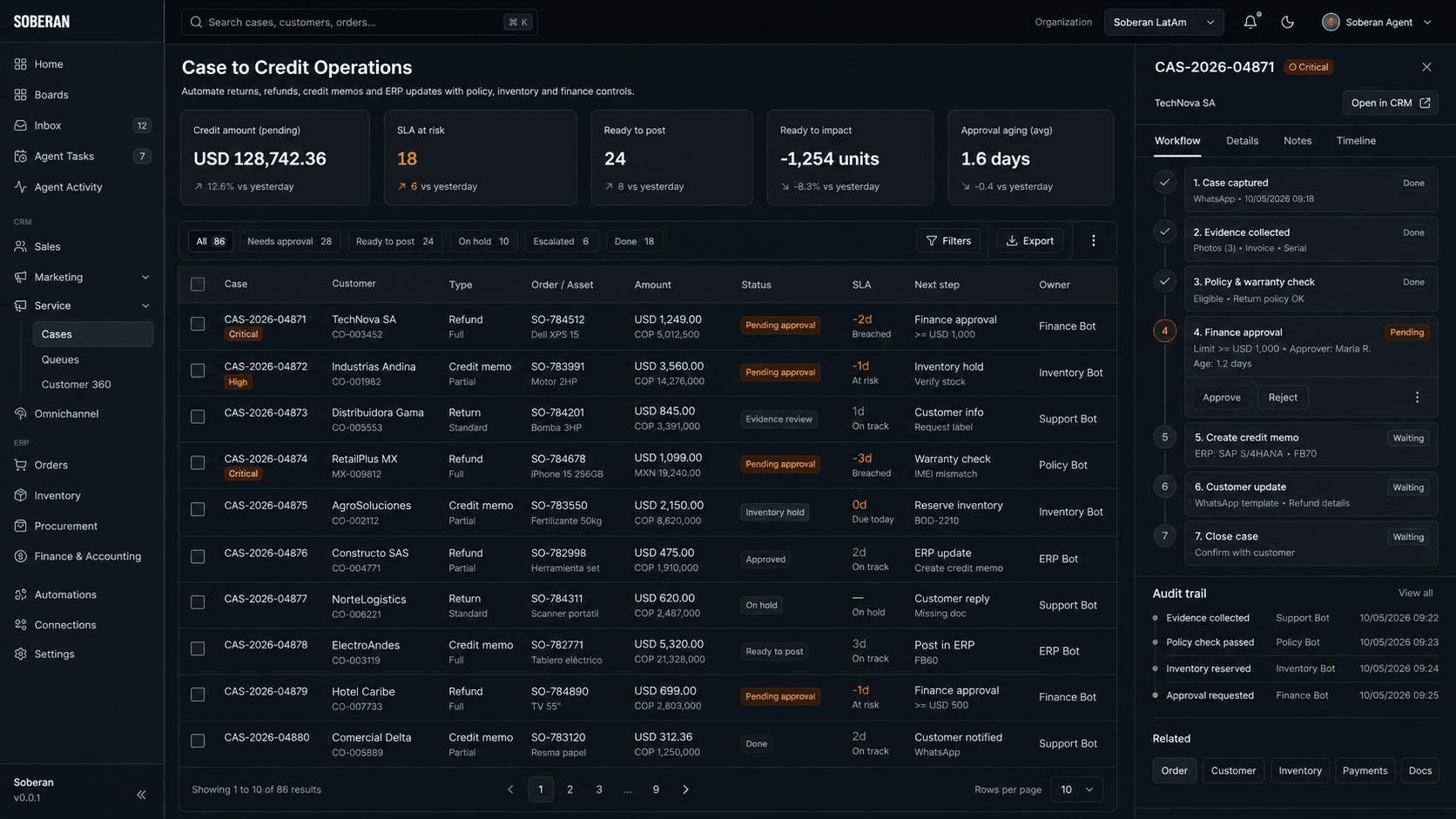
The answer: automate the case-to-credit loop, not just the customer reply
The external signal is becoming specific. Salesforce is pushing agents from front-office experiences into back-office process execution. SAP is putting Joule agents into finance and order-management work such as invoice disputes, credit memo recommendations, and order lifecycle questions. ServiceNow is positioning autonomous CRM around service, order operations, invoice disputes, returns, and recalls. McKinsey frames the same shift as agents executing ERP processes while humans govern outcomes, trust, and exceptions.
For SOBERAN buyers, the operating point is simple: do not let the contact center promise a refund, replacement, or credit before the agent has checked policy, order history, payment status, tax exposure, inventory impact, and approval thresholds. The customer experience depends on the invisible work after the conversation.
Concrete workflow to automate first
- Capture the request from WhatsApp, phone, email, portal, or CRM, then classify whether it is a refund, return, credit memo, warranty exception, billing correction, damaged shipment, cancellation, or service recovery case.
- Verify identity, order, invoice, payment status, delivery evidence, product condition, return window, customer tier, regional policy, tax treatment, and prior exceptions before proposing an action.
- Decide whether inventory needs a hold, return label, quarantine, inspection, restock, replacement reservation, warehouse task, or supplier claim before finance posts anything.
- Generate the recommended action: deny with reason, request missing evidence, approve a partial refund, approve a credit memo, reserve replacement stock, escalate to finance, or send the case to a human reviewer.
- Update CRM case, ERP order, finance record, inventory status, customer notification, and audit history with the approved action, evidence, responsible person, approval timestamp, and next checkpoint.
- Close the loop by measuring customer update latency, approval aging, credit leakage, repeat-contact rate, inventory recovery, and whether the posted ERP record matches the customer promise.
Competitor landscape
- 01
Salesforce Agentforce Operations
Back-office agent execution across disconnected systemsSalesforce positions Agentforce Operations around specialized agents that coordinate work across email, ERP, approvals, compliance checks, and audit trails after front-office activity creates downstream work.
- Best for
- Salesforce-centered organizations that want agentic process automation close to CRM, Slack, Teams, process blueprints, and broader customer or employee operations.
- Note
- Mid-market buyers should inspect how ERP postings, refund thresholds, regional tax rules, inventory holds, and non-Salesforce service channels are governed before an agent acts.
- 02
SAP Business AI and Joule agents
Finance and order-management agents inside SAPSAP describes Business AI release highlights for finance and commercial operations, including dispute resolution, credit memo recommendations, payment advice processing, and order-management guidance.
- Best for
- SAP-standardized companies that need AI-assisted resolution inside S/4HANA, finance, receivables, order management, and document-heavy processes.
- Note
- Teams still need a policy layer when the refund or credit decision starts in WhatsApp, a contact center, a marketplace, or a non-SAP CRM before it reaches finance.
- 03
ServiceNow Customer Service Management
Service workflow automation for returns and complex casesServiceNow positions CSM and Autonomous CRM around AI agents, customer service automation, return requests, product recalls, orders, invoice disputes, and governed work across systems.
- Best for
- Service organizations that want customer cases, service operations, order management, and enterprise workflow controls on the ServiceNow AI Platform.
- Note
- Evaluate whether customer messaging, ERP finance updates, local inventory, tax treatment, and regional approval policies can run as one auditable operating loop.
- 04
SOBERAN
Case-to-credit automation across contact center, CRM, ERP, finance, and inventorySOBERAN connects customer conversations, service cases, order context, policy checks, finance approvals, inventory actions, ERP updates, CRM notes, and audit history in one governed loop.
- Best for
- LatAm mid-market operators whose refund, return, and credit decisions depend on WhatsApp, voice, mixed ERPs, local tax rules, warehouse reality, and human approval thresholds.
- Note
- Use SOBERAN when the bottleneck is not answering the customer, but safely converting a customer issue into the right finance, inventory, and ERP action.
Operating model, governance, and KPIs
- Operating model: contact center owns the customer interaction, customer operations owns the case policy, finance owns refund and credit thresholds, inventory owns product recovery, and ERP or CRM administrators own record-update permissions.
- Governance: require human approval for high-value refunds, tax-sensitive credits, repeat exceptions, damaged-goods disputes, warranty overrides, VIP customers, payment reversals, and any posting that changes recognized revenue or inventory value.
- Data policy: define source precedence for customer identity, invoice status, payment status, delivered quantity, return evidence, product condition, inventory disposition, tax rule, credit limit, and customer-facing language.
- KPIs: time to first decision, approval aging, refund cycle time, credit memo accuracy, repeat-contact rate, preventable escalations, inventory recovery rate, finance exception leakage, ERP completeness, CRM completeness, and audit-ready case closure.
- Buyer intent: heads of customer operations, finance operations, RevOps, ecommerce operations, wholesale operations, and contact center leaders should start here when refund and credit decisions are slow because evidence lives across too many systems.
- How SOBERAN fits: SOBERAN gives AI agents controlled access to the conversation, customer record, ERP order, invoice, payment status, inventory signal, policy, approval queue, WhatsApp or voice channel, and audit trail so the case can close without losing financial control.
- Internal links to prioritize: /contact-center, /automate/order-management, /automate/chat-email-support, /automate/dispute-handling, /automate/inventory-reconciliation, /erp, /crm, /ai-automation, /ai-native-erp, /ai-native-crm, /industries/retail-ecommerce, and /industries/wholesale-distribution.
Sources and trend signals
- Salesforce: Agentforce OperationsPrimary Salesforce signal on moving agents from front-office experiences into back-office execution across disconnected systems, approvals, ERP work, and audit-ready outcomes.
- CIO: Salesforce expands beyond the front officeEnterprise-technology coverage highlighting returns processing, inventory reconciliation, supply-chain oversight, ERP systems, human review, and audit trails as back-office agent targets.
- SAP Business AI release highlights Q1 2026SAP signal on Joule agents and AI-assisted finance, dispute resolution, credit memo recommendations, payment advice processing, sales-order creation, and order-management guidance.
- SAP Help: Dispute ResolutionOfficial SAP Help page used to verify the dispute-resolution pattern that connects dispute cases with verification, resolution options, and credit memo assignment.
- ServiceNow Customer Service ManagementOfficial ServiceNow page used to verify customer service automation, AI agents, return-request handling, product recalls, and service workflow positioning.
- McKinsey: AI disruption in ERPMcKinsey signal on ERP agents, auditability, human oversight, agentic operating models, and ERP as the reliable backbone for enterprise execution.
- McKinsey: trust in AI-powered customer careCustomer-care signal on rewiring operating models, trust, governance, human roles, and agents executing end-to-end workflows across customer journeys.
- a16z: the enterprise orchestration layerMarket perspective on coordinated multi-agent systems becoming an orchestration layer that plans, analyzes, and executes work across enterprise tools.
- Sequoia: context for agents at scaleAgent-context signal: reliable automation depends on company-specific process context, escalation paths, and operating knowledge rather than generic chat behavior.
- SOBERAN contact center automationInternal SOBERAN page for connecting voice, WhatsApp, service queues, CRM, ERP, and governed customer operations.
- SOBERAN order management automationInternal SOBERAN page for order exceptions, customer updates, ERP context, and operational actions behind the service conversation.
- SOBERAN ERP and CRM pagesInternal SOBERAN path for ERP execution; pair with /crm, /ai-automation, /ai-native-erp, and /ai-native-crm when mapping case-to-credit automation.