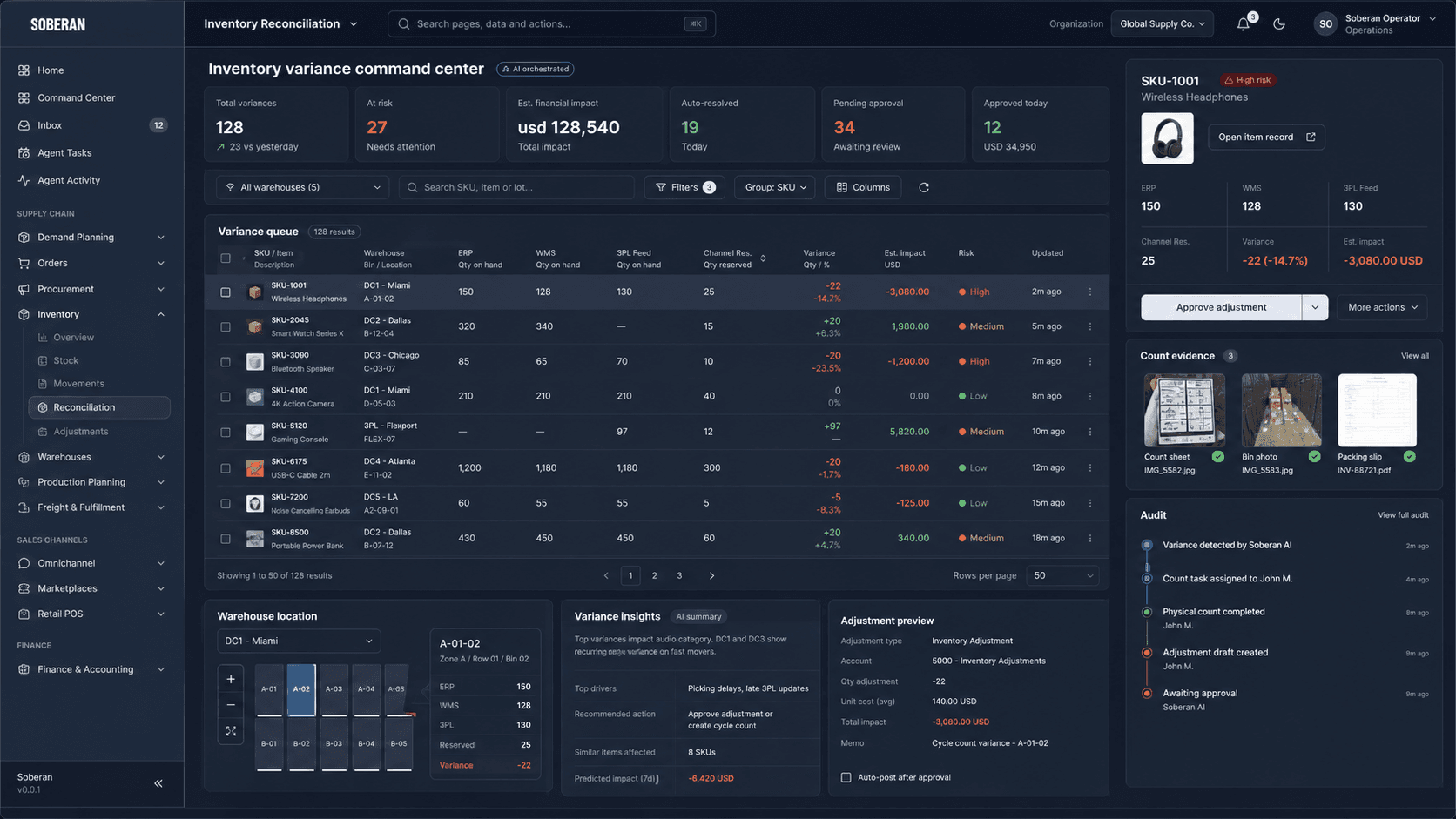
The answer: automate variance closure, not just variance detection
The best first workflow is the daily variance queue. The agent should compare system quantities, identify the likely source of the mismatch, request physical or digital evidence, estimate financial and customer-promise impact, route the right approver, and update records only after controls pass.
Buyer intent comes from inventory control, warehouse operations, finance, ecommerce, and planning teams that already see mismatches but lose time deciding which count is trusted and which system should change first.
Concrete workflow to automate first
- Compare ERP on-hand, WMS bin quantity, 3PL feed, channel reservations, open orders, returns, transfers, cycle counts, and recent adjustments by SKU and location.
- Classify variance causes such as delayed 3PL feed, wrong bin, open pick task, unposted receipt, return not inspected, damaged stock, duplicate SKU, marketplace reservation, or manual adjustment error.
- Collect count evidence from photos, count sheets, scan events, movement history, receipt documents, shipment records, and user notes.
- Calculate impact on available-to-promise, open orders, stockout risk, financial adjustment value, shrinkage, replenishment recommendation, and customer communication.
- Route approval by tolerance, SKU value, customer impact, finance threshold, warehouse responsibility, and repeated variance history.
- Update ERP, WMS, 3PL, ecommerce channel, planning, finance, and audit records with the approved quantity, reason code, evidence, and accountable owner.
Competitor landscape
- 01
SAP Extended Warehouse Management
Warehouse physical inventory and cycle countingSAP documentation describes cycle counting as a recurring physical inventory process for stock during the fiscal year inside Extended Warehouse Management.
- Best for
- SAP-centered warehouse operations that need mature WMS execution, physical inventory processes, and enterprise controls.
- Note
- For cross-system variance closure, confirm how 3PL feeds, ecommerce reservations, finance approvals, and customer-promise impacts are orchestrated outside SAP.
- 02
Oracle NetSuite Inventory Counts
ERP inventory count processOracle NetSuite documentation describes periodic inventory counts for maintaining on-hand item quantity accuracy.
- Best for
- Operators running NetSuite as the ERP of record that need native count records and inventory adjustment controls.
- Note
- NetSuite can be the accounting and inventory source of truth, but variance work often still requires WMS, 3PL, marketplace, and physical-count evidence.
- 03
Manhattan Active Warehouse Management
Cloud WMS with inventory visibilityManhattan positions Active Warehouse Management around real-time end-to-end visibility, inventory tracking, unified distribution control, and a single source of truth.
- Best for
- Large warehouse and distribution networks that need advanced WMS execution, labor, automation, slotting, and inventory visibility.
- Note
- Buyers should inspect how variance approval, finance impact, ERP updates, and channel availability are controlled across the full operating stack.
- 04
SOBERAN
Inventory variance closure across ERP, WMS, 3PL, channels, and financeSOBERAN connects inventory signals, count evidence, tolerance policy, approval queues, financial impact, channel availability, and system updates in one governed loop.
- Best for
- Stock-heavy operators that need fewer oversells, fewer hidden variances, faster count closure, and cleaner inventory records across mixed systems.
- Note
- Use SOBERAN when the bottleneck is not seeing the variance, but proving it, approving it, and synchronizing the correction everywhere it matters.
Operating model, governance, and metrics
- Operating model: warehouse owns physical count evidence, inventory control owns variance classification, finance owns adjustment thresholds, planning owns replenishment impact, and ecommerce owns channel availability risk.
- Governance: require approval for high-value adjustments, shrinkage indicators, repeated SKU variance, customer-order impact, negative stock, damaged goods, substitute items, and finance-posting changes.
- Metrics: variance aging, count completion time, adjustment approval time, inventory accuracy by location, oversell incidents, stockout caused by variance, financial adjustment value, and repeated variance rate.
- How SOBERAN fits: SOBERAN gives agents controlled access to ERP, WMS, 3PL, channels, planning, finance, approvals, and audit history so inventory corrections are explainable and reversible through policy.
- Internal links to prioritize: /automate/inventory-reconciliation, /automate/order-management, /automate/automated-replenishment, /inventory-management, and /supply-chain.
Sources and trend signals
- Gartner: agentic AI spend in supply chain management softwareGartner forecasts fast growth for agentic AI in SCM software and notes the shift from assistants to agents executing supply-chain tasks and multi-step workflows.
- Accenture: autonomous supply chainAccenture frames autonomous supply chain around organized, interoperable data across finance, marketing, sales, and operations for end-to-end planning and execution.
- SAP EWM cycle counting documentationOfficial SAP documentation used to verify recurring physical inventory and cycle counting concepts in Extended Warehouse Management.
- Oracle NetSuite inventory counts documentationOfficial Oracle NetSuite documentation used to verify inventory count records for maintaining on-hand item quantity accuracy.
- SOBERAN inventory reconciliation automationInternal SOBERAN use case page for ERP, WMS, 3PL, channel variance, approvals, and inventory correction records.