ERP SoftwareModule07 / 11
Freight and fulfillment that customers experience as reliability
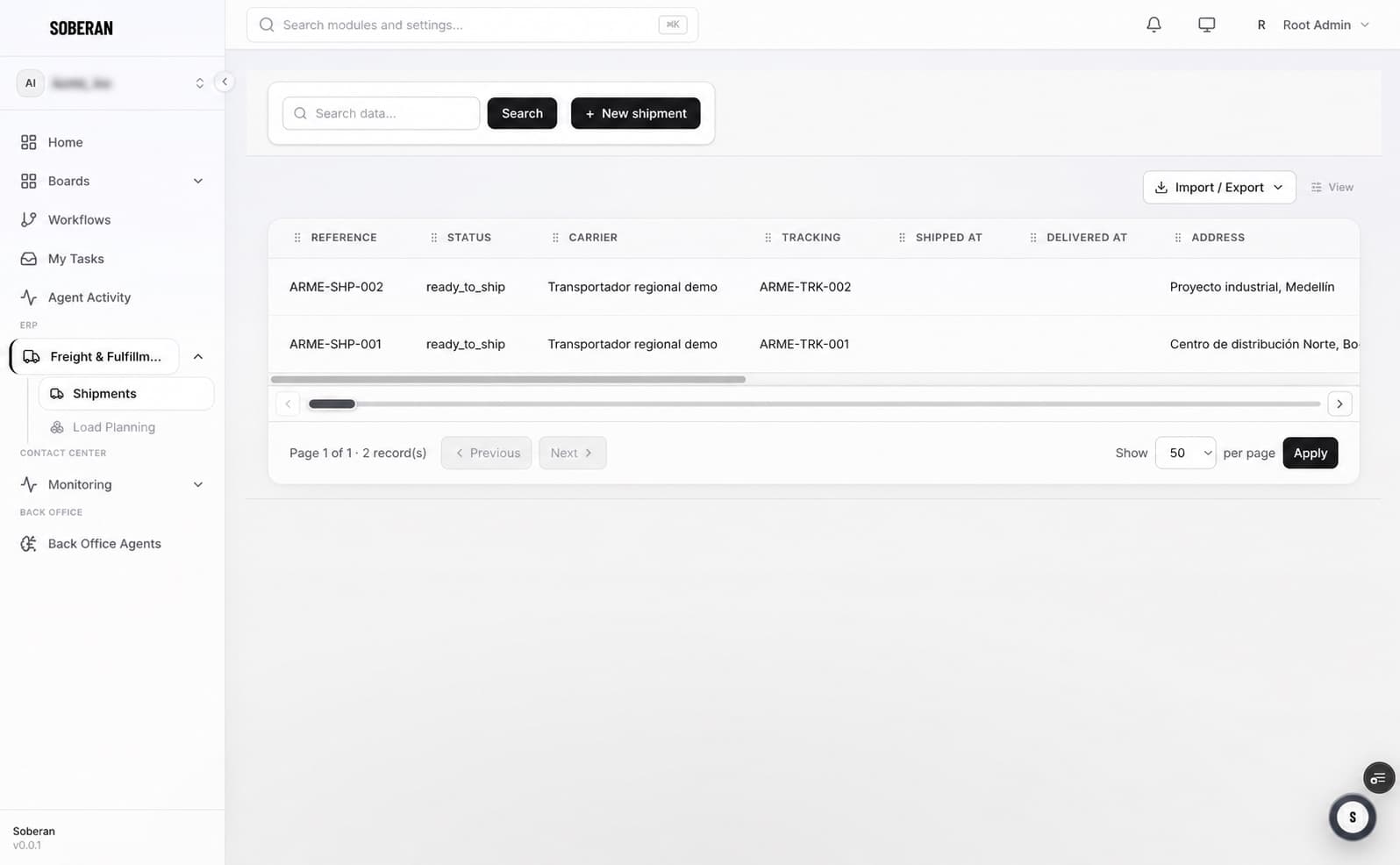
Bridge the gap between "order promised" and "order delivered" with shipment context tied to inventory and customer communications.
 ERP Software / 07
Operational coverage
The work your team can stop coordinating by hand.
Late shipments erode LTV faster than a bad ad campaign. This module is for operators who need logistics visibility without maintaining a separate universe of spreadsheets for every 3PL relationship.
Shipment planning visibility adjacent to orders and inventory commitments
Carrier and lane context for customer service and finance
Better landed-cost storytelling over time as freight data compounds
Handoffs that reduce “where is my order?” dead air
Operational impact
Results teams can feel in the operation.
SOBERAN ships in English and Spanish with implementation playbooks focused on the United States and Latin America. Scoped module rollouts commonly target first value in about 30 days depending on integrations and data readiness.
- 01
Fewer missed delivery windows from opaque handoffs
- 02
Better landed cost understanding over time
- 03
Clearer accountability between warehouse, carriers, and customer service
Why now
See delivery risk before the customer asks.
As volume grows, manual handoffs stop scaling.
Next step
Before you decide
Frequently asked questions
01Do you replace a TMS?
Mid-market teams often need ERP-level shipment orchestration first. Deep TMS replacement depends on mode complexity - we scope pragmatically.
02Can we connect parcel and LTL carriers?
Carrier connectivity is implemented based on your mix and available APIs or EDI relationships.
03How does CRM service use this?
When service agents have shipment and order context in one platform, customers get accurate answers faster.
04Does it help with cross-border LatAm moves?
Regional logistics vary widely; we focus on traceability, timing signals, and integration points your partners already expose.
05How does Freight connect to Orders and Service?
Agents and customers get answers grounded in shipment status tied to the same order record CRM and ERP already share - without opening a separate TMS spreadsheet.
06Is Freight and fulfillment that customers experience as reliability only software or also a managed service?
SOBERAN combines software, agent services, and human oversight. In Freight and fulfillment that customers experience as reliability, the software layer keeps data, policies, and audit trails aligned; the SOBERAN Agent prepares and executes routine work; and your team approves exceptions, spend, policy changes, and sensitive decisions.
Bring it to your operation
See ERP Software working with your data and policies.
In 30 minutes, we will walk through the workflow, required integrations, and where human approval stays in control.
Book a demo