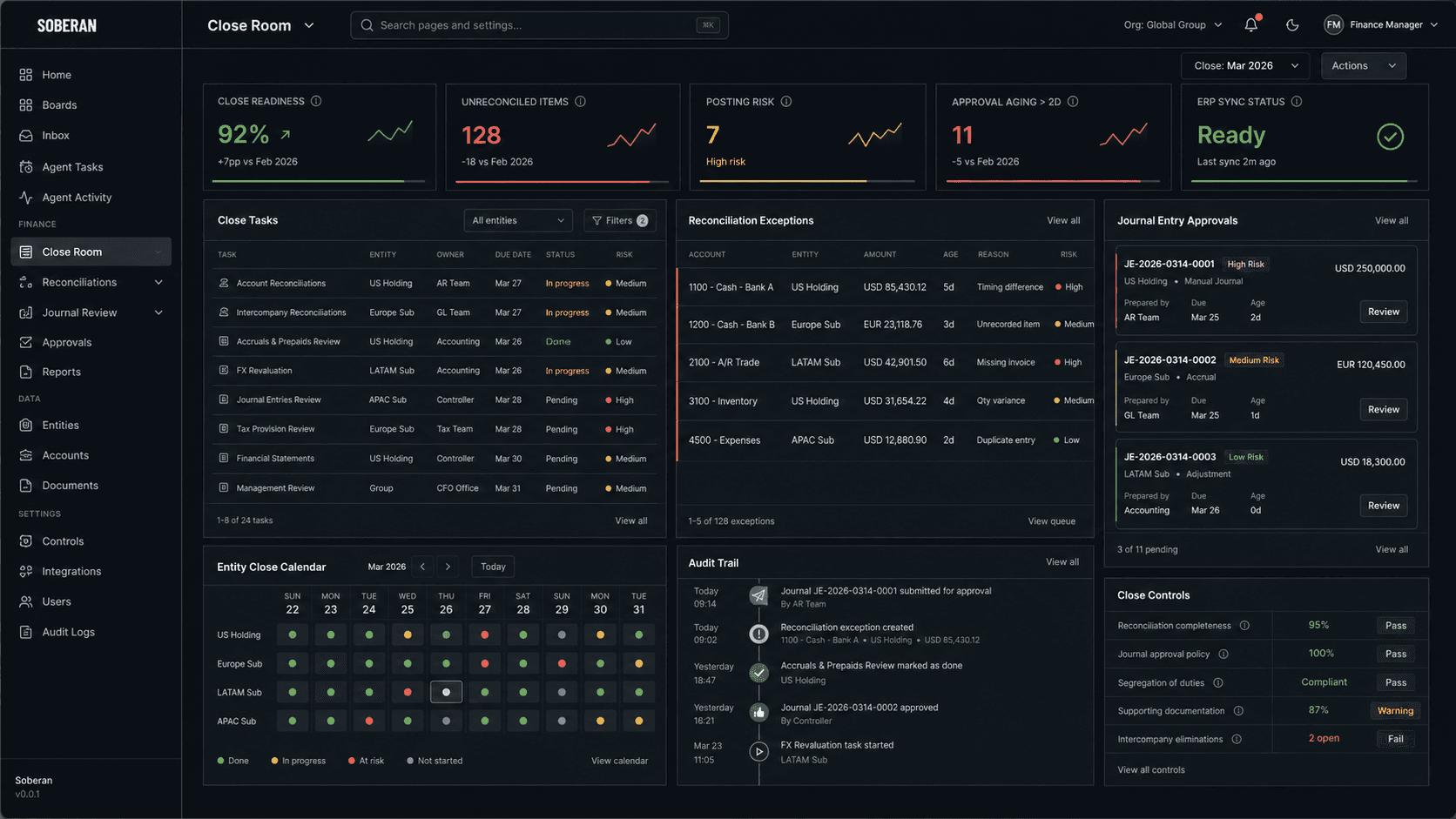
The answer: automate the close room, not just the variance explanation
The external signal is clear. SAP is positioning autonomous finance agents around journal entries, reconciliation, and error resolution. Sage is adding close analytics, AI import, cash intelligence, and finance agents for mid-market accounting teams. Salesforce is extending agents into back-office processes that need approvals, audit trails, and ERP updates. McKinsey frames the same architecture as agents executing ERP processes while the system of record preserves reliability, auditability, and compliance.
For SOBERAN buyers, the practical point is sharper: do not ask an agent to “close the books” until it can prove every source, tolerance, approval, entity status, tax-sensitive adjustment, and ERP update. The first useful finance agent is a period-close control room that reduces exception aging without weakening controller oversight.
Concrete workflow to automate first
- Build the close calendar by entity, country, account group, responsible team, due date, dependency, and required evidence before the period starts.
- Ingest ERP balances, subledger activity, bank feeds, AR and AP aging, inventory valuation, order holds, tax registers, payroll accruals, and manual spreadsheet inputs.
- Classify close work into clean reconciliation, missing evidence, timing difference, duplicate posting, unmatched cash, inventory valuation issue, intercompany mismatch, accrual review, tax provision review, and journal approval risk.
- Prepare decision packets with source records, variance math, aging, policy threshold, proposed adjustment, affected entity, approver, before-and-after ledger impact, and audit evidence.
- Route human approvals for high-value journals, tax-sensitive adjustments, intercompany eliminations, revenue recognition exposure, inventory write-downs, and any exception that changes reported results.
- Update the ERP, close checklist, CRM or order context when relevant, finance task queue, management dashboard, and audit trail only after policy and approval conditions are satisfied.
Competitor landscape
- 01
SAP Autonomous Suite and Autonomous Close Assistant
Autonomous finance agents inside SAP-led operationsSAP says its Autonomous Suite will deploy domain-specific Joule Assistants across finance and other functions, including an Autonomous Close Assistant for journal entries, reconciliation, and error resolution.
- Best for
- SAP-centered enterprises that want finance automation close to S/4HANA, SAP data context, Joule agents, and SAP governance.
- Note
- Mid-market operators should validate how non-SAP accounting apps, local spreadsheets, WhatsApp or service exceptions, and regional tax rules become governed close evidence.
- 02
Sage Intacct AI finance capabilities
Close analytics and finance agents for mid-market accounting teamsSage describes AI-powered close analytics, bottleneck detection, Finance Intelligence Agent, cash intelligence, line-level matching, and AI-assisted data imports in Sage Intacct.
- Best for
- Finance teams already standardized on Sage Intacct that want tighter close visibility, cash insight, and accounting workflow support.
- Note
- Ask whether exceptions that originate in operations, sales orders, inventory, or customer service can be governed before they become late close adjustments.
- 03
Salesforce Agentforce Operations
Back-office execution with approvals and audit trailsSalesforce positions Agentforce Operations around agents that complete complex work across disconnected systems, approvals, compliance checks, ERP work, and audit-ready outcomes.
- Best for
- Organizations where finance exceptions are linked to CRM, customer operations, procurement, service, onboarding, or cross-team back-office processes.
- Note
- Evaluate how finance authority, posting controls, and ERP source-of-truth rules are enforced when an agent starts from a non-finance system.
- 04
SOBERAN
Financial close control across ERP, CRM, contact center signals, approvals, and audit historySOBERAN connects ERP balances, finance tasks, operational exceptions, customer and order context, approval queues, human review, and audit history so agents can close exceptions without bypassing controls.
- Best for
- LatAm mid-market operators whose close depends on mixed accounting systems, spreadsheets, inventory reality, sales or service exceptions, local tax exposure, and controller approval.
- Note
- Use SOBERAN when the problem is not producing another report, but proving which exception can be closed, which one needs approval, and which source record must change.
Operating model, governance, and KPIs
- Operating model: controllers own close policy, accounting owns reconciliations and journals, operations owns source evidence, ERP administrators own posting permissions, and executives review close risk by entity before sign-off.
- Governance: require explicit approval for materiality thresholds, tax adjustments, intercompany eliminations, inventory valuation changes, manual journals, revenue recognition exposure, bank unreconciled items, and late period reopenings.
- Data policy: define source precedence for ledger balances, subledgers, bank records, inventory valuation, customer credits, supplier invoices, tax registers, payroll accruals, FX rates, and spreadsheet uploads.
- KPIs: days to close, entity readiness, reconciliation completion, unreconciled balance aging, journal approval aging, late adjustments, reopened periods, audit evidence completeness, ERP posting accuracy, and controller review load.
- Buyer intent: CFOs, controllers, finance operations leaders, ERP owners, and operations leaders should start here when close delays come from scattered evidence, unclear responsibility, and manual journal review.
- How SOBERAN fits: SOBERAN gives agents controlled access to finance records, ERP and CRM context, operational evidence, approval policy, close task status, WhatsApp or voice exceptions when relevant, and audit history so humans approve risky decisions while routine close work moves.
Sources and trend signals
- SAP: Autonomous Enterprise at SAP Sapphire 2026Primary SAP signal on SAP Business AI Platform, SAP Autonomous Suite, Joule agents, finance assistants, and the Autonomous Close Assistant for journal entries, reconciliation, and error resolution.
- Sage: AI-powered Intacct finance capabilitiesPrimary Sage signal on Finance Intelligence Agent, close analytics, bottleneck detection, cash intelligence, AI line-level matching, data import, and trusted finance data access.
- McKinsey: AI disruption in ERPMcKinsey signal on agentic ERP operating models, human oversight, auditability, compliance, system-of-record reliability, and clean ERP data foundations.
- Salesforce: Agentforce OperationsPrimary Salesforce signal on agents completing back-office work across disconnected systems, compliance checks, approvals, ERP processes, and audit-ready outcomes.
- CFO Dive: advanced ERP and financial close speedFinance-technology coverage used as a market signal that advanced ERP capabilities and AI are being evaluated through close-time reduction and finance productivity.
- a16z: enterprise orchestration layerMarket perspective considered for the broader shift from isolated copilots to coordinated enterprise orchestration across tools, teams, and decisions.
- Sequoia: context for agents at scaleMarket perspective considered for why agents need company-specific context, process knowledge, and execution memory before acting on operational decisions.