The short answer: choose the operating model, not the logo
For a global enterprise already standardized on SAP, start with SAP IBP. For highly complex or end-to-end supply-chain planning, compare Kinaxis, o9, Blue Yonder, and Logility. For retail and consumer-goods networks, include RELEX and Celes. Oracle Cloud SCM customers should test Oracle Demand Management. Inventory-heavy teams that need daily replenishment should include Netstock, Slimstock, StockIQ, Streamline, and Blue Ridge.
Include SOBERAN when the forecast is only the beginning. Its best fit is an operations team that must decide by SKU and warehouse whether to buy, transfer, hold, escalate, or ask for approval—and then write the approved decision back to the ERP with evidence. SOBERAN can replace spreadsheet-heavy planning for a scoped workflow or operate above an established ERP and planning stack.
How we evaluated the 15 tools
- Planning depth: statistical forecasting, machine learning, demand sensing, hierarchy, promotions, new products, intermittent demand, and planner overrides.
- Decision context: on-hand inventory, allocations, open sales and purchase orders, in-transit stock, lead times, minimum order quantities, pack sizes, safety stock, capacity, and service targets.
- Workflow: exception prioritization, scenario comparison, collaboration, approvals, ownership, and planner productivity at SKU-location scale.
- Execution: purchase and transfer recommendations, production or replenishment handoff, supplier follow-up, ERP writeback, and confirmation that the action actually occurred.
- Fit: industry, company scale, planning maturity, ERP landscape, implementation effort, regional support, and who owns the system after go-live.
- Proof: current official product documentation, visible capabilities, customer evidence, and a clear answer to which buyer and workflow the tool serves.
The 2026 demand planning software shortlist
This is a buyer shortlist, not a claim that one product is universally better. SOBERAN appears first because this analysis prioritizes the operating loop from demand signal through replenishment approval and ERP execution; the remaining entries cover enterprise suites and specialist planning tools. We used G2's current Demand Planning category for product discovery and official vendor documentation for capability claims; G2 ratings and review counts can change. Verify current packaging, pricing, integrations, language coverage, security, implementation scope, and feature availability directly with every vendor.
- 01
SOBERAN
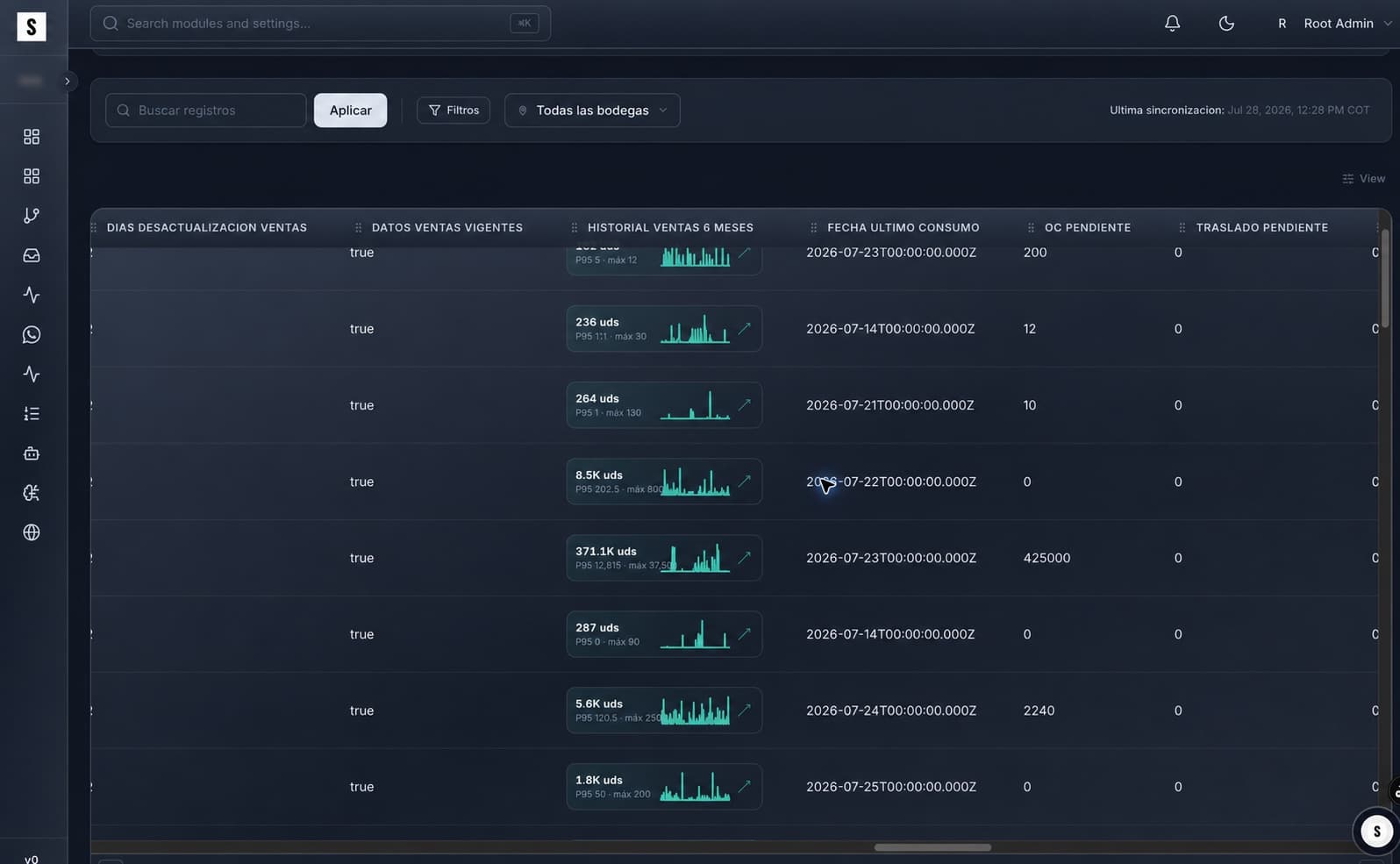
Operations-first demand planning with governed ERP executionSOBERAN combines SKU-by-location signals, inventory and open supply, purchase and transfer recommendations, exception review, human approvals, ERP writeback, and an audit trail. At Sumatec, the operating model processes more than 3 million inventory records across 80 warehouses and 50,000+ SKUs.
- Best for
- Stock-heavy distributors, retailers, and manufacturers that need demand planning to drive controlled work across buyers, warehouses, suppliers, and one or several ERPs.
- Note
- SOBERAN is not a universal replacement for enterprise IBP. It is strongest when a scoped planning and replenishment workflow needs to go live quickly and execute across fragmented operational systems.
- 02
SAP Integrated Business Planning
Enterprise IBP for SAP-centered supply chainsSAP IBP combines S&OP, forecasting and demand, response and supply, demand-driven replenishment, inventory planning, simulations, alerts, statistical models, machine learning, and demand sensing on a cloud platform.
- Best for
- Large enterprises that already run substantial SAP operations and need integrated demand, supply, inventory, and S&OP planning across a complex network.
- Note
- Test implementation ownership, data-model readiness, planner usability, third-party system integration, and the exact handoff from an approved plan into daily ERP execution.
- 03
Kinaxis Maestro
Concurrent demand and supply-chain orchestrationKinaxis positions Maestro demand planning around machine-learning forecasts, short-term sensing, external signals, demand-at-risk analysis, consensus planning, explainable drivers, scenario work, and concurrent supply-chain context.
- Best for
- Global manufacturers and complex supply chains where planners must understand demand, supply, capacity, inventory, and customer impact at the same time.
- Note
- Validate configuration effort, data latency, planner adoption, industry fit, and whether the organization is ready for a broad concurrent-planning operating model.
- 04
o9 Solutions
Enterprise knowledge graph and AI/ML planningo9 describes a modular demand-planning platform with collaborative forecasting, AI/ML driver-based forecasting, an Enterprise Knowledge Graph, exception-based planning, multi-level horizons, scenarios, and cross-functional assumptions.
- Best for
- Large enterprises seeking a configurable digital planning model across demand, supply, commercial, financial, and integrated business planning processes.
- Note
- Ask which capabilities are standard versus configured, how long the initial value path takes, who maintains the knowledge model, and how approved decisions reach execution systems.
- 05
Blue Yonder Demand and Supply Planning
AI-backed demand, supply, and inventory planningBlue Yonder combines demand forecasting, supply optimization, inventory planning, scenarios, planner workflows, exception resolution, machine learning, explainability, and links across planning and execution.
- Best for
- Large retailers, manufacturers, and distribution networks that need deep planning and optimization across demand, supply, inventory, logistics, and execution.
- Note
- Confirm migration path, implementation scope, module boundaries, integration architecture, and which planning or execution components are required for the end-to-end workflow.
- 06
RELEX
AI-native retail, consumer-goods, and replenishment planningRELEX provides demand planning and sensing, inventory and replenishment, manufacturing planning, pricing and promotions, merchandising, IBP, S&OP, and retail operations on a unified AI platform.
- Best for
- Retailers, consumer-goods manufacturers, and wholesalers that need demand signals connected to replenishment, promotions, store operations, and fresh or high-volume assortments.
- Note
- Evaluate industry-template fit, configuration, automation boundaries, assortment complexity, store-level data, and the ownership of exceptions that still require a person.
- 07
Logility
AI-first end-to-end supply-chain planningLogility combines AI-first demand planning and sensing with multi-echelon inventory optimization, automated inventory policies, supply planning, and broader supply-chain execution. DemandAI+ exposes forecast drivers, promotions, anomalies, and short-term signals while downstream applications connect the plan to inventory and supply decisions.
- Best for
- Mid-market and enterprise manufacturers, distributors, and consumer-goods companies that want a supply-chain-native platform spanning demand, inventory, supply, and operational planning.
- Note
- Confirm which applications are included, the implementation and data-model effort, ERP integration, planning grain, and whether the proposed scope reaches replenishment and execution rather than stopping at demand insights.
- 08
Oracle Demand Management
Demand sensing and forecasting inside Oracle Cloud SCMOracle documents Demand Management as a cloud supply-chain planning solution for sensing, predicting, and shaping customer demand, connected to the broader Oracle Fusion Cloud SCM suite.
- Best for
- Oracle Cloud SCM customers that want demand planning inside the same enterprise application family and governance model.
- Note
- Test forecasting and exception depth against specialist tools, confirm the licensed module set, and show the full route from forecast change to supply, purchasing, or production action.
- 09
Netstock
Mid-market demand and inventory planning above ERPNetstock supports top-down, bottom-up, and middle-out forecasts across product, customer, channel, and region; collaborative planning; inventory optimization; replenishment; supplier performance; and connections to established ERPs.
- Best for
- Mid-market distributors, manufacturers, and retailers that need faster implementation and a dedicated inventory and demand-planning layer over an existing ERP.
- Note
- Validate the required package, data grain, promotion and new-product needs, multi-warehouse rules, approval workflow, and how recommended orders are reviewed and returned to the ERP.
- 10
Slimstock Slim4
Inventory optimization and supply-chain planningSlimstock positions Slim4 as a supply-chain planning platform for demand forecasting, inventory optimization, replenishment, S&OP, promotions, and planner workflow across retailers, distributors, and manufacturers.
- Best for
- Inventory-heavy mid-market and enterprise teams that want a mature specialist platform, planning expertise, and regional implementation support.
- Note
- Ask for the exact regional delivery model, ERP connector, implementation plan, planner workload, local references, and the workflow after Slim4 produces an order recommendation.
- 11
StockIQ
ERP-connected forecasting and automated replenishmentStockIQ positions itself as a planning layer above ERP for demand forecasting, replenishment, inventory optimization, supplier collaboration, and S&OP. Its replenishment logic dynamically adjusts reorder points, lead times, and safety stock as operating conditions change.
- Best for
- Mid-market distributors and manufacturers that want forecasting and replenishment intelligence without replacing the ERP that runs purchasing and inventory transactions.
- Note
- Test item-location depth, order-policy support, supplier constraints, exception workflow, connector maturity, and whether approved recommendations create or update the required ERP documents.
- 12
Streamline
Purchase, transfer, and production recommendationsStreamline generates purchase, transfer, material-requirements, and production plans from forecasts and replenishment parameters. It recalculates recommendations as on-hand and open-order data change, supports minimum and maximum lots and rounding, and can create or export purchase orders to connected ERP and accounting systems.
- Best for
- Small and mid-market distributors, manufacturers, and multi-location inventory teams that need a practical path from forecast to purchase or transfer plan.
- Note
- Validate collaboration and approval needs, integration direction, data refresh frequency, multi-echelon complexity, implementation support, and the controls around purchase-order export.
- 13
Blue Ridge
Daily replenishment optimization for buyersBlue Ridge calculates suggested order quantities each day for every product-location using the forecast, order schedule, lead time, safety stock, supplier economics, brackets, and deals. Buyers can approve, adjust, or recalculate by exception instead of manually building routine orders.
- Best for
- Distributors, wholesalers, and retailers where buyers must balance service, working capital, supplier brackets, forward buys, and frequent replenishment decisions.
- Note
- Test ERP writeback, multi-location transfers, promotion and perishability requirements, exception ownership, supplier collaboration, and the implementation model for your distribution network.
- 14
Datup
AI supply-chain analytics for Latin AmericaDatup connects operational data to product-by-location demand forecasts, inventory and reorder recommendations, purchasing, portfolio ranking, distribution, S&OP and S&OE collaboration, and proactive recommendations through email or WhatsApp. Its public site emphasizes integration with ERP, CRM, WMS, and TMS data.
- Best for
- Latin American retail, consumer-goods, pharmaceutical, manufacturing, and distribution teams that want AI forecasting, inventory analytics, purchasing recommendations, and a relatively focused implementation path.
- Note
- Validate forecast accuracy on your own cohort, external-signal relevance, ERP writeback depth, approval controls, subscription scope, and which recommendations execute automatically versus remain advisory.
- 15
Celes
AI demand planning and replenishment for Latin American retailCeles publishes SKU-by-store-by-day forecasting, promotions and external signals, planner adjustments, AI exception monitoring, purchasing, distribution, and automated store replenishment for retail operations.
- Best for
- Retailers in Latin America that need Spanish-language planning, granular store forecasts, purchasing, distribution, replenishment, and local operating context.
- Note
- Validate fit outside retail, country coverage, ERP and POS integration, planning hierarchy, governance of autonomous adjustments, and how outcomes compare on a controlled SKU-store cohort.
How to choose by company and workflow
- SAP-centered global enterprise: start with SAP IBP and compare Kinaxis, o9, Blue Yonder, or Logility when broader orchestration, end-to-end supply-chain planning, or industry fit justifies another platform.
- Complex manufacturing or constrained supply: prioritize Kinaxis, o9, Blue Yonder, SAP IBP, and Oracle; test multi-level supply, bills of material, capacity, allocation, and response to disruption.
- Retail and consumer goods: compare RELEX, Blue Yonder, Celes, Slimstock, Netstock, and Blue Ridge at the SKU-store-day level with promotions, lifecycle, substitution, availability, supplier economics, and replenishment in the demo.
- Operational replenishment: compare Blue Ridge, StockIQ, Streamline, Netstock, Slimstock, and SOBERAN using daily suggested orders, transfers, lead times, safety stock, supplier minimums, pack rules, buyer exceptions, approval, and ERP writeback.
- Mid-market distribution: compare Netstock, Slimstock, StockIQ, Streamline, Blue Ridge, and SOBERAN using real long-tail demand, supplier minimums, pack rules, lead times, multiple warehouses, and slow-moving inventory.
- Latin America: include Datup, Celes, and SOBERAN, then verify Spanish support, local ERP connectivity, WhatsApp or supplier-channel workflows, implementation ownership, and references in a similar operating environment.
- Execution gap after planning: include SOBERAN when the team already knows what should happen but recommendations still become spreadsheets, manual ERP entries, email approvals, and untracked supplier follow-up.
What makes SOBERAN different
SOBERAN is positioned as an AI-native operating layer, not a finance-led planning suite or a generic forecast workbench. It can read from established ERPs such as SAP Business One, NetSuite, Odoo, Exact, Siesa, and other operational systems, then maintain the evidence and control needed to move from a signal to an approved action.
The clearest production proof is Sumatec. SOBERAN SAI processes more than 3 million inventory records across 80 warehouses and more than 50,000 SKUs. Planners review SKU-by-warehouse recommendations, distinguish purchases from transfers, account for pending and in-transit inventory, exclude records without demand, and send approved work toward Sumatec's ERP with traceability.
That makes SOBERAN relevant when the buying question is not only which tool predicts demand. The question is which operating model turns demand into a defensible buy, transfer, hold, or escalation decision—and proves that the decision was executed.
See the production evidence in the Sumatec demand-planning customer story.
The buyer demo: one SKU, three warehouses, one approved action
Give every vendor the same anonymized case. One SKU sells through three warehouses and two channels. Demand is intermittent, a promotion starts next week, one warehouse is below safety stock, another has excess, an open purchase order is late, the supplier has a minimum order quantity and pack constraint, and one large customer order is not yet firm.
Ask the tool to show the source records, forecast baseline, promotion effect, missing or suspect data, available and allocated inventory, inbound supply, transfer option, purchase option, service-level impact, cash impact, and why the exception deserves attention now. Then change the supplier lead time and promotion assumption. The scenario should update without hiding which inputs changed.
Finish the test after the forecast. Have a planner approve a transfer for one warehouse and a purchase draft for another. Verify approval limits, ERP writeback, document status, supplier follow-up, owner, exception queue, reversal path, and audit record. If the demo ends at a chart or CSV export, the operating loop is incomplete.
Implementation and governance checklist
- Define the planning grain before selecting models: SKU, location, channel, customer, time bucket, currency, unit of measure, and forecast hierarchy.
- Name the source of truth for product, location, sales, returns, inventory, allocation, purchase orders, transfers, lead times, supplier constraints, promotions, and customer commitments.
- Measure a baseline before go-live: forecast bias, weighted MAPE, forecast value added, service level, stockouts, excess, inventory turns, expedite cost, planner touches, exception age, and recommendation-to-execution time.
- Separate recommendations from writes. Set approval thresholds for forecast overrides, service targets, transfers, purchase value, supplier expedites, and exceptions with customer or cash impact.
- Require versioned assumptions, source evidence, role-based access, record-level lineage, reversible actions, and an audit trail that connects forecast change to operational outcome.
- Roll out by a measurable cohort—one category, business unit, or warehouse network—then compare against a control group before expanding automation.
Sources and product proof
- SAP Integrated Business PlanningOfficial SAP overview for demand, supply, inventory, S&OP, machine learning, demand sensing, simulations, and integration.
- Kinaxis demand planningOfficial Kinaxis page for forecasting, demand sensing, consensus planning, explainability, demand at risk, and Maestro orchestration.
- o9 demand planningOfficial o9 page for AI/ML forecasting, knowledge graph, assumptions, exception-based planning, horizons, and collaboration.
- Blue Yonder Demand and Supply PlanningOfficial Blue Yonder page for demand, supply, inventory, scenarios, planner workflows, AI, and execution-aware planning.
- RELEX solutions overviewOfficial RELEX overview for demand sensing, replenishment, inventory, manufacturing, retail planning, IBP, and S&OP.
- Logility demand planningOfficial Logility page for AI-first forecasting, demand sensing, driver visibility, anomalies, promotions, and downstream supply-chain planning.
- Oracle Demand ManagementOfficial Oracle documentation for sensing, predicting, and shaping demand in Oracle Fusion Cloud SCM.
- Netstock demand planningOfficial Netstock page for hierarchical forecasts, collaboration, inventory planning, actionable replenishment, and ERP-connected workflows.
- Slimstock Slim4Official Slimstock product site for forecasting, inventory optimization, replenishment, S&OP, and supply-chain planning.
- G2 Demand Planning categoryCurrent G2 category used to discover and cross-check demand-planning products; ratings and review counts change over time.
- StockIQ planning suiteOfficial StockIQ site for ERP-connected forecasting, replenishment, inventory optimization, supplier collaboration, and S&OP.
- Streamline purchase-order workflowOfficial Streamline documentation for purchase recommendations, order review, and sending purchase orders to an ERP or accounting system.
- Blue Ridge replenishment optimizationOfficial Blue Ridge page for daily suggested order quantities, order-cycle economics, supplier deals, and exception-based buyer workflows.
- Datup AI supply-chain analyticsOfficial Datup site for product-location forecasts, inventory and purchasing recommendations, portfolio ranking, distribution, collaboration, integrations, and proactive actions.
- Celes demand planningOfficial Celes page for SKU-store-day forecasts, promotions, external signals, planner adjustments, and AI exception monitoring.
- SOBERAN demand planningSOBERAN product page for SKU-level demand signals, replenishment recommendations, approvals, ERP execution, and implementation scope.
- Sumatec demand-planning customer storyProduction evidence for more than 3 million inventory records, 80 warehouses, 50,000+ SKUs, purchase and transfer recommendations, and ERP execution.