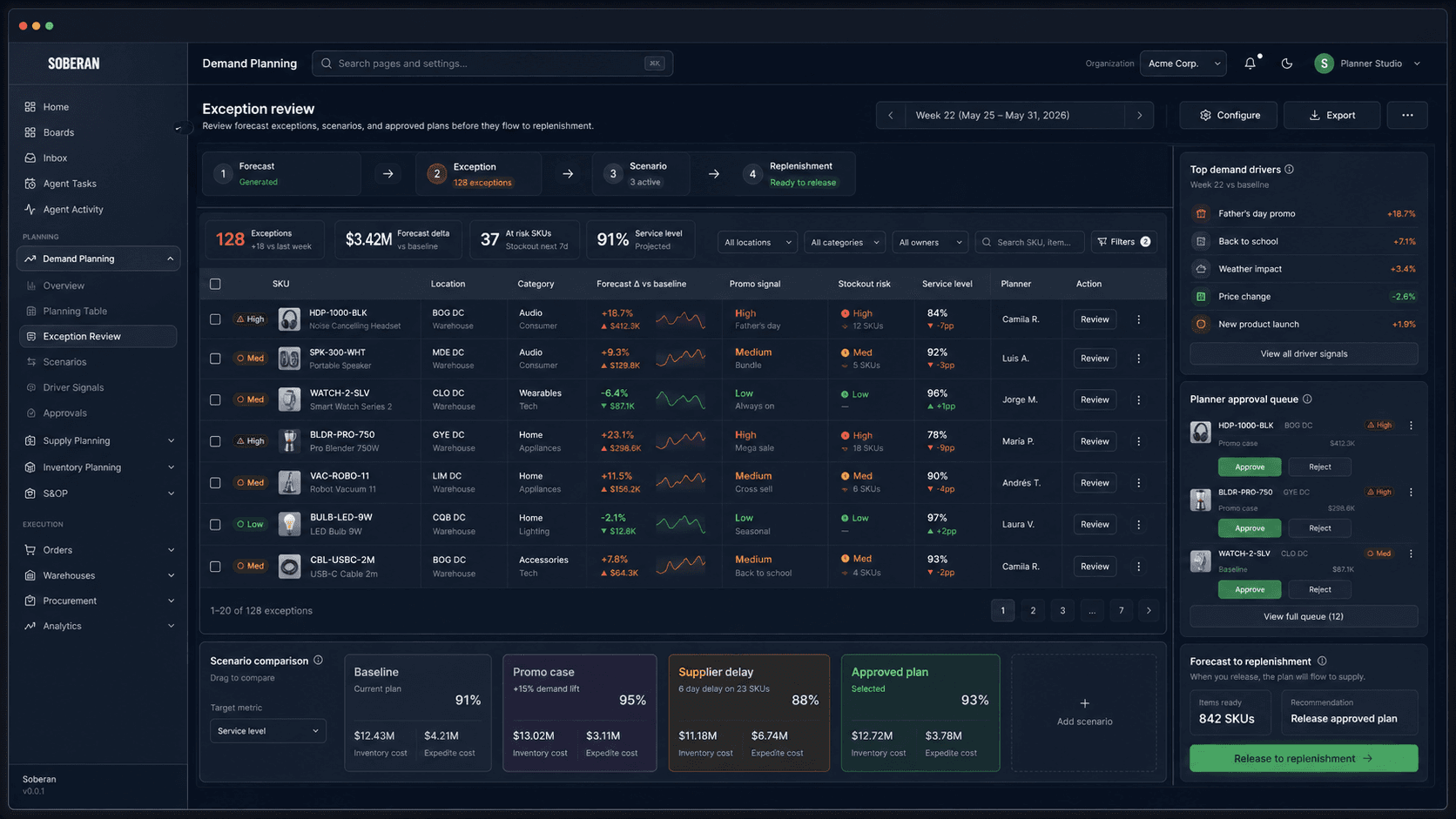
The answer: automate the exception-review loop
The useful workflow refreshes the forecast, explains demand drivers, ranks exceptions by business impact, compares scenarios, and routes only material decisions to planners before the approved plan flows into replenishment, purchasing, transfer, or production work.
Buyer intent is strongest when supply chain leaders have too many SKUs, volatile promotions, supplier delays, and spreadsheet-based S&OP cycles that cannot explain why the plan changed.
Concrete workflow to automate first
- Ingest demand signals from sales history, open orders, ecommerce, marketplaces, returns, promotions, launches, weather, events, service issues, and customer commitments.
- Refresh forecast baselines by SKU, location, channel, customer group, time bucket, service target, and forecast hierarchy.
- Explain exceptions: forecast miss, demand spike, slow mover, launch uncertainty, promotion lift, cannibalization, stockout masking, supplier delay, and data-quality gaps.
- Run scenarios for baseline, promotion, supplier delay, service-level target, inventory cap, expedited freight, and new product assumptions.
- Route planner approvals with financial and operating impact: revenue at risk, inventory dollars, expedite cost, service-level change, and stockout exposure.
- Release approved plans into replenishment with writeback to purchase drafts, transfer recommendations, production needs, forecast overrides, and audit history.
Competitor landscape
- 01
SAP Integrated Business Planning
Enterprise demand planning and S&OPSAP describes demand planning with machine learning, statistical models, demand sensing, collaborative input, and connection to S&OP and inventory planning.
- Best for
- Large enterprises already standardized on SAP supply chain planning and cross-functional planning processes.
- Note
- Implementation effort, data model readiness, and execution handoff should be evaluated for mid-market operators.
- 02
Kinaxis Maestro Demand Planning
AI-infused concurrent planningKinaxis positions Demand Planning around consensus forecasts, machine-learning forecasting and sensing, exception workflows, and end-to-end orchestration.
- Best for
- Complex supply chains that need concurrent planning across demand, supply, capacity, logistics, and S&OP.
- Note
- Validate whether planner workflows stay usable for the team size and data maturity you actually have.
- 03
Oracle Demand Management
Cloud demand sensing and predictionOracle documentation describes Demand Management as a planning solution for sensing, predicting, and shaping customer demand.
- Best for
- Oracle Cloud SCM organizations that want planning capabilities integrated with broader supply chain applications.
- Note
- Check how exceptions translate into governed buyer, warehouse, and supplier work outside planning.
- 04
SOBERAN
Demand planning agent with replenishment handoffSOBERAN emphasizes the operating loop from forecast refresh to exception review, scenario approval, replenishment action, and human governance.
- Best for
- Stock-heavy operators that need planners, buyers, warehouse teams, and CRM/service context aligned in one execution layer.
- Note
- The differentiator is governed handoff into buy, transfer, and supplier follow-up rather than forecast-only analytics.
Operating model, governance, and metrics
- Operating model: demand planners own forecast assumptions, sales and marketing own promotion and customer signals, procurement owns supplier constraints, and operations owns service-level tradeoffs.
- Governance: require planner approval for forecast overrides, new-product assumptions, service-level changes, supplier expedite decisions, large spend recommendations, and scenarios with material margin impact.
- Metrics: forecast value add, bias, weighted MAPE, exception aging, service level, stockout risk, excess inventory, expedite spend, planner touches per SKU, and percent of approved plans released to replenishment on time.
- Quality controls: compare forecast overrides to outcomes, audit scenario assumptions, track data gaps by source, and review late changes that caused stockout or excess exposure.
- How SOBERAN fits: SOBERAN connects demand planning, inventory, procurement, warehouse, orders, and SOBERAN Agent so approved plans become traceable actions instead of spreadsheet notes.
Sources and trend signals
- Gartner - Supply Chain Planning Technology Hype Cycle 2025Analyst trend signal for autonomous planning maturity and supply chain planning technology investment.
- Accenture - Making autonomous supply chains realTrend reference for supply chain autonomy, real-time data, demand forecasts, and governed operational decisions.
- McKinsey - Rewire supply chain for a fragmented worldTrend signal on AI and gen AI impacts in supply chain planning, demand forecasting, and execution amid volatility.
- SAP IBP demand planningOfficial SAP page for demand planning with machine learning, statistical models, collaboration, and demand sensing.
- SOBERAN demand planning automationMatching SOBERAN use-case page for forecast preparation, exception review, scenario planning, and replenishment actions.