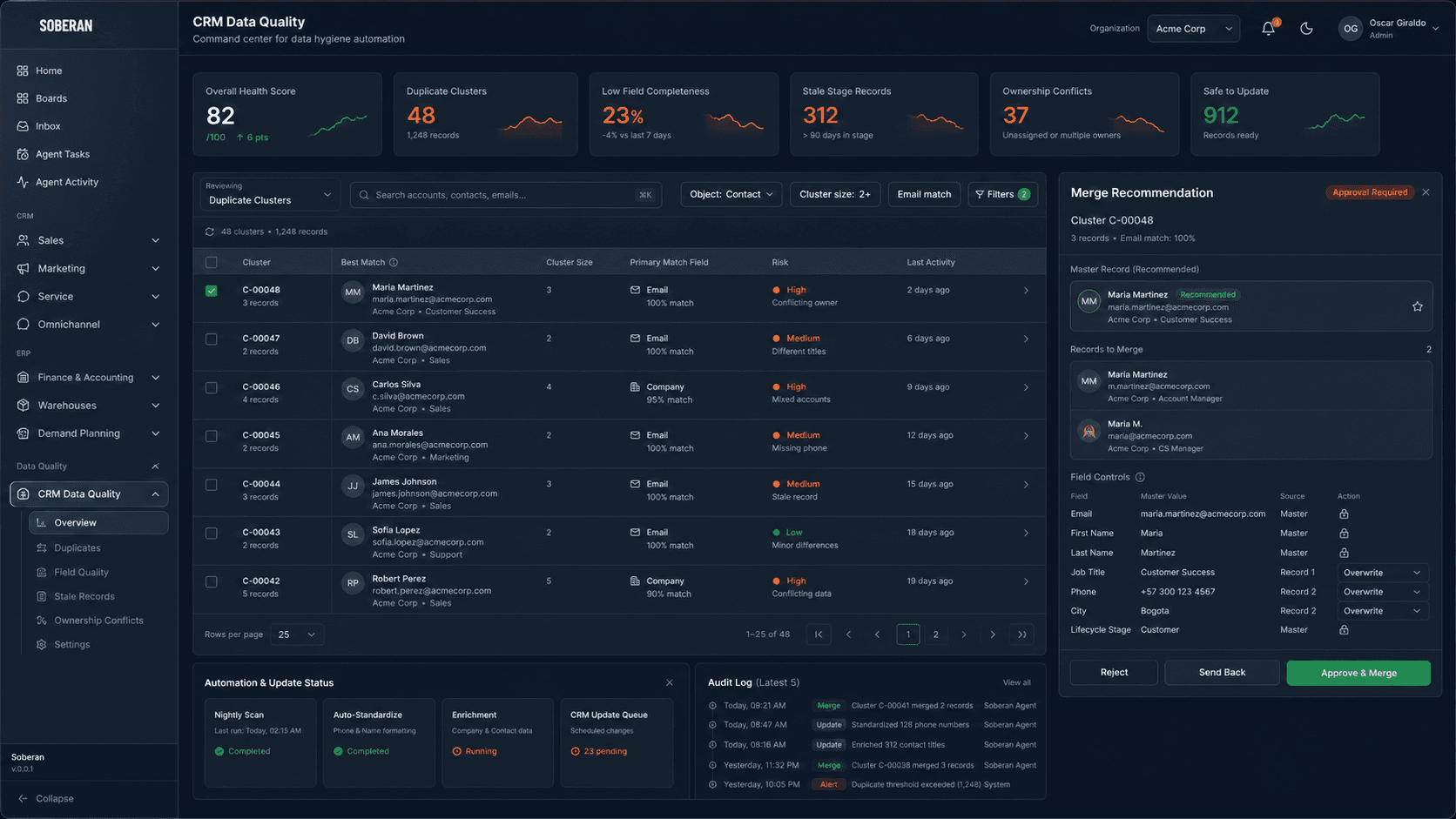
The answer: automate the data quality queue, not a bulk cleanup
The useful AI agent continuously detects CRM data issues, groups records by risk, recommends the safest correction, applies low-risk updates within field-level policy, and escalates merges or lifecycle changes for approval. The goal is a daily operating queue, not a quarterly spreadsheet project.
Buyer intent sits with revenue operations, sales leaders, marketing operations, customer success, and RevOps teams preparing CRM data for AI agents, attribution, territory management, and lifecycle automation.
Concrete workflow to automate first
- Scan account, contact, opportunity, task, campaign, consent, ownership, and lifecycle fields across CRM and connected systems.
- Detect duplicates, missing required fields, stale stages, invalid owners, conflicting account hierarchies, unverified emails, bounced contacts, and records without recent activity.
- Cluster related records by email, domain, phone, tax ID, company name, location, source system, and existing account relationship.
- Recommend field-level actions: standardize value, enrich safe field, flag uncertainty, merge candidate, assign responsible person, create task, or block change.
- Apply only low-risk changes automatically and require approval for merges, lifecycle stage changes, territory changes, consent changes, and account ownership changes.
- Record the before-and-after values, source, confidence, reviewer, action, and dependent reports or automations affected by the change.
Competitor landscape
- 01
Validity DemandTools
CRM data management and deduplicationValidity positions DemandTools around CRM data quality, deduplication, standardization, mass updates, and data maintenance for Salesforce and other CRM environments.
- Best for
- Teams that need mature CRM cleanup, duplicate prevention, and administrator-led data management controls.
- Note
- Evaluate whether the workflow is continuous enough for daily AI-agent operations and how approvals are handled by field risk.
- 02
Insycle
CRM data quality and operationsInsycle markets CRM data cleaning, duplicate management, standardization, import cleanup, and ongoing data maintenance for RevOps teams.
- Best for
- Marketing and revenue operations teams that want CRM hygiene workflows around HubSpot, Salesforce, and similar systems.
- Note
- Ask how source evidence, risky changes, lifecycle governance, and downstream sales actions are connected.
- 03
HubSpot data quality tools
Native CRM data quality featuresHubSpot describes data quality software for monitoring properties, formatting issues, duplicate management, and CRM data health.
- Best for
- HubSpot-centric teams that want native data quality controls before buying a broader operations layer.
- Note
- Confirm fit when data quality depends on ERP, billing, support, commerce, and territory systems outside HubSpot.
- 04
SOBERAN
CRM data hygiene tied to operating actions and field governanceSOBERAN detects CRM quality issues, prepares evidence, applies field-level policy, requests approval, and records safe updates across CRM and operating systems.
- Best for
- Companies that need clean CRM records for AI agents, sales execution, service context, and ERP-connected customer operations.
- Note
- Use SOBERAN when CRM hygiene must become a controlled operating routine rather than a periodic data project.
Operating model, governance, and metrics
- Operating model: assign ownership for duplicate policy, required fields, source precedence, lifecycle changes, territory rules, and enrichment sources.
- Governance: block automatic changes to consent status, legal name, account hierarchy, owner, lifecycle stage, territory, revenue fields, and any field used in compensation or compliance reporting.
- Approval design: allow safe formatting updates, but require human approval for merges, account reassignment, customer status changes, and changes with downstream workflow impact.
- Metrics: duplicate cluster aging, required-field completeness, bounced-contact rate, stale opportunity count, merge cycle time, safe updates applied, approval backlog, and report error reduction.
- How SOBERAN fits: SOBERAN keeps CRM hygiene connected to the work that depends on it: seller tasks, customer service, account history, ERP context, and governed system updates.
Sources and trend signals
- McKinsey - Data governance for generative AITrend signal on why data governance, quality, ownership, and controls matter before scaling generative AI.
- Accenture - Generative AI data readinessAccenture reference on preparing enterprise data foundations, data quality, and governance for generative AI adoption.
- Validity DemandToolsOfficial Validity page for CRM data quality, duplicate management, standardization, and data maintenance.
- HubSpot data quality softwareOfficial HubSpot page for CRM data quality, formatting issues, duplicate management, and data health.
- Insycle CRM data managementOfficial Insycle page for CRM data cleaning, deduplication, standardization, and ongoing maintenance.
- SOBERAN CRM data hygiene automationMatching SOBERAN use-case page for duplicate detection, field controls, approvals, and CRM updates.
- SOBERAN integrationsRelated internal page for connecting CRM, ERP, service, commerce, and finance systems into one operating layer.