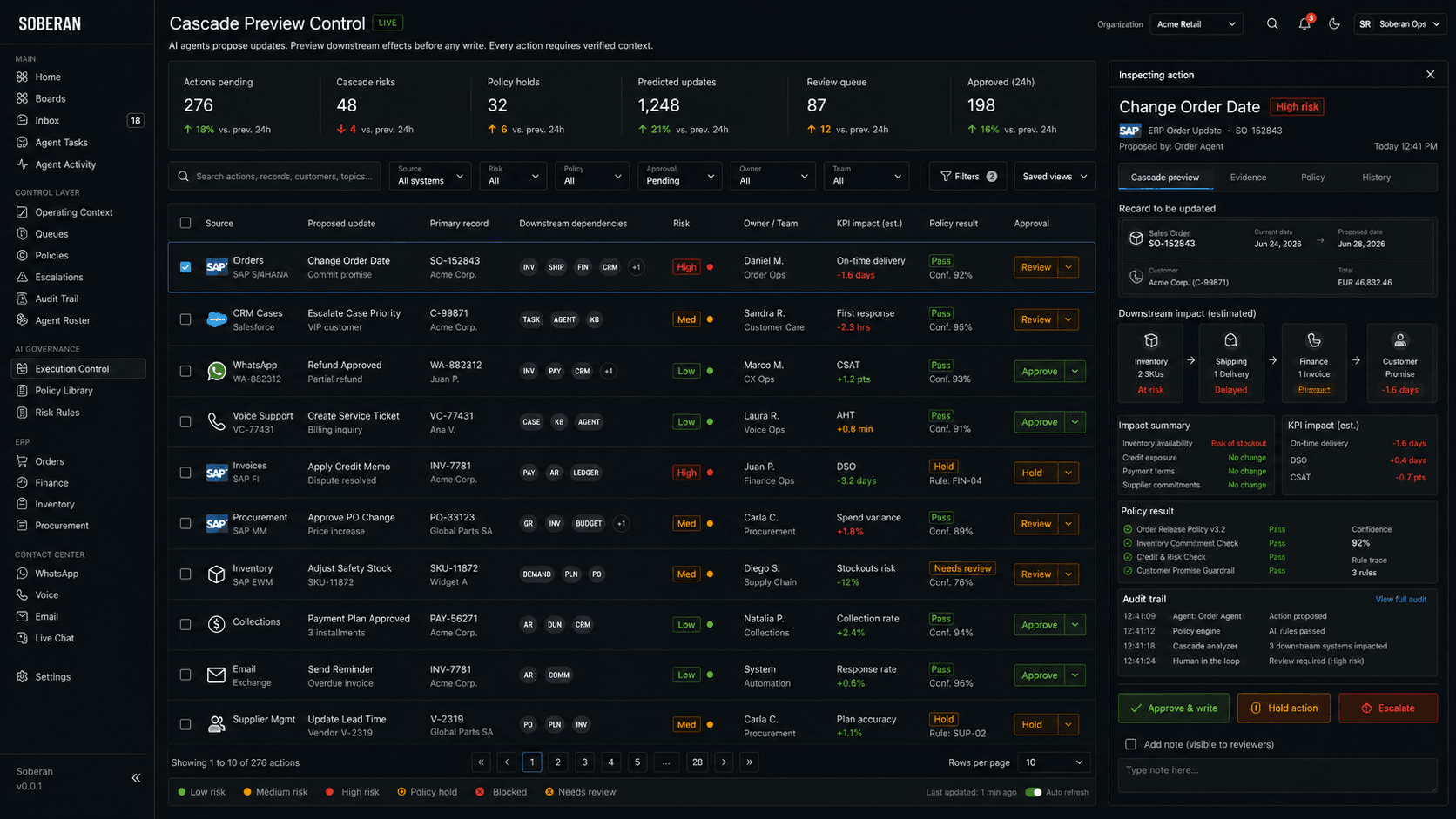
The answer: preview the cascade before the write
The current enterprise AI signal is not just that agents can act. It is that action inside business systems creates hidden side effects. Recent World of Workflows research describes how agents in enterprise environments can miss cascading effects across interconnected databases. EntWorld makes the same point from the ERP and CRM side: enterprise agents face dense interfaces, strict business logic and state-transition requirements that general agents still struggle to satisfy. McKinsey's State of AI research shows scaling value depends on redesigned workflows, human validation and KPI tracking, while SAP is positioning Joule Agents around business process grounding, dependency awareness, governance and cross-application action.
For SOBERAN buyers, the practical implication is simple. Before an AI agent updates an order date, closes a case, releases an invoice, changes a supplier commitment, records a collections promise or answers a customer, it should preview the cascade. What else changes? Which promise becomes risky? Which policy is triggered? Which team owns the exception? Which metric improves or deteriorates? If the preview is weak, the action should stay in review.
What operators should do differently
Most automation demos show the happy path: the agent reads a request, selects an action and updates the system. Real operations are different. One ERP order change can affect inventory allocation, delivery dates, credit exposure, sales commitments, WhatsApp replies, call-center case state and finance reporting. One CRM update can trigger assignment, reminders, consent checks, renewal work and customer communications.
The better operating rule is to separate recommendation from system write. Let agents research, draft, classify and propose early. Let them write only after the cascade preview shows the downstream effects clearly enough for the business to defend the decision.
Workflows where side effects decide the action
- Order exceptions where a date change touches inventory, shipment, credit, customer promise and sales priority.
- WhatsApp service where a refund, replacement or delivery answer changes the CRM case, ERP order, customer expectation and supervisor queue.
- Voice support where a payment promise affects collections priority, contact policy, account notes and future call treatment.
- Invoice exceptions where releasing a hold affects cash position, supplier exposure, tolerance policy and month-end controls.
- Procurement follow-up where a supplier date change affects production, customer delivery, alternate sourcing and inventory risk.
- Inventory reconciliation where a stock adjustment affects replenishment, available-to-promise, customer service and finance controls.
- CRM hygiene where merging or changing a customer record affects territory, consent, automation rules, open opportunities and service history.
Buyer intent: ask to see the cascade preview
A serious buyer should ask vendors to show the screen between recommendation and system write. Which record will change? Which dependent records are checked? Which downstream effect is estimated? Which customer promise is at risk? Which approval path applies? Which KPI moves? Can the reviewer hold, approve or escalate the action without losing the evidence?
This matters in LatAm mid-market operations because the cascade often crosses imperfect systems: ERP, CRM, WhatsApp, voice notes, spreadsheets, bank portals, tax documents, supplier messages and warehouse scans. A useful agent does not hide that complexity. It turns it into an approval surface operators can inspect.
Operating model and governance
- Define action classes separately from intents: answer, draft, classify, recommend, update, release, block, escalate and notify.
- For every write action, name the target record, dependent records, required evidence, policy, approval level and responsible team.
- Create side-effect rules for common objects: order, case, invoice, payment, shipment, inventory item, supplier, customer and opportunity.
- Require a cascade preview whenever the action changes customer promise, money, stock, delivery, compliance, tax, consent or ownership.
- Use review thresholds: low-risk previews can be approved automatically, medium-risk previews require queue review and high-risk previews require a named approver.
- Log the full decision chain: input, records read, proposed update, downstream effects, policy result, reviewer, final write and KPI impact.
- Expand autonomy only when preview accuracy improves, correction volume falls and supervisors trust the action history.
KPIs that prove cascade control is working
- Cascade-preview completion rate before ERP, CRM, finance or contact-center writes.
- Side-effect miss rate: actions where a downstream impact was found after approval.
- Correction volume after agent-updated records.
- Approval cycle time by action class and risk level.
- Customer-impact indicators: promise-kept rate, repeat contact, case reopening, refund cycle time and complaint rate.
- Operational indicators: order delay, inventory accuracy, invoice release time, supplier confirmation variance and collections recovery.
- Autonomous write rate for actions with clean previews and low historical correction volume.
Risks to govern
The first risk is silent constraint violation: the agent makes a valid-looking update that breaks an invisible business rule somewhere else. The second risk is false confidence: the interface shows a green policy check even though a dependent record was stale, missing or contradictory. The third risk is reviewer fatigue: supervisors approve too many low-context actions because the system does not show what changed downstream.
The control is to make the cascade visible. The agent should be able to say: this is the exact write I propose, these records depend on it, these effects are expected, this policy applies, this customer or financial impact is likely, this reviewer is responsible and this is what will be logged if approved.
How SOBERAN fits
SOBERAN fits when the buyer needs AI agents to act across ERP, CRM, contact center, WhatsApp, voice, finance, procurement, inventory and supply-chain queues without turning every update into a blind write. SOBERAN can expose the cascade preview as an operating surface: target record, source evidence, dependent records, policy, responsible team, proposed update, expected impact and audit trail.
The implementation path is practical. Start with one high-volume action class such as order-date changes, WhatsApp delivery answers, invoice holds, supplier commitment changes, inventory adjustments, collections promises or CRM merges. Build the cascade preview for that action. Then widen autonomy only where the preview is complete, the team trusts the approval path and the downstream metrics improve.
Sources and trend signals
- World of Workflows research on enterprise dynamicsUsed for the signal that enterprise agents can miss hidden cascading effects across interconnected databases and workflow rules.
- EntWorld benchmark for ERP and CRM agentsUsed for the signal that enterprise systems require state-consistent retrieval, strict business logic and deterministic verification.
- Agentic AI in Industry deployment barriersUsed for the finding that production integration is blocked when companies lack adequate output verification mechanisms.
- SAP Joule Agents and SAP AI Agent HubUsed for the enterprise signal around business process grounding, dependency awareness, governance and cross-application action.
- McKinsey: The State of AIUsed for the scaling signal that AI value depends on redesigned workflows, human validation and KPI tracking.
- WSJ CIO Journal on IBM and AI operating modelsUsed for the high-authority market signal that AI returns require workflow and operating-model change, not technology adoption alone.
- TechRadar Pro on invisible AI operationsUsed for the operating-readiness signal that agents need observable, consistent systems before they execute safely.
SOBERAN pages to connect this work
- AI automationUse this as the operating layer for governed agent action across queues.
- AI-native ERPConnect action previews to order, invoice, finance and inventory records.
- AI-native CRMKeep customer actions tied to ownership, consent, history and next steps.
- Contact centerUnify WhatsApp, voice and service queues with supervisor controls.
- Order management automationPreview downstream effects before order-date, delivery or allocation changes.
- Inventory reconciliation automationControl the cascade from stock adjustments to promises and replenishment.
- Invoice verification against POsConnect invoice decisions to PO, receipt, tolerance and approval context.
- WhatsApp customer service automationShow how customer replies affect ERP, CRM and service commitments.
- Inbound phone support automationTie voice commitments to identity, consent, case state and policy.
- AI collections automationPreview payment-plan effects before updating accounts and customer messages.
- Supply chainKeep customer promises connected to inventory, suppliers and execution state.