The answer: context before autonomy
The current enterprise AI signal is shifting from chat assistants toward context and orchestration. SAP is positioning Business Data Cloud and Joule around a harmonized business data layer, knowledge graph, governed AI agents and cross-application action. a16z frames the next enterprise software layer as orchestration across teams and tools. McKinsey's State of AI research keeps returning to the same operating gap: value depends on redesigned work, human validation and measurable outcomes. TechRadar Pro's SAP Sapphire coverage describes AI becoming less visible as it gets embedded into operational systems. MarketWatch reports that AWS is investing heavily in forward-deployed agentic AI work and a semantic layer for enterprise implementation.
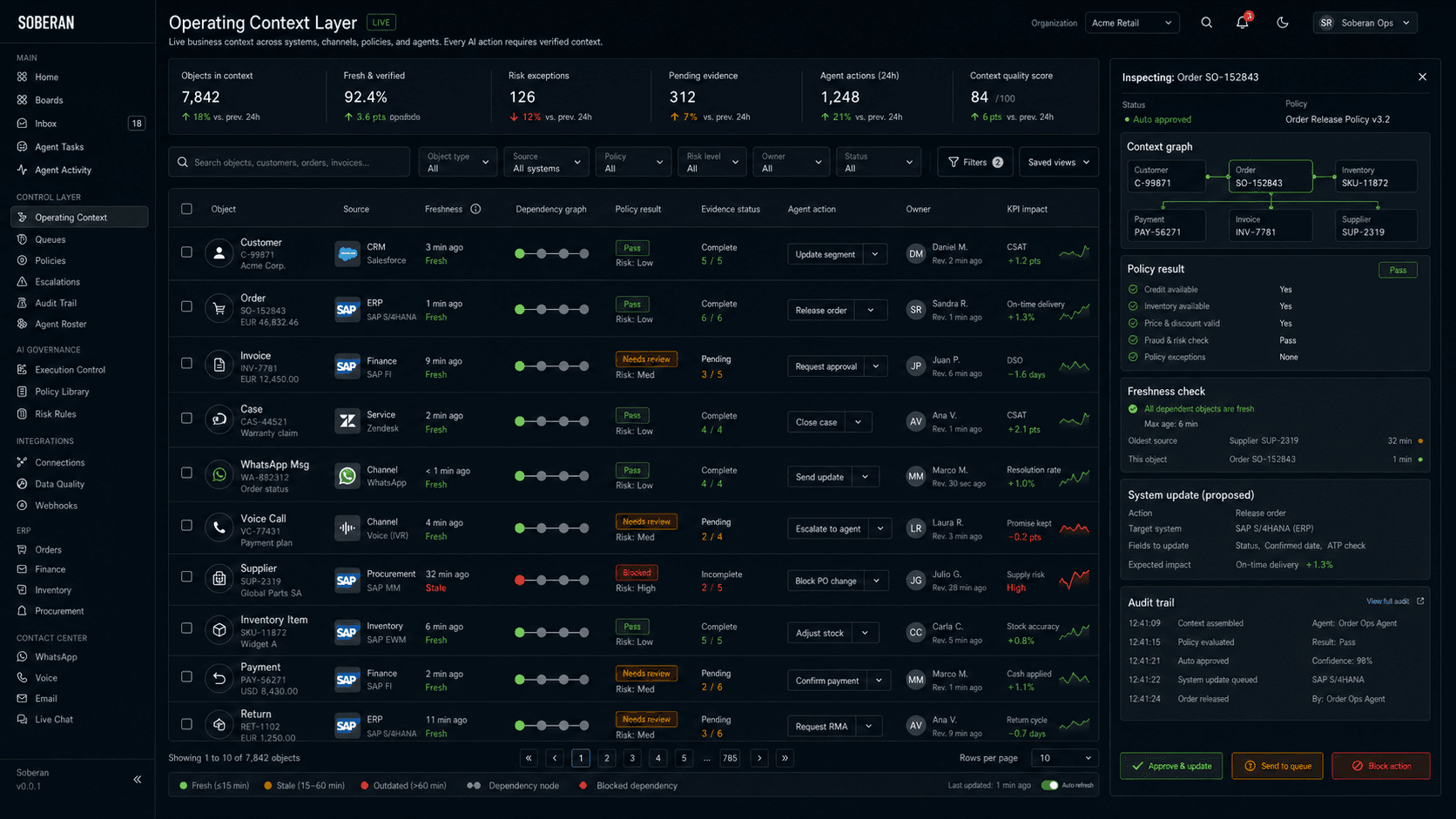
For SOBERAN buyers, the practical implication is direct. Do not start by asking how much autonomy an AI agent should have. Ask whether the agent can see the operating context that makes the action safe: source record, freshness, customer impact, policy result, dependency, responsible team, approval state and audit trail.
What operators should do differently
Most mid-market automation failures are not caused by a missing model. They happen because the agent sees a fragment of the business: a CRM field without the order state, an ERP order without the WhatsApp promise, an invoice without receipt evidence, a supplier update without production impact, or a collections note without consent and payment history.
The better move is to define the operating context for each queue before expanding autonomy. The agent can read broadly, but it should act only when the required context is complete enough to defend the result. That turns AI from a floating assistant into an accountable operating layer tied to ERP, CRM, contact center, finance, procurement and supply-chain records.
Workflows where context decides the action
- Order exceptions where the agent needs customer promise, inventory, credit state, delivery evidence, warehouse status and sales priority before changing an ERP order.
- WhatsApp service where the answer depends on CRM case history, ERP order status, approved policy language, prior promises and transfer rules.
- Voice support where identity, consent, account status, payment state and escalation policy must be known before the agent records a commitment.
- Collections where payment history, dispute flags, promise history, allowed terms and finance exposure define what the agent can propose.
- Procurement follow-up where supplier messages, purchase orders, production dates, alternate vendors and customer exposure determine the safe next step.
- Invoice exceptions where PO, receipt, tax, tolerance, supplier evidence and approval responsibility must align before release or rejection.
- CRM hygiene where duplicate records, account owner, consent, recent activity and downstream automation decide whether a merge or update is allowed.
Buyer intent: ask for the context map
A serious buyer should ask vendors to show the context map, not only the agent conversation. Which objects does the agent read? Which field is the system of record? How fresh is each signal? Which contradictions block the action? Who owns the policy? Which record is updated? Can a supervisor see the evidence behind the recommendation?
This is especially important in LatAm operations because the truth often sits across ERP, CRM, WhatsApp, voice notes, spreadsheets, bank portals, tax documents, warehouse scans and supplier messages. The operating context layer should not pretend those sources are clean. It should show what is known, what is stale, what conflicts and what action is allowed.
Operating model and governance
- Name the operating objects that agents can touch: customer, order, invoice, case, payment, shipment, supplier, product, inventory position and approval.
- Define one source of record for each object, then define the acceptable supporting evidence from CRM, contact center, WhatsApp, voice, finance, procurement and warehouse systems.
- Track freshness as a control, not a detail: customer promise, stock, payment, supplier confirmation and delivery state should expire when they can no longer support the action.
- Create contradiction rules so the agent knows when ERP, CRM, customer message, supplier evidence or payment state disagree.
- Assign a responsible team for every policy and context gap so exceptions do not drift between sales, service, finance, logistics and operations.
- Log the full action chain: record read, evidence used, policy applied, context gap, approval state, message sent, update made and KPI impact.
- Expand autonomy only where the context map shows fewer stale signals, fewer contradictions, faster cycle time and lower correction volume.
KPIs that prove context is working
- Context completeness rate by queue and intent.
- Freshness failure rate for customer, order, inventory, payment, supplier and case signals.
- Contradiction rate between ERP, CRM, customer-channel and external evidence.
- Autonomous update rate after required context is complete.
- Correction volume after agent-updated records in ERP, CRM, finance or contact center systems.
- Cycle time from context gap detected to safe action completed.
- Customer-impact indicators: repeat contact, promise-kept rate, case reopening, delivery accuracy, refund cycle time and complaint rate.
Risks to govern
The first risk is false context. A clean-looking record can hide stale inventory, a changed customer priority, a blocked invoice or an unrecorded supplier update. The second risk is context overload: the agent reads many systems but no one defines which signal wins when they conflict. The third risk is invisible ownership: a policy changes, but the team responsible for it is not tied to the agent's action.
The control is to make context operational. The agent should be able to say: this is the record I trust, this is the evidence I used, this is the policy result, this is the unresolved gap, this is the responsible reviewer and this is the system update I am allowed to make.
How SOBERAN fits
SOBERAN fits when the buyer needs AI agents to work across ERP, CRM, contact center, WhatsApp, voice, finance, procurement, inventory and supply-chain queues without losing operational discipline. SOBERAN can make the context layer visible in one work surface: source records, customer conversations, evidence, policy, freshness, owner, proposed action and audit history.
The implementation path is practical. Start with one high-volume queue such as order exceptions, WhatsApp service, inbound phone support, invoice holds, supplier follow-up, collections promises or CRM data cleanup. Define the context required for the agent to read, draft, escalate or update a record. Then widen autonomy only where the context layer proves the action is complete enough to defend.
Sources and trend signals
- SAP Business Data CloudUsed for the primary enterprise signal around harmonized business data, knowledge graph context and governed AI across business applications.
- SAP Joule Agents and SAP AI Agent HubUsed for the agent signal around business context, trusted data, governance, cross-application action and centralized agent visibility.
- a16z: Big Ideas 2026, the enterprise orchestration layerUsed for the market framing that enterprise AI is moving from isolated copilots toward orchestration across teams and tools.
- McKinsey: The State of AIUsed for the scaling signal that value depends on redesigned work, human validation and KPI tracking, not model access alone.
- TechRadar Pro on invisible AI operationsUsed for the operating-model signal that AI value is moving into embedded enterprise processes rather than standalone demos.
- MarketWatch on AWS agentic AI investmentUsed for the current market signal around forward-deployed implementation teams and semantic layers for enterprise AI.
SOBERAN pages to connect this work
- AI automationUse this as the operating layer for governed AI action across queues.
- AI-native ERPConnect agent context to order, invoice, finance and inventory records.
- AI-native CRMKeep customer context, ownership, consent and next actions current.
- Contact centerUnify WhatsApp, voice, service queues and supervisor controls.
- WhatsApp customer service automationAttach customer replies to ERP, CRM and policy context.
- Inbound phone support automationTie voice support to identity, consent, CRM and service records.
- Order management automationUse context to resolve exceptions, delivery questions and order changes.
- CRM data hygiene automationTurn record quality into a prerequisite for agent action.
- Procurement automationConnect supplier evidence, purchase orders and operational impact.
- Invoice verification against POsRequire PO, receipt, tolerance and approval context before finance action.
- Supply chainKeep customer promises connected to inventory, capacity and execution state.