What counts as AI-native CRM
An AI-native CRM is designed around machine-readable context and agent actions, not only a database that humans maintain. It should automatically capture relevant activity from email, calendar, calls, meetings, forms, messaging channels, and connected product or order systems. It should turn that activity into structured records with provenance, then use policy to recommend, prepare, or execute the next step.
The distinction is operational. A legacy CRM with AI may summarize a call after a salesperson records it. An AI-native CRM should associate the call with the right account, extract commitments, update qualified fields, flag uncertainty, create the next task, and show what evidence caused each change. Useful systems also expose permissions, approval thresholds, reversible actions, and an audit trail. Autonomy without control is not maturity.
Not every product on the shortlist is equally autonomous. Some are systems of record built for agents to read and write. Others are self-maintaining CRMs, customer-memory layers, outbound systems, or composable platforms. We include boundary cases because buyers will encounter them in the same evaluation, but each note explains where the AI-native claim is strongest and where it still needs proof.
How we evaluated the 2026 field
We looked for public product evidence rather than slogans: automatic capture, structured writeback, agent or workflow execution, permissions, integrations, customer proof, credible funding, transparent documentation, or a clear architectural reason to shortlist the platform. Funding is a durability signal, not a product score. A large round does not prove workflow depth, and an early product can still fit a narrow use case extremely well.
The ranking favors products that can become a durable customer system, not isolated writing assistants. We also distinguish between actions that are suggested, prepared for approval, and executed autonomously. Those modes have different risk profiles. A founder-led sales team may value aggressive automation; a regulated enterprise or physical-goods operator may require bounded actions, approval gates, identity, and evidence for every writeback.
Product positioning changes quickly in this category. Treat this as a shortlist for a live evaluation, then verify current availability, pricing, integrations, data residency, security certifications, and production references directly with each vendor.
The ranked shortlist
These ten products represent different centers of gravity inside the same emerging category. The ranking balances product maturity, public proof, CRM depth, and the extent to which AI changes daily operation rather than decorating the interface.
- 01
Attio
Flexible CRM for agentic revenueAttio has the strongest scale signal among modern AI-first CRM entrants. Its official Series B announcement reported $52M raised in the round and $116M total, while its platform combines real-time ingestion, a flexible data model, workflows, APIs, MCP access, and agent-oriented product direction.
- Best for
- Startups and growth teams that want a fast, highly configurable CRM foundation with strong data modeling, automation, developer surfaces, and room for agents.
- Note
- The platform is broad and flexible, which can still require thoughtful CRM architecture. In the demo, separate live autonomous actions from roadmap language and metered AI features.
- 02
Clarify
Autonomous CRM for lean GTM teamsClarify publicly reports $22.5M in total funding and positions the product around automatic call capture, enrichment, deal creation, task assignment, follow-up, and a personal sales agent. Its pricing model offers unlimited seats and meters AI work through credits.
- Best for
- Founder-led, seed, and Series A teams that want a CRM to maintain itself with minimal administration and low friction across the whole team.
- Note
- The opinionated, lighter model is part of the appeal. Confirm reporting depth, custom-object needs, data governance, and how the credit model behaves at production volume.
- 03
Day.ai
Customer memory and AI-native CRMDay.ai was founded by former HubSpot leaders and announced a $4M seed led by Sequoia Capital. The product automatically organizes email and meeting context, creates customer memory, updates opportunities, drafts follow-ups, and provides assistants that work over that structured context.
- Best for
- Teams where customer knowledge is scattered across conversations and the first priority is automatic capture, shared memory, meeting intelligence, and agent-ready context.
- Note
- Its center of gravity is memory and conversation intelligence. Buyers needing deep territory management, forecasting, or complex enterprise objects should test the CRM floor carefully.
- 04
Lightfield
Self-assembling, meeting-led CRMLightfield describes itself as an AI-native CRM that self-assembles from connected email and calendar data, captures calls and meetings, keeps records current, and supports natural-language work over relationship and pipeline context. Its public site reports adoption by more than 5,000 companies.
- Best for
- Meeting-heavy B2B sales teams that want conversation capture, relationship history, preparation, follow-up, and pipeline maintenance in one workspace.
- Note
- Ask how well the product handles important signals outside scheduled meetings, complex data models, multi-entity permissions, and high-volume non-call activity.
- 05
SOBERAN
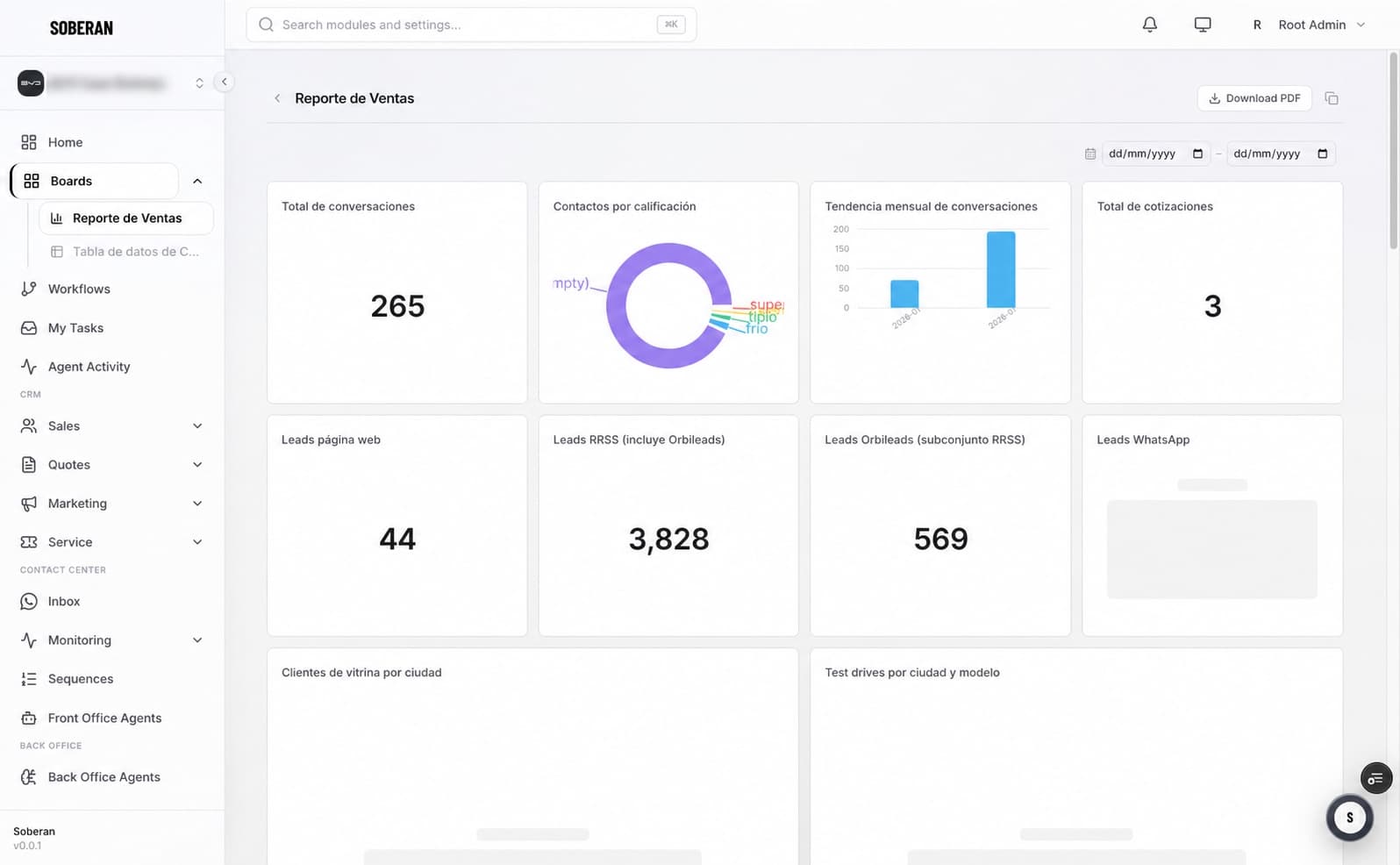
AI-native CRM with ERP and service executionSOBERAN combines CRM, ERP, contact center workflows, and a governed agent layer. It qualifies leads, updates records, routes service work, and connects customer commitments to orders, inventory, fulfillment, billing, WhatsApp, and voice. BYD Casa Restrepo provides public production evidence for a shared WhatsApp-to-CRM pipeline across three locations.
- Best for
- Stock-heavy and operations-heavy businesses where sales promises must stay aligned with inventory, order, fulfillment, finance, and customer-service reality.
- Note
- SOBERAN is broader than a sales-only CRM. Shortlist it when cross-functional execution is the problem; teams seeking only a lightweight founder CRM may prefer a narrower product.
- 06
Zero
Zero-click CRM and GTM platformZero publicly documents a CRM, lead database, enrichment, signal monitoring, workflows, sequences, call notes, and AI agents for research, drafting, and follow-up. It targets seed-to-Series B teams and brings prospecting and CRM activity into the same system.
- Best for
- Early-stage sales teams that want sourcing, enrichment, outbound, call capture, and pipeline automation in one aggressive zero-click operating model.
- Note
- The autonomy and outbound focus are deliberate. Verify approval controls, deliverability, permission boundaries, reporting depth, and fit for post-sale customer operations.
- 07
Breakcold
Multichannel AI-native sales CRMBreakcold combines pipelines, enrichment, meeting capture, email, LinkedIn, WhatsApp, Telegram, and MCP access. Its public product materials say agents can update leads, assign tags, create follow-up tasks, and keep multichannel activity attached to the right record.
- Best for
- Agencies and sales teams of roughly 5–30 people whose relationship motion spans social channels, email, messaging, and direct outbound.
- Note
- Its multichannel design is differentiated. Enterprise buyers should verify administration, regional compliance, forecasting, permission depth, and governance for agent-written updates.
- 08
Ahoy
AI-prepared action with human approvalAhoy is built around agents that capture calls, emails, and meetings, keep records current, monitor pipeline signals, and prepare briefs, tasks, and follow-ups for approval. It also publishes SOC 2 Type I and II and HIPAA claims for buyers with security requirements.
- Best for
- Founder-led through mid-market revenue teams that want the AI to prepare work while a human keeps judgment over what is sent or changed.
- Note
- The approval-first model is a strong governance choice. Confirm current general availability, integration coverage, CRM depth, customer references, and time to production.
- 09
Twenty
Open-source CRM built for agents and extensionsTwenty offers an open-source CRM core, custom data model, workflows, APIs, self-hosting, MCP, and app extensions. Its 2026 release materials describe AI agents, chats, model choice, record enrichment, email drafting, skills, and permission-aware agent access.
- Best for
- Technical teams that value self-hosting, open source, data ownership, custom CRM applications, and the ability to build agent workflows inside their own model.
- Note
- Some agent capabilities have moved through alpha or beta documentation. Verify the exact cloud or self-hosted version, production status, support model, and security controls you will deploy.
- 10
folk
Lightweight relationship CRM with practical AIfolk combines contact enrichment, Magic Fields, conversation-derived notes, research, lead scoring, follow-up suggestions, call transcript extraction, and a simple relationship workspace. Its public materials emphasize editable AI assistance and fast adoption for lean teams.
- Best for
- Startups, agencies, partnerships, recruiting, and relationship-led teams that prioritize simplicity, personalized outreach, enrichment, and follow-up over enterprise CRM complexity.
- Note
- folk is a boundary case: practical AI is embedded throughout, but the product is more human-operated than the most autonomous systems in this list. Evaluate it on usability rather than autonomy claims.
How to choose between the ten platforms
- If you want the deepest flexible modern CRM foundation, start with Attio and compare its live agent behavior, data model, workflows, MCP access, reporting, and total AI usage cost against your operating requirements.
- If your main problem is reps failing to maintain CRM, compare Clarify, Day.ai, Lightfield, Ahoy, and Zero on automatic capture. Test email, meetings, calls, duplicates, uncertain field values, pipeline changes, and the evidence behind every suggested update.
- If sales commitments must trigger orders, inventory checks, fulfillment, billing, service, WhatsApp, or voice workflows, include SOBERAN. Ask the vendor to run the handoff across CRM and operational systems rather than ending the demo at closed-won.
- If multichannel outbound is central, compare Zero and Breakcold on sourcing, enrichment, deliverability, LinkedIn and messaging coverage, opt-out controls, sequencing, and whether responses write back cleanly to the customer record.
- If you need source access, self-hosting, a custom application layer, or developer-owned workflows, evaluate Twenty. Confirm which agent features are production-ready in the release you will actually operate.
- If adoption and simplicity matter more than autonomy, include folk. A CRM that the team consistently uses can outperform a more autonomous platform that does not fit the sales motion.
- Do not use a generic feature checklist alone. Choose one representative workflow and score source capture, identity resolution, record accuracy, policy, approval, action, exception handling, writeback, auditability, analytics, and recovery when the agent is wrong.
The demo test: signal, decision, action, and proof
Bring one real workflow to every demo. A useful example is an inbound buyer who replies by email after a call, asks for a delivery date, and mentions a second stakeholder. The vendor should show how the CRM associates the activity, updates the right opportunity, identifies the stakeholder, records the commitment, checks any required operational context, recommends or performs the next step, and exposes uncertainty.
Then change the happy path. Introduce a duplicate contact, a missing consent flag, a conflicting deal owner, a customer request that exceeds policy, or inventory that cannot support the promised date. Ask what the agent does, who receives the exception, whether a human can approve or reverse the action, and where the reason is logged. That sequence reveals more than a long AI feature tour.
Finally, inspect the operating economics. Ask which actions consume credits, what happens when limits are reached, how historical email and call data is handled, how administrators monitor agents, and how records can be exported. The best AI-native CRM is not the one that produces the most impressive answer; it is the one your team can trust, govern, and afford at real activity volume.
AI-native versus incumbent CRM with AI
Salesforce, HubSpot, Microsoft Dynamics, Zoho, and other incumbents now provide substantial AI and agent capabilities. They are not included in this ranked native shortlist because their systems of record predate the current agent architecture. That does not make them poor choices. Large enterprises may reasonably prefer an incumbent ecosystem, mature administration, regional partners, and an agent layer over an existing deployment.
The practical comparison is not new vendor versus old vendor. It is operating model versus operating model. If an incumbent can capture source activity, maintain accurate records, execute governed actions, integrate the required systems, and deliver a usable audit trail at an acceptable cost, it may win. If the team still spends Friday updating fields after buying the AI package, the architecture has not changed enough.
For many buyers, the right first move is not a full CRM replacement. A governed agent can prove one workflow on top of the current CRM, measure cycle time and data quality, and reveal whether the long-term answer should be an overlay, a modern CRM migration, or a unified CRM and operations platform.
Sources and proof points
- Attio Series B announcementOfficial announcement for Attio's $52M Series B, $116M total funding, and AI-native CRM architecture.
- Clarify funding and general availabilityOfficial announcement for Clarify's $22.5M total funding and autonomous CRM product.
- Day.ai seed announcementOfficial explanation of Day.ai's $4M seed, customer-intelligence model, and automatic CRM capture.
- Lightfield getting-started guideOfficial product guide describing the self-assembling AI-native CRM and its connected data sources.
- SOBERAN CRMSOBERAN's CRM, ERP context, governed agent execution, and customer production evidence.
- Zero product referenceOfficial structured product reference for Zero's CRM, lead data, workflows, sequences, and AI agents.
- Breakcold AI-native CRMOfficial product page for Breakcold's multichannel CRM, enrichment, agent actions, and MCP access.
- Ahoy AI-native CRMOfficial product page for Ahoy's approval-led agent model, CRM capture, actions, and security claims.
- Twenty 2026 releasesOfficial release history for Twenty's open-source CRM, agents, chats, MCP, skills, and extensions.
- folk AI CRM featuresOfficial guide to folk's enrichment, AI fields, research, scoring, notes, and follow-up assistance.