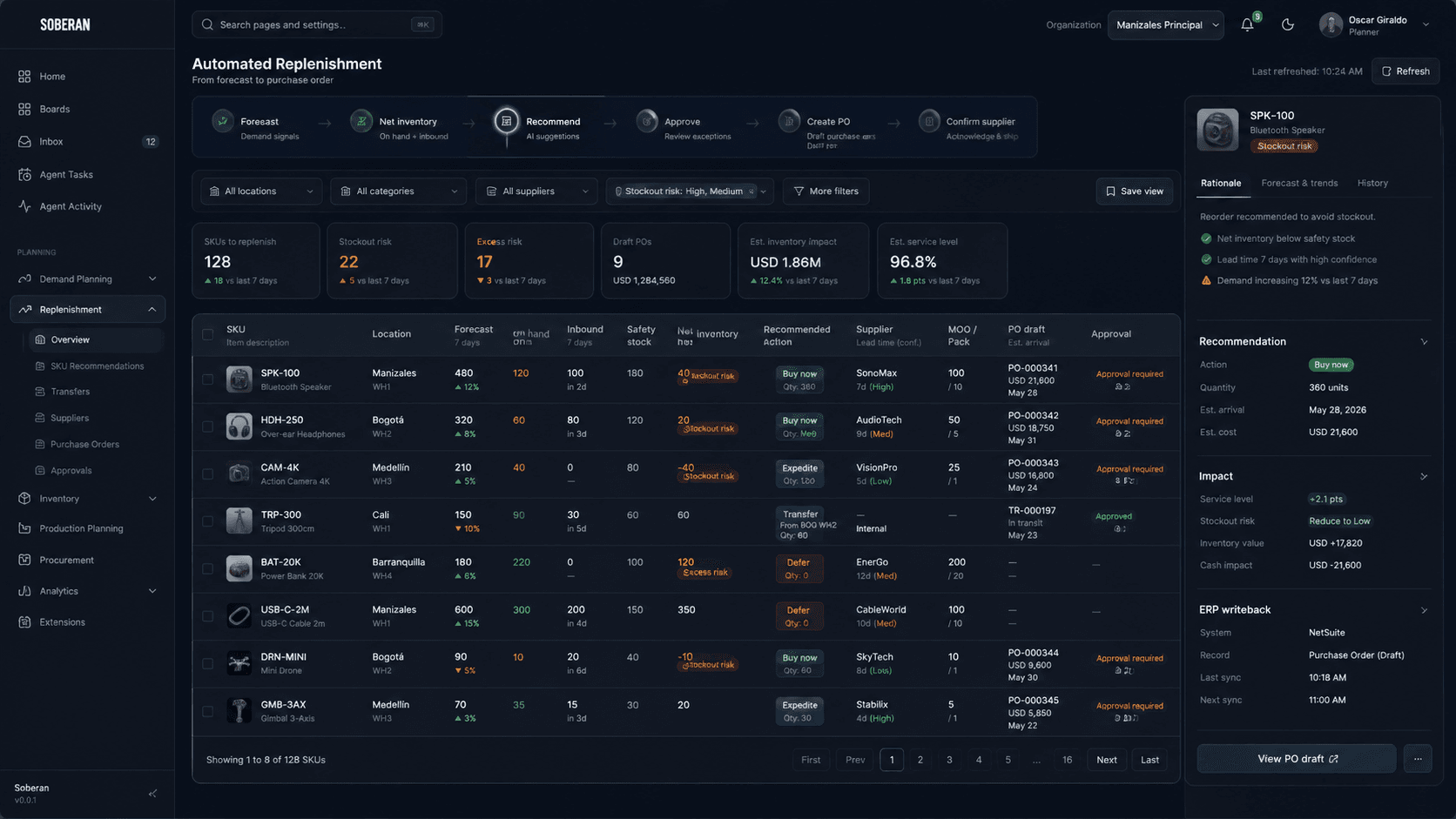
The answer: automate the recommendation-to-PO loop
The useful workflow reads forecast demand, on-hand inventory, inbound supply, allocations, safety stock, MOQ, pack size, lead time, supplier reliability, and service-level policy, then recommends the next action with enough evidence for approval.
For stock-heavy operators, buyer intent is practical: fewer preventable stockouts, less excess inventory, faster buyer review, clearer cash impact, and fewer purchase orders created from static min-max rules.
Concrete workflow to automate first
- Build the planning baseline from SKU, location, forecast, sales history, open orders, returns, inbound POs, transfers, backorders, and committed stock.
- Calculate net need using safety stock, target service level, lead time, MOQ, pack size, supplier calendar, order frequency, and cash or warehouse constraints.
- Classify the recommendation as buy now, transfer, expedite, defer, cancel, substitute, supplier follow-up, or human review.
- Explain the recommendation with stockout risk, excess risk, demand change, supplier delay, margin impact, cash impact, and confidence.
- Route approval based on spend, supplier exception, forecast override, new SKU, low confidence, strategic customer risk, or inventory write-off exposure.
- Create the controlled PO or transfer draft and write back rationale, approver, supplier confirmation, delivery promise, and exception status to ERP.
Competitor landscape
- 01
Oracle NetSuite Replenishment Planning
ERP replenishment planningNetSuite documentation covers replenishment planning using demand, stock levels, lead times, and reorder recommendations inside ERP workflows.
- Best for
- Companies already operating purchasing, inventory, and finance in NetSuite and needing native planning controls.
- Note
- Validate how explainability, approval packets, supplier follow-up, and cross-system evidence are handled for exceptions.
- 02
SAP Integrated Business Planning
Enterprise supply chain planningSAP positions Integrated Business Planning around demand, inventory, response, supply, and sales and operations planning.
- Best for
- Large enterprises standardizing planning models, scenarios, and supply chain coordination at global scale.
- Note
- Check how planners move from scenario and exception to executable PO or transfer action in the systems buyers already use.
- 03
SOBERAN
AI replenishment agent with PO approvalsSOBERAN focuses on the execution loop: calculate need, recommend the action, route approvals, create controlled POs, and follow supplier confirmation.
- Best for
- Stock-heavy teams running ERP, ecommerce, warehouses, supplier portals, and planning spreadsheets that need governed purchase execution.
- Note
- The differentiator is turning planning evidence into approved operating actions with traceable writeback.
Operating model, governance, and metrics
- Operating model: planners own forecast overrides, buyers own supplier commitments, finance owns cash thresholds, operations owns location constraints, and the agent owns the exception queue.
- Governance: require approval for high spend, low-confidence forecasts, supplier changes, expedites, substitutions, new SKUs, negative margin exposure, and forecast overrides.
- Metrics: stockout rate, excess inventory, inventory turns, service level, buyer review time, recommendation acceptance, PO cycle time, supplier confirmation delay, expedite cost, and override accuracy.
- Audit controls: store the demand signal, inventory snapshot, policy values, recommendation version, approval decision, PO draft, supplier response, and ERP writeback timestamp.
- How SOBERAN fits: SOBERAN connects demand planning, inventory, procurement, supplier communication, NetSuite, Odoo, Shopify, Amazon, warehouse systems, and SOBERAN Agent into one governed replenishment workflow.
Sources and trend signals
- Accenture - next-generation supply chain researchTrend signal for mature supply chains using AI, generative AI, autonomous decision-making, simulations, and continuous improvement.
- Gartner - Hype Cycle for Supply Chain Planning Technologies, 2025Analyst reference for supply chain planning technology leaders navigating volatility and evolving planning landscapes.
- Oracle NetSuite Replenishment PlanningOfficial NetSuite documentation for creating item supply plans and time-phased replenishment planning.
- SAP Integrated Business PlanningOfficial SAP page for demand, inventory, response, supply, and sales and operations planning.
- SOBERAN automated replenishmentMatching SOBERAN use-case page for reorder recommendations, purchase actions, approvals, and supplier confirmation.