The answer: buy the control layer, not just the agent
The external signal is clear: service AI is consolidating into large enterprise suites while most companies are still early in scaling agentic work. Salesforce's June 2026 agreement to acquire Fin puts an AI customer agent with WhatsApp, SMS, phone, email, chat, and Slack coverage inside a major CRM platform. SAP is positioning Joule Agents around context-aware, policy-aware business operations. McKinsey's latest State of AI survey shows broad adoption, but also a stubborn gap between experimentation and workflow-level scale.
For SOBERAN buyers, the point is practical. A LatAm contact center cannot treat each agent, chatbot, CRM assistant, or ERP add-on as a separate island. The operating value appears when WhatsApp, voice, cases, orders, invoices, credit exposure, promises to pay, approvals, and audit history are governed in one place.
What operators should do differently
Do not start with the question, 'Which AI agent should we deploy?' Start with, 'Which operational decision will this agent be allowed to make, which systems prove the decision, and who is accountable when the decision changes a customer or financial record?' That framing turns a vendor demo into an operating design.
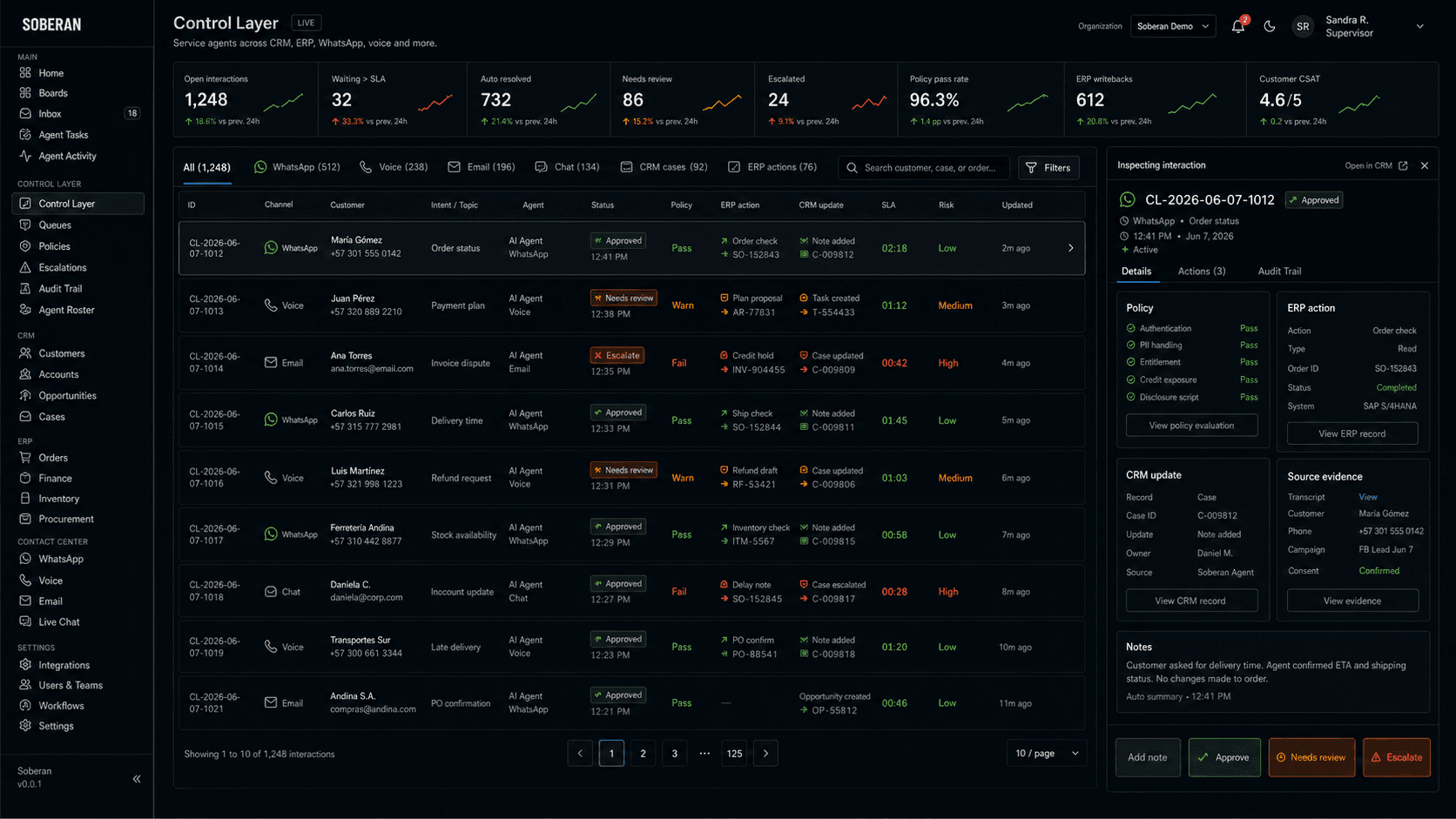
The service-agent control layer should define the queue, source systems, allowed actions, customer channel, policy version, approval threshold, escalation rule, and KPI for each workflow. In practice, this means the same supervisor can inspect a WhatsApp order-status case, a voice payment-plan request, a CRM update, an ERP order check, and a finance exception without losing the audit trail.
Workflows to automate first
- Order-status and delivery exceptions where the agent checks ERP order state, shipment evidence, customer history, and service policy before sending a WhatsApp or voice update.
- Payment-plan and collections requests where the agent validates balance, aging, consent, promise date, credit exposure, and policy before creating a finance update.
- Invoice, return, warranty, and refund cases where the agent gathers evidence, classifies the issue, prepares the ERP or CRM action, and routes exceptions for approval.
- CRM service hygiene where the agent updates case status, contact data, sentiment, reason codes, responsible team, and next action without overwriting commercial judgment.
- Procurement and supplier follow-up where the agent checks purchase order status, confirmation, receipt gaps, tax data, and buyer approval before recommending action.
- Voice escalation and QA where the agent summarizes the interaction, flags risk, attaches evidence, and moves the case to a person before the SLA breaks.
Buyer intent: prove system action and governance
A COO, CFO, head of customer experience, contact-center director, RevOps lead, ERP owner, or CRM owner should ask vendors to show how the agent moves from conversation to system action. The proof is not a polished answer; it is the order check, CRM update, finance note, policy decision, human approval, and resolved outcome tied to the same interaction.
Mid-market operators should also ask whether the control layer can work across the systems they already run. Consolidation by large suites may be useful, but most LatAm teams still operate with mixed ERP, CRM, WhatsApp, voice, spreadsheets, payment tools, and local process rules. The agent layer has to meet that reality instead of forcing every workflow into one suite on day one.
Operating model
- Assign a business owner for each automated queue: service, collections, sales operations, finance operations, procurement, or supply chain execution.
- Maintain a policy library with approval limits, blocked actions, escalation triggers, language rules, consent requirements, and country-specific compliance requirements.
- Create a supervisor view that shows live interactions, evidence used, ERP action, CRM update, policy result, risk level, reviewer, SLA, and final outcome.
- Release agents by workflow and channel, not by generic capability. A WhatsApp order-status agent and a voice collections agent need different evidence, tone, and approval rules.
- Review unresolved, escalated, and manually corrected cases every week to improve policy, data hygiene, prompts, and integration reliability.
KPIs that should decide scale
- Autonomous resolution rate by workflow, channel, and policy class.
- Customer wait time, repeat contact, SLA breach rate, and escalation quality.
- ERP records updated correctly, CRM notes posted, finance promises captured, and failed system actions by cause.
- Policy pass rate, blocked actions, approval cycle time, and audit completeness.
- Revenue protection, cost-to-serve reduction, collections recovery, exception backlog aging, and supervisor rework.
Risks to govern
The risk in service-agent consolidation is hidden autonomy. If the agent answers in one platform, reads context in another, and changes a record somewhere else, the operator can lose the evidence chain. That is how incorrect order promises, unsafe payment plans, bad CRM data, and unapproved refunds become operational debt.
Governance should cover identity, permissions, evidence, data freshness, human review, fallback behavior, reversibility, and audit. For customer-facing channels such as WhatsApp and voice, it should also cover consent, tone, language, disclosure, escalation, and regulator-ready records.
How SOBERAN fits
SOBERAN is built for this control-layer problem: it connects contact-center conversations, CRM context, ERP evidence, finance and operations records, human approvals, and audit into one operating surface. The goal is not to add another isolated bot; it is to let the agent execute real work while supervisors can see, approve, block, and improve the operating loop.
For LatAm operators, that matters because high-volume channels often start in WhatsApp or voice but end in ERP, CRM, finance, procurement, or supply chain execution. SOBERAN helps teams turn those interactions into governed actions: status updates, order checks, case notes, payment promises, exception queues, supplier follow-up, and customer resolution.
Sources and trend signals
- Salesforce: definitive agreement to acquire FinUsed for the consolidation signal: Salesforce plans to acquire Fin for approximately $3.6 billion and bring Fin's customer agent platform into Agentforce and service operations.
- McKinsey: The state of AI in 2025Used for the adoption gap signal: AI use is broad, but many organizations remain in experimentation or pilot phases, and workflow redesign separates high performers.
- SAP: Joule Agents and Joule AssistantsUsed for the enterprise-suite signal: SAP frames agents around context-aware, policy-aware reasoning and larger cross-functional business operations.
- a16z: The Enterprise Orchestration LayerUsed for the market signal that AI is moving from isolated copilots to coordinated systems that execute work across teams and tools.
- Sequoia: Context for Agents at ScaleUsed for the context signal: agents need company-specific process memory, tickets, logs, chats, and editable knowledge before they can act reliably.