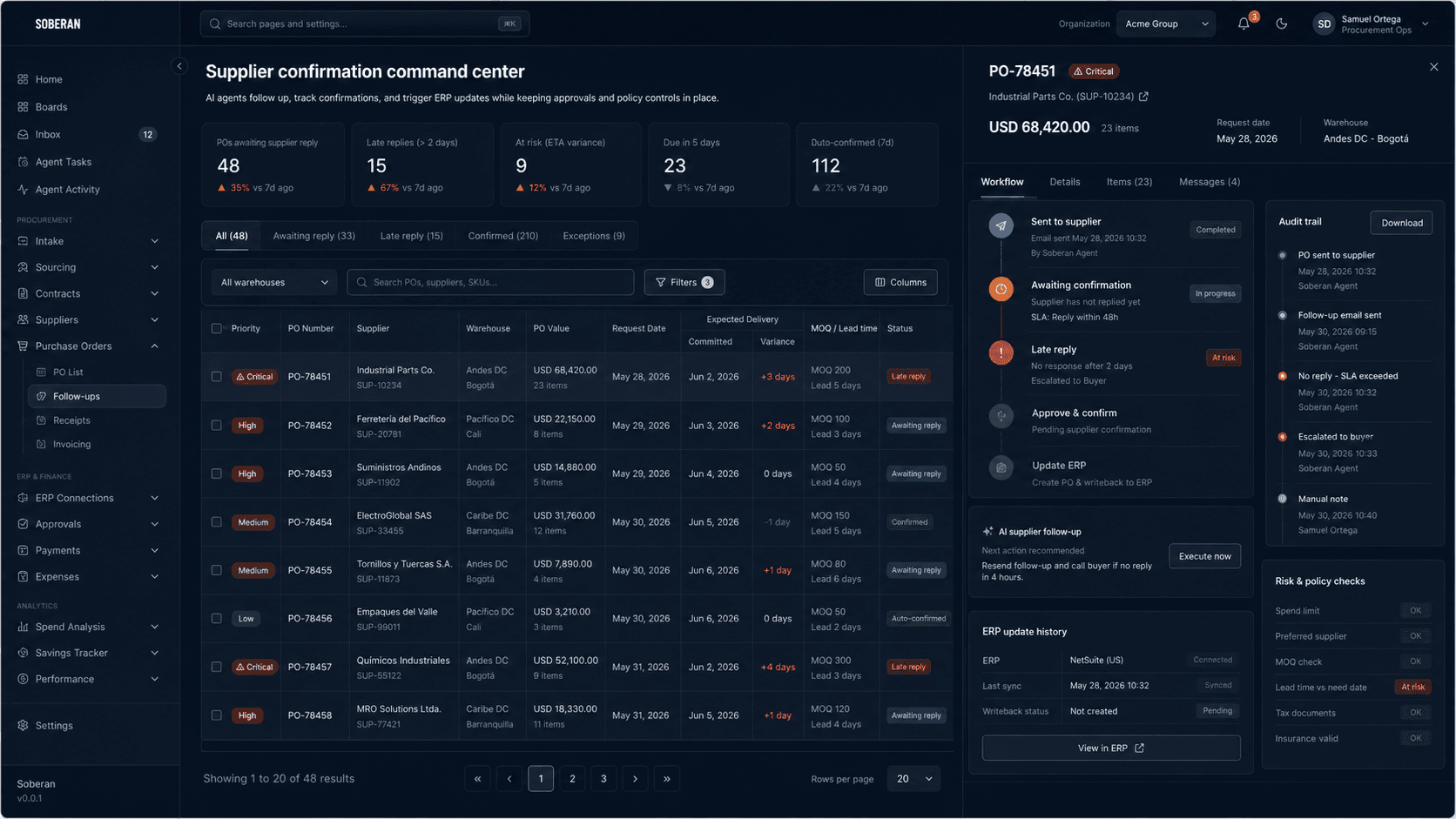
The answer: automate the supplier confirmation loop after PO approval
The best first workflow is not intake or PO creation. It is the post-approval loop where buyers lose days waiting for supplier replies, revised delivery dates, MOQ exceptions, tax documents, and shipment proof. The agent should turn every supplier response into a controlled decision packet: what changed, whether policy allows it, who approves, and what ERP field must update.
Buyer intent is practical. Procurement, operations, finance, and planning teams want shorter PO cycle time, fewer stockout-causing supplier delays, and better evidence when a confirmed date slips. The agent must preserve spend control while reducing manual follow-up.
Concrete workflow to automate first
- Monitor open POs by supplier, buyer, warehouse, promised date, value, MOQ, lead time, inventory risk, and response SLA.
- Send approved supplier follow-ups through email or supplier portals and attach the PO, requested delivery date, quantities, and missing documents.
- Classify supplier replies as confirmed, late, partial quantity, revised date, price variance, MOQ issue, substitute item, missing tax document, or no response.
- Compare the reply against spend policy, preferred supplier rules, lead-time tolerance, replenishment urgency, and inventory service-level risk.
- Route exceptions to the right buyer or finance approver with evidence, recommendation, impact, and due date.
- Update ERP with confirmation status, revised ETA, supplier note, attachment, escalation reason, and audit history once the decision is approved.
Competitor landscape
- 01
Zip
Procurement orchestration platformZip positions its platform around intake-to-procure, procure-to-pay, supplier onboarding, workflow orchestration, integrations, and AI agents.
- Best for
- Large teams that need a procurement front door, request intake, approvals, and orchestration across managed spend.
- Note
- For supplier confirmation, test how approved POs become supplier follow-up, ERP updates, and exception closure outside the intake layer.
- 02
Ivalua
AI procurement platformIvalua describes a procurement platform that unifies people, AI agents, workflows, data, governance, and source-to-pay execution.
- Best for
- Enterprise procurement teams standardizing broad source-to-pay data, controls, supplier management, and agent governance.
- Note
- Validate whether the supplier confirmation loop fits your ERP, supplier communication patterns, and local approval thresholds.
- 03
GEP Quantum Intelligence
Procurement and supply chain orchestrationGEP Quantum Intelligence is positioned as an agentic orchestration platform connecting procurement, supply chain, ERPs, finance, and operational systems.
- Best for
- Global enterprises that want end-to-end procurement and supply-chain orchestration with managed services depth.
- Note
- Operators should still inspect the daily buyer workflow: supplier reply capture, exception ownership, and ERP confirmation history.
- 04
SOBERAN
PO follow-up connected to planning, approvals, ERP, and supplier evidenceSOBERAN connects demand signals, approved POs, supplier replies, policy checks, buyer approvals, and ERP updates in one operating loop.
- Best for
- Stock-heavy operators that need supplier confirmation to protect replenishment, service levels, and finance controls.
- Note
- Use SOBERAN when the bottleneck is not request intake alone, but making sure suppliers confirm and exceptions close before inventory risk grows.
Operating model, governance, and metrics
- Operating model: procurement owns supplier rules, planning owns inventory urgency, finance owns spend thresholds, and buyers own exceptions that change price, quantity, or delivery promise.
- Governance: require approval for supplier changes to price, payment terms, MOQ, substitute item, split shipment, delivery date beyond tolerance, tax data, and high-value POs.
- Metrics: supplier confirmation SLA, late reply rate, PO cycle time, exception aging, revised ETA accuracy, stockout risk avoided, ERP update completeness, and buyer workload reduction.
- Buyer intent: teams evaluating this use case usually have replenishment delays, supplier emails outside ERP, weak audit trails, and planning decisions based on unconfirmed POs.
- How SOBERAN fits: SOBERAN turns supplier confirmation into a governed loop: monitor, contact, classify, compare policy, route approval, update ERP, and preserve evidence.
Sources and trend signals
- McKinsey - Agentic AI in procurementCurrent analyst signal on agentic AI shifting procurement from transaction tasks toward broader source-to-pay value and risk management.
- Accenture - AI-enabled supply chainsRecent trend signal on AI-led decision intelligence across supply chain, procurement, finance, and operations under human oversight.
- Gartner - AI agent governanceGovernance signal for matching AI agent controls to autonomy level, access scope, and operational risk.
- Zip procurement orchestrationOfficial Zip page for procurement orchestration, workflow engine, supplier onboarding, integrations, and AI agents.
- SOBERAN procurement automationMatching internal use-case page for purchase requests, approvals, PO creation, supplier follow-up, and ERP updates.
- SOBERAN ERP automationRelated internal page for operations teams connecting procurement, inventory, finance, and execution systems.