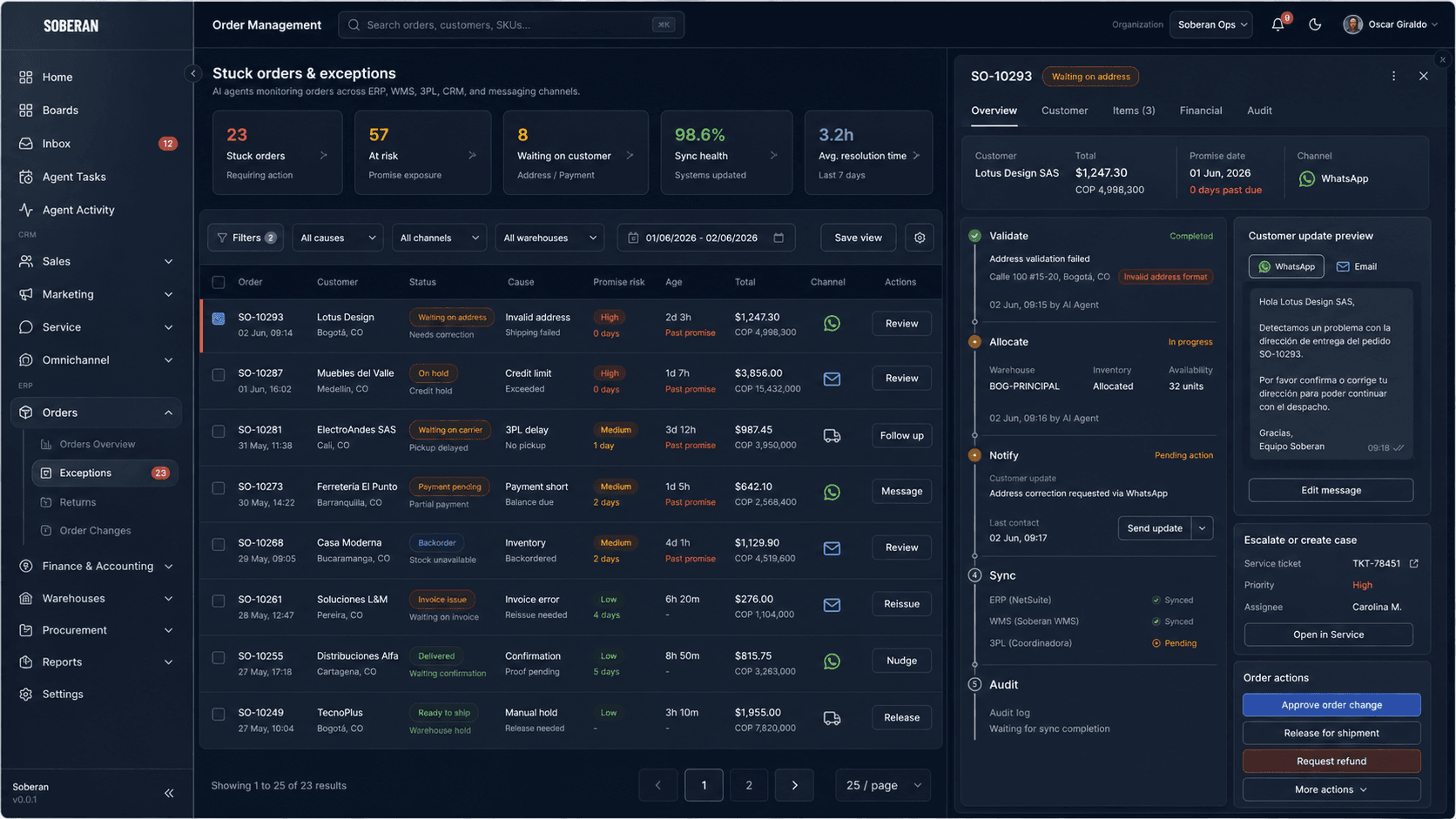
A resposta: automatizar o controle de status, não apenas a entrada de pedidos
O primeiro fluxo de trabalho a automatizar é o ciclo de controle de status: identificar pedidos onde a promessa está em risco, explicar o problema, decidir se é necessária uma atualização do cliente ou aprovação humana, enviar a mensagem aprovada e escrever o resultado de volta para todos os sistemas operacionais.
A intenção do comprador geralmente vem de líderes de operações, comércio eletrônico, atendimento ao cliente e finanças que lidam com repetidos tickets “onde está meu pedido”, promessas de entrega perdidas, reembolsos, vendas excessivas e reconciliação manual entre sistemas.
Fluxo de trabalho concreto para automatizar primeiro
- Monitore pedidos por data prometida, estágio de atendimento, status de alocação, retenção de pagamento ou crédito, qualidade do endereço, evento da transportadora, resposta 3PL e histórico de tíquetes de serviço.
- Classifique a causa: problema de endereço, escassez de estoque, pedido em atraso, retenção de pagamento, limite de crédito, atraso da transportadora, retenção no armazém, emissão de fatura, solicitação de reembolso ou alteração do cliente.
- Crie o pacote de evidências com registro de pedido, instantâneo de inventário, evento de armazém, evento de transportadora, conversa com cliente, status de pagamento e próxima ação recomendada.
- Aplique regras para mensagens do cliente, aprovação de reembolso ou reenvio, divisão de remessa, reserva de estoque, correção de endereço e proprietário de escalonamento.
- Envie atualizações aprovadas por WhatsApp ou e-mail que reflitam o status atual, a próxima etapa, a data prevista e a ação necessária do cliente.
- Sincronize ERP, WMS, 3PL, CRM, emissão de tickets, comunicação com o cliente e registros de auditoria para que o próximo agente ou humano veja a mesma verdade.
Cenário do concorrente
- 01
Gerenciamento de pedidos do Salesforce
Gerenciamento e atendimento de pedidos conectados ao CRMA Salesforce posiciona o atendimento de pedidos em torno de dados centralizados de pedidos, suporte a pedidos, gerenciamento distribuído de pedidos, ações de serviço, devoluções, reenvios e visibilidade de estoque.
- Best for
- Equipes de comércio e serviços já padronizadas no Salesforce Commerce Cloud, Service Cloud e Customer 360.
- Note
- Avalie como ERP, WMS, 3PL, WhatsApp e exceções financeiras que não sejam do Salesforce são governadas quando o status muda entre sistemas.
- 02
Conjunto de pedidos e atendimento IBM Sterling
Atendimento de pedidos omnicanal empresarialA IBM descreve Sterling como um OMS para atendimento omnicanal, estoque em tempo real, precisão de pedidos, orquestração de pedidos e opções de entrega centradas no cliente.
- Best for
- Grandes varejistas, distribuidores e redes de atendimento complexas que precisam de orquestração de pedidos configurável.
- Note
- As operadoras de médio porte devem testar o esforço de implementação, a governança das ações e como as atualizações dos clientes fluem para as ferramentas de serviço diárias.
- 03
Comércio Fluente
Gerenciamento distribuído de pedidos com IA e disponibilidade de estoqueO Fluent Commerce posiciona o Fluent Order Management em torno do gerenciamento distribuído de pedidos, disponibilidade de estoque, orquestração de pedidos, otimização de atendimento e conectores habilitados para IA.
- Best for
- Varejistas e marcas com necessidades complexas de disponibilidade de estoque e roteamento de atendimento.
- Note
- Pergunte como as atualizações de status, reembolsos, casos de serviço e alterações de ERP são controlados quando um agente de IA começa a executar ações de pedidos.
- 04
SOBERAN
Controle de status de pedidos em ERP, WMS, serviços e canais de clientesSOBERAN conecta evidências de pedidos, inventário, regras de comunicação com clientes, controles de aprovação e atualizações de sistema em um ciclo de status governado.
- Best for
- Operadores que precisam de menos pedidos paralisados, menos tíquetes de serviço repetidos e registros de status mais limpos em sistemas mistos.
- Note
- Use SOBERAN quando o principal problema não for a captura de pedidos, mas sim manter os clientes e as equipes internas alinhados quando o atendimento mudar.
Modelo operacional, governança e métricas
- Modelo operacional: as operações controlam o status de cumprimento, o serviço controla a comunicação com o cliente, o financeiro controla a política de reembolso e crédito e as equipes de depósito ou 3PL possuem evidências de execução física.
- Governança: exige aprovação humana para reembolsos, descontos, alterações de crédito, cancelamentos de remessas, substituições de endereço, itens substitutos e exceções de clientes de alto valor.
- Métricas: contagem de pedidos travados, taxa de promessa em risco, tempo médio de resolução, taxa de resposta de pedidos no primeiro contato, conclusão da sincronização de status, vazamento de reembolso, envelhecimento do escalonamento e precisão de atualização do cliente.
- Intenção do comprador: as equipes que pesquisam esse tópico geralmente têm clientes solicitando status, enquanto os registros de ERP, transportadora, armazém, serviço e mercado discordam.
- Como o SOBERAN se encaixa: O SOBERAN executa o loop de status: detecta a exceção, explica a causa, escolhe a ação segura, notifica o cliente, atualiza os sistemas e preserva a trilha de auditoria.
Fontes e sinais de tendência
- McKinsey - IA em cadeias de suprimentos de distribuiçãoSinal de tendência recente sobre os distribuidores que utilizam IA para orquestrar as operações diárias da cadeia de suprimentos, enquanto os clientes esperam um cumprimento mais rápido e transparência.
- Gartner - Tendências de IA da cadeia de suprimentos para 2026O Gartner sinaliza que as cadeias de suprimentos estão mudando de projetos isolados de IA para propriedade de fluxo de trabalho, governança, supervisão e sistemas multiagentes.
- Software de atendimento de pedidos SalesforcePágina oficial do Salesforce para atendimento de pedidos, suporte a pedidos, gerenciamento distribuído de pedidos e dados centralizados de pedidos.
- Conjunto de pedidos e atendimento IBM SterlingPágina oficial da IBM para gerenciamento de pedidos omnicanal, visibilidade de inventário, orquestração de atendimento e opções de entrega ao cliente.
- Automação de gerenciamento de pedidos SOBERANPágina de casos de uso internos correspondentes para validação de pedidos, roteamento de exceções, atualizações de status, controle de atendimento e comunicação com o cliente.
- Automação de contact center SOBERANPágina interna relacionada para automação de atendimento ao cliente por voz, WhatsApp, chat, e-mail, política e escalonamento.