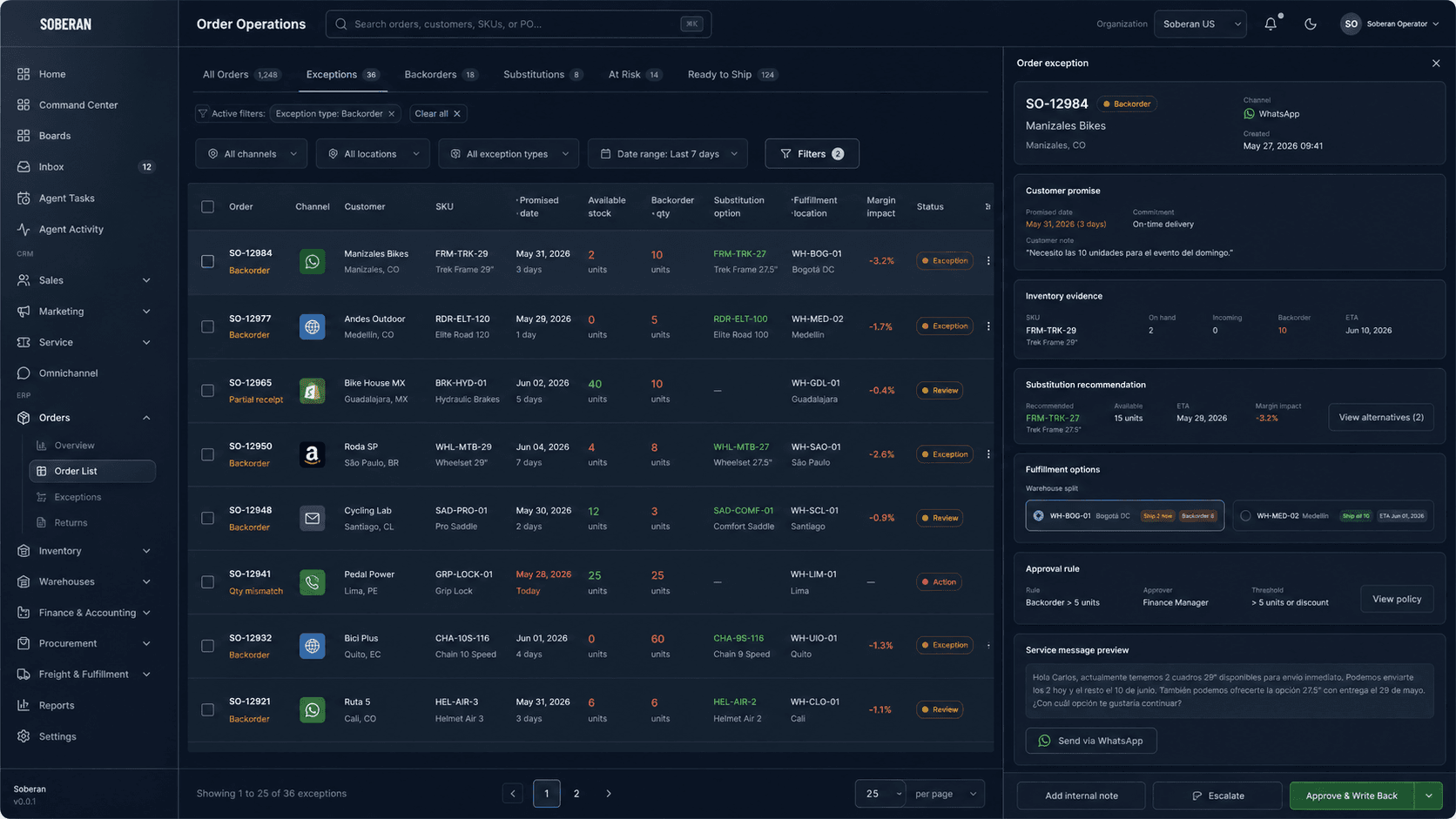
The answer: automate the promise-risk decision before the customer asks
The useful AI agent watches new orders, inventory availability, incoming supply, warehouse capacity, channel promise, substitution rules, margin impact, and customer communication policy. It identifies orders at risk, assembles the decision packet, recommends the safest option, and updates the order record after approval.
Buyer intent is strongest for operations leaders, commerce teams, service leaders, and fulfillment managers that need fewer manual order checks, fewer broken delivery promises, and more consistent customer communication when stock is constrained.
Concrete workflow to automate first
- Monitor orders by channel, promised date, customer tier, SKU, available-to-promise quantity, reserved stock, incoming supply, warehouse location, carrier constraint, and margin impact.
- Detect exceptions: full backorder, partial backorder, stock mismatch, late purchase order, warehouse capacity issue, substitution available, split-shipment option, or customer approval required.
- Rank options using policy: keep promise, substitute item, ship partial quantity, split shipment, transfer inventory, wait for inbound stock, notify service, or escalate to operations.
- Prepare evidence for the reviewer: original promise, source channel, inventory records, substitute item, customer preference, margin impact, delivery date, and recommended message.
- Send approved updates to ERP, commerce, WMS, CRM, and service tools so the order status, customer message, and operational task stay aligned.
- Close the loop after action: shipment created, substitution accepted, customer declined, order canceled, item transferred, or exception aged beyond SLA.
Competitor landscape
- 01
Salesforce Order Management
CRM-connected order fulfillmentSalesforce positions order fulfillment software around routing, delivery options, order support, distributed order management, returns, reshipments, and customer experience.
- Best for
- Retail and commerce teams already invested in Salesforce Commerce Cloud, Service Cloud, and Customer 360.
- Note
- Evaluate how ERP, WMS, supplier, and local inventory records participate when the exception is outside Salesforce.
- 02
IBM Sterling Order Management
Enterprise omnichannel order orchestrationIBM describes Sterling Order Management as omnichannel order fulfillment with real-time inventory, warehouse management, ship-from-store, BOPIS, and promise protection.
- Best for
- Large enterprises with complex channels, fulfillment nodes, and order orchestration requirements.
- Note
- The buying question is how quickly operations can configure exception policy and connect it to customer-facing service actions.
- 03
Oracle Order Management
SCM order promising and substitution controlsOracle documents item substitution in Order Management when the preferred item is out of stock, including Global Order Promising and inventory checks.
- Best for
- Organizations standardized on Oracle Cloud SCM that need substitution rules tied to order promising and inventory.
- Note
- Confirm how customer communication, channel promises, and service escalation are handled around the core SCM decision.
- 04
SOBERAN
AI order exception control across commerce, ERP, inventory, and serviceSOBERAN connects order, inventory, warehouse, customer, service, and approval context so backorders and substitutions become governed operating decisions.
- Best for
- Operators that need exception detection, evidence, customer communication, approval, and system updates across mixed ERP, commerce, WMS, and service stacks.
- Note
- Use SOBERAN when the order problem is not only routing inventory but coordinating the people and systems responsible for the customer promise.
Operating model, governance, and metrics
- Operating model: define exception policies by channel, SKU class, customer tier, location, order value, promised date, substitution eligibility, and margin threshold.
- Governance: require approval for substitutions that change price, bundle, regulated item, customer terms, service-level agreement, or margin beyond policy.
- Customer controls: use approved messaging for delay notices, substitute offers, partial shipment explanations, and cancellation options.
- Metrics: promise-risk detection time, backorder aging, substitution acceptance rate, on-time ship rate, margin impact, service contacts avoided, and exception closure SLA.
- How SOBERAN fits: SOBERAN gives operations a single place to see why the promise is at risk, which action is allowed, who approved it, and which systems were updated.
Sources and trend signals
- Accenture - Autonomous fulfillmentTrend signal for AI-driven orchestration across order management, warehousing, transportation, visibility, and disruption resolution.
- Gartner - Distributed order management market guideGartner market guide reference for distributed order management systems and order orchestration as a software category.
- Salesforce Order Management and FulfillmentOfficial Salesforce page for fulfillment automation, distributed order management, order support, returns, and reshipments.
- IBM Sterling Order ManagementOfficial IBM page for omnichannel fulfillment, real-time inventory, warehouse management, ship-from-store, and customer promise management.
- Oracle item substitution in Order ManagementOfficial Oracle documentation for using substitute items when the preferred item is out of stock.
- SOBERAN order management automationMatching SOBERAN use-case page for order exceptions, inventory checks, customer communication, and approved system updates.
- SOBERAN inventory managementRelated SOBERAN page for stock availability, inventory accuracy, and operational context behind order exceptions.