The answer: reconcile evidence before posting adjustments
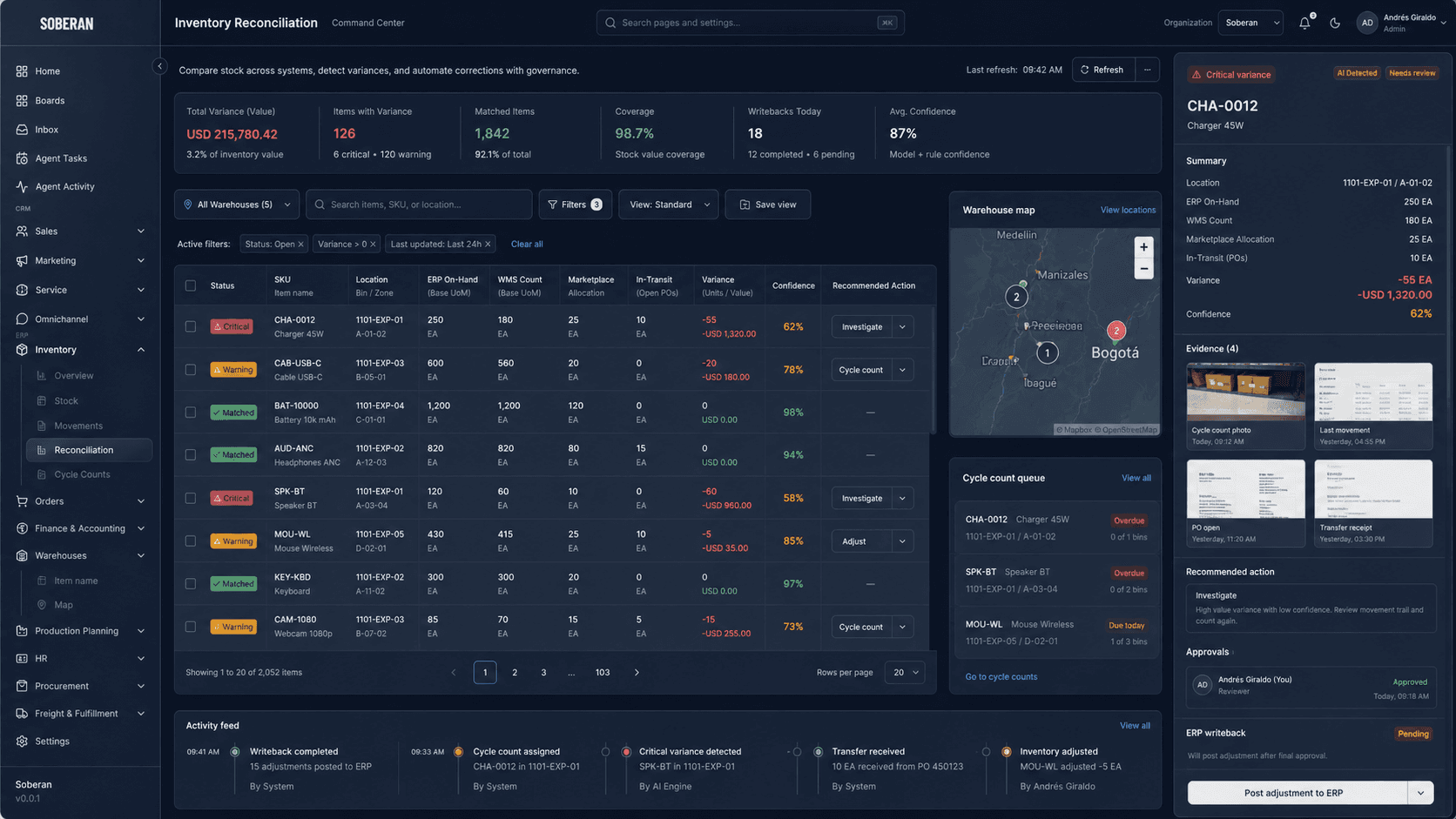
AI inventory reconciliation should compare ERP on-hand, WMS counts, 3PL feeds, transfer orders, marketplace reservations, open picks, returns, and in-transit purchase orders. The agent should classify the variance, assemble evidence, recommend action, and require approval before financial or inventory writeback.
Buyer intent is operational: COOs, inventory controllers, warehouse leaders, finance, and ecommerce operators want higher inventory accuracy, fewer stockouts caused by bad data, and fewer manual spreadsheet hunts.
Concrete workflow to implement first
- Ingest inventory snapshots from ERP, WMS, 3PL, POS, ecommerce, marketplace, transfer, and purchase order systems.
- Match SKU, lot, serial, unit of measure, warehouse, bin, committed quantity, available-to-promise, and in-transit status before comparing counts.
- Classify variances by value, operational risk, age, movement history, demand urgency, and whether the item is already in a cycle count plan.
- Create an evidence packet with last receipt, shipment, transfer, return, count photo, user action, integration timestamp, and proposed adjustment.
- Route low-risk corrections for approval and send high-risk discrepancies to cycle count, warehouse investigation, or finance review.
Competitor landscape
- 01
SAP Extended Warehouse Management
Enterprise WMS and physical inventorySAP EWM documentation covers physical inventory procedures, cycle counting, ERP integration, and posting differences.
- Best for
- Large operators already standardized on SAP warehouse and inventory processes.
- Note
- Strong system of record controls still need cross-system exception narratives when data lives in channels, 3PLs, and spreadsheets.
- 02
Oracle NetSuite WMS
Inventory counts and adjustmentsNetSuite documentation describes completing inventory counts and creating positive or negative inventory adjustment transactions after approval.
- Best for
- Mid-market teams running inventory, accounting, and warehouse workflows inside NetSuite.
- Note
- Validate how variances from non-NetSuite channels and external warehouses are explained before adjustment.
- 03
SOBERAN
AI reconciliation layer across ERP and channelsSOBERAN focuses on comparing operational systems, preparing variance evidence, assigning the right human review, and writing approved corrections back.
- Best for
- Stock-heavy operators that need reconciliation across ERP, WMS, ecommerce, 3PL, marketplace, and finance context.
- Note
- The differentiator is exception explanation and governed writeback across existing systems.
Operating model, governance, and metrics
- Operating model: inventory control owns tolerance rules, warehouse teams own physical investigation, finance owns value thresholds, and the AI agent owns detection, evidence assembly, and workflow routing.
- Governance: require human approval for high-value variances, negative stock corrections, serialized inventory, finance-impacting adjustments, regulated products, and repeated discrepancies.
- Metrics: inventory accuracy, variance value, count-to-close time, writeback approval rate, recurring discrepancy rate, stockout caused by data error, and audit completeness.
- How SOBERAN fits: SOBERAN can connect ERP, WMS, warehouse tasks, channel orders, and finance data so reconciliation becomes an auditable operating loop instead of a spreadsheet exercise.
Sources and trend signals
- Accenture - Resilient supply chain visibilityTrend signal for intelligent visibility, control towers, and AI-enabled supply chain resilience.
- SAP EWM - Physical InventoryOfficial documentation on physical inventory procedures, cycle counting, and ERP integration.
- SAP EWM - Cycle CountingOfficial cycle counting reference for regular product-specific stock checks.
- Oracle NetSuite - Completing Inventory CountsOfficial documentation for count completion, approvals, and inventory adjustments.