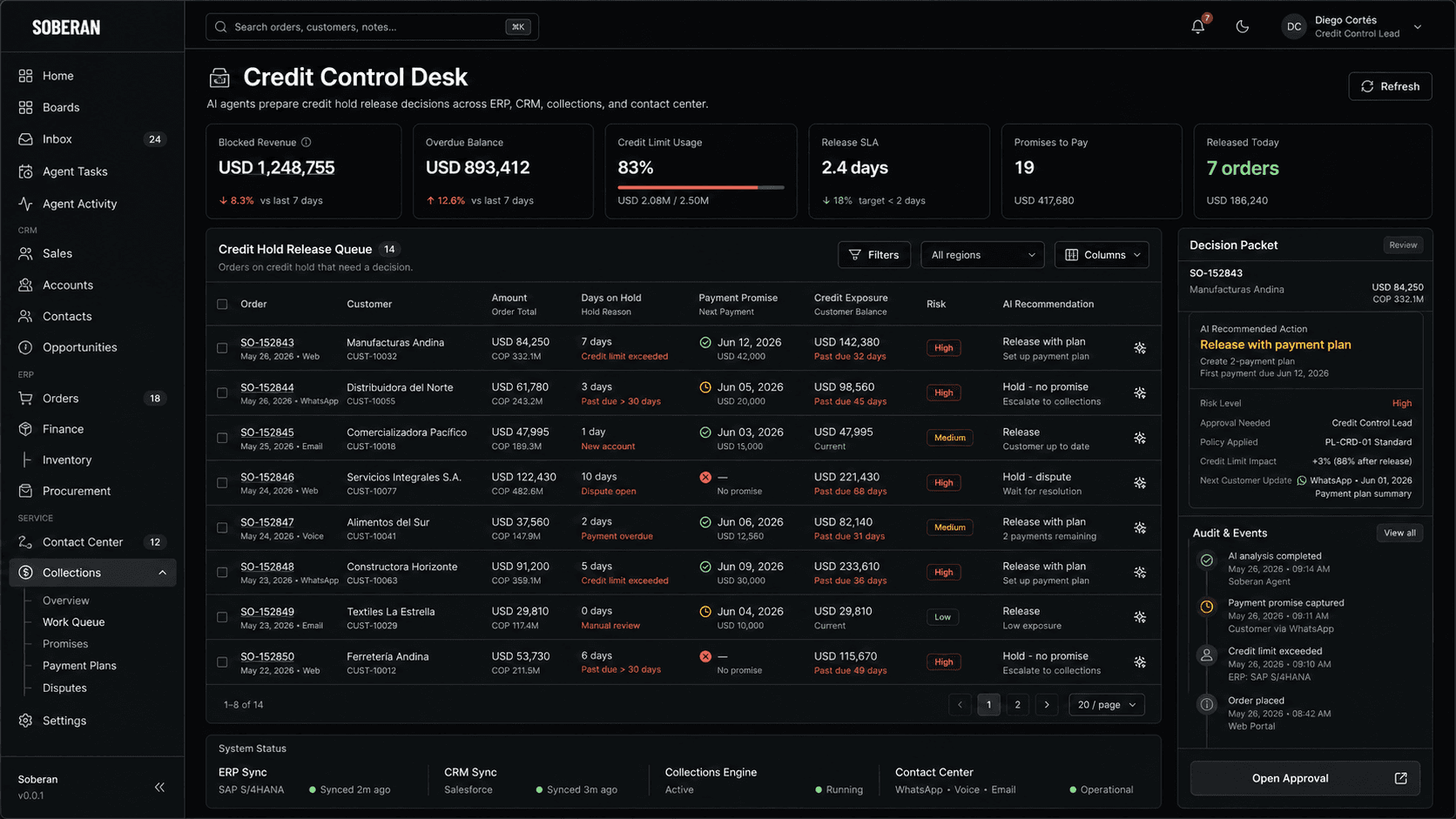
The answer: make credit-hold release the first revenue-control agent
Credit hold is where AI-agent hype meets operating reality. A blocked order may involve overdue invoices, a credit-limit breach, a strategic customer, a promised payment, a sales commitment, a WhatsApp escalation, a warehouse deadline, and an ERP policy that finance cannot ignore. If the agent only answers the customer, it misses the decision. If it releases the order without controls, it creates financial risk.
For SOBERAN buyers, the useful agent is a credit-hold release desk. It builds one decision packet from ERP, CRM, collections, contact-center history, payment promises, order margin, customer priority, and approval policy. The agent recommends release, partial release, payment-plan release, hold, dispute review, or escalation, then updates every system only after the right person approves.
Concrete workflow to automate first
- Detect orders blocked by credit limit, overdue invoices, disputed balances, missing payment promise, exceeded payment terms, manual finance hold, or conflicting customer records.
- Assemble the decision packet with order value, margin exposure, customer segment, account history, open invoices, days past due, payment promises, dispute status, prior exceptions, sales notes, and service escalations.
- Classify the next action as release, release with payment plan, partial release, request payment, route to collections, send dispute review, escalate to finance, or keep the hold because policy is breached.
- Prepare the customer update for WhatsApp, voice, email, or CRM case notes with the approved status, payment requirement, next date, responsible team, and what still cannot be confirmed.
- Require human approval for high-value orders, strategic accounts, new customers, disputed invoices, repeated exceptions, margin risk, legal exposure, regulatory language, and any release above policy threshold.
- After approval, update ERP order status, credit hold reason, CRM account note, collections queue, payment promise record, contact-center timeline, sales task, customer message, and audit history from the same decision record.
Competitor landscape
- 01
SAP Business AI and autonomous enterprise
Enterprise AI positioned around applications, data, and governed executionSAP is framing the autonomous enterprise around business applications, data, and AI that can support more connected operating decisions across core enterprise processes.
- Best for
- SAP-centered organizations that want agents close to SAP process data, finance policy, supply chain context, and enterprise governance.
- Note
- Buyers still need to test how credit policies, non-SAP CRM activity, WhatsApp or voice escalations, local collections practice, and human approvals appear in the daily credit-hold queue.
- 02
Salesforce Agentforce Contact Center
AI contact-center agents connected to CRM, voice, digital channels, and supervisor controlsSalesforce describes Agentforce Contact Center as a way to combine CRM context, AI agents, voice and digital service channels, workforce tools, analytics, and supervisor oversight.
- Best for
- Service organizations already standardized on Salesforce that want AI agents close to cases, customer profiles, service channels, and contact-center reporting.
- Note
- For credit-hold release, the CRM conversation is only one part of the decision. ERP credit exposure, payment promises, finance approval, and collections records still need one governed operating packet.
- 03
Oracle Fusion Cloud SCM AI agents
Embedded agents across supply chain, order management, service, procurement, and inventoryOracle announced AI agents inside Fusion Cloud Supply Chain & Manufacturing for planning, procurement, manufacturing, maintenance, inventory, logistics, order management, and service workflows.
- Best for
- Oracle-centered enterprises that want agents embedded inside existing Oracle application workflows, security, and data controls.
- Note
- Mid-market operators with mixed ERP, CRM, WhatsApp, voice, and local collections processes should verify how exceptions move across systems before accepting an automated release recommendation.
- 04
SOBERAN
Credit-hold release desk across ERP, CRM, collections, and contact centerSOBERAN gives the agent one governed view of orders, invoices, payment promises, customer priority, sales context, service escalations, approval policy, and audit history before blocked orders change status.
- Best for
- LatAm mid-market companies where order release, collections, sales commitments, and customer updates happen across multiple systems and channels.
- Note
- Use SOBERAN when the expensive delay is not answering “where is my order?” but deciding whether that order should be released, held, partially released, or escalated with evidence.
Operating model, governance, and KPIs
- Operating model: finance owns credit policy, collections owns payment promise truth, sales owns customer priority, operations owns shipment feasibility, service owns customer communication, and RevOps owns CRM field quality.
- Governance: classify each blocked order by credit exposure, overdue balance, dispute status, customer segment, margin risk, promise reliability, prior exception history, approval threshold, and allowed system update.
- Data policy: define source precedence for credit limit, open invoices, payment terms, promised payment date, disputed balance, order margin, shipment date, customer tier, case history, and channel consent.
- KPIs: hold-release cycle time, blocked revenue aging, promise-to-pay conversion, release-after-payment rate, bad-debt leakage, disputed-balance resolution, customer-update SLA, approval latency, repeat exception rate, and audit completeness.
- Risks to govern: agents can release orders based on stale receivables, ignore disputed balances, over-prioritize sales pressure, create inconsistent customer messages, or update ERP and CRM differently if the decision record is not shared.
- How SOBERAN fits: SOBERAN turns credit hold into a governed operating queue where the agent gathers evidence, recommends the decision, obtains approval, updates ERP and CRM, and gives the contact center a precise customer-ready update.
Sources and trend signals
- McKinsey: The end of ERP as we know itAnalyst signal that agentic AI is pushing ERP from isolated task automation toward end-to-end process orchestration while system-of-record control still matters.
- Salesforce: Agentforce Contact CenterPrimary Salesforce signal that AI agents, CRM context, voice, digital channels, analytics, workforce tools, and supervisor controls are converging in service operations.
- TechRadar Pro: SAP unveils the autonomous enterprise with AI at the coreMajor-outlet enterprise software signal from SAP Sapphire that business applications, data, and AI are being positioned as the operating base for more autonomous enterprise processes.
- Oracle AI agents for Fusion Cloud Supply Chain & ManufacturingPrimary Oracle signal for embedded agents across planning, procurement, manufacturing, maintenance, inventory, logistics, order management, and service workflows.
- Accenture Technology Vision 2025Consulting signal that AI autonomy is becoming a business-architecture question, with trust, governance, and human oversight as core design requirements.
- a16z: Big Ideas 2026, the enterprise orchestration layerInvestor signal that enterprise AI is moving from isolated copilots toward coordinated systems that plan, analyze, and execute work across teams and tools.