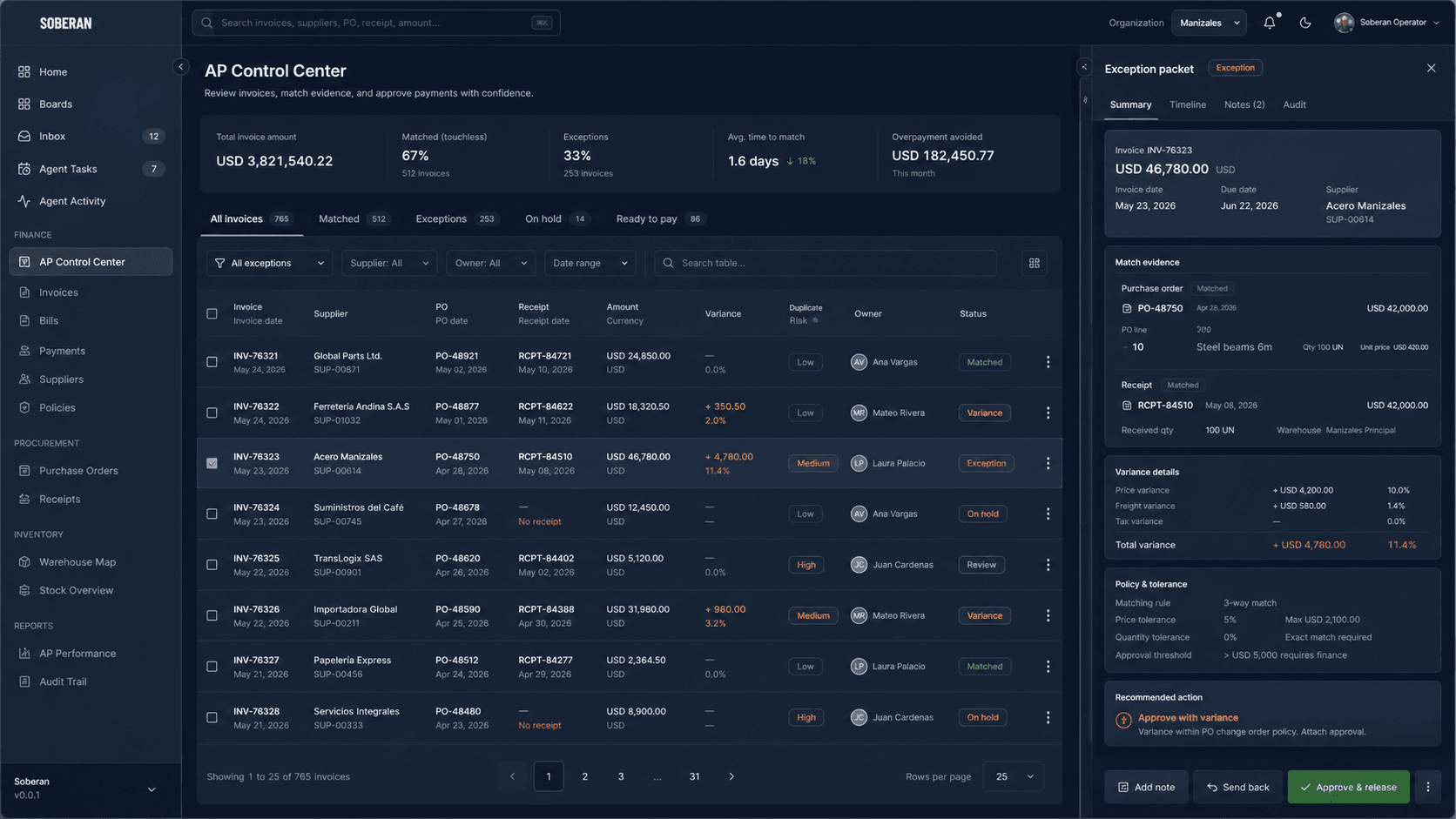
The answer: automate the exception decision packet
The highest-value pattern is an AI agent that compares the invoice, purchase order, receipt, contract, supplier profile, and tolerance policy, then classifies the exception before payment is released. The agent should not approve risky variances by itself. It should assemble evidence, recommend the next action, assign the right reviewer, and update AP with a traceable decision.
Buyer intent is strongest for controllers, AP managers, procurement operations, and supply chain finance teams that already have invoice capture but still lose time on missing receipts, price variances, duplicate invoices, supplier aliases, freight charges, tax differences, and unclear approval responsibility.
Concrete workflow to automate first
- Ingest supplier invoice fields, attachments, PO references, line items, tax, freight, currency, payment terms, bank data, and supplier aliases.
- Pull operating evidence from ERP, procurement, receiving, inventory, supplier portal, contract repository, and prior invoice history.
- Classify the exception as clean match, price variance, quantity variance, missing receipt, duplicate risk, charge variance, tax issue, missing PO, contract mismatch, or supplier master-data issue.
- Apply policy by amount, tolerance, supplier tier, segregation-of-duties rule, location, inventory class, and payment date risk.
- Create a reviewer packet with source records, variance math, blocked amount, likely root cause, recommended action, confidence, due date, and payment hold status.
- Record the outcome in AP and ERP: approved, sent back, receipt requested, PO change needed, supplier dispute, duplicate blocked, or payment released.
Competitor landscape
- 01
Tipalti PO matching
AP automation and PO matchingTipalti documents 2-way and 3-way PO matching, header or line-level matching, approval flow, and matching triggers for PO-backed bills.
- Best for
- Finance teams that want AP capture, coding, PO matching, and payments in one AP platform.
- Note
- Validate exception ownership, receipt evidence, supplier communication, and how variance decisions return to the ERP.
- 02
SAP Ariba Invoice Management
Enterprise invoice-to-pay controlSAP describes invoice processing with rules, validation, visibility into orders, exceptions, receipts, payments, and two-way or three-way matching.
- Best for
- Large procure-to-pay organizations standardized on SAP Ariba and supplier-network processes.
- Note
- Ask how nonstandard invoices, local ERP variants, partial receipts, and LatAm supplier communication are handled operationally.
- 03
BILL AP automation
AP approvals and payment automationBILL positions AP automation around invoice capture, automated approval routing, electronic payments, audit trails, and transparency.
- Best for
- SMB and mid-market finance teams that want simpler invoice approvals and payment execution.
- Note
- Check fit when the core pain is PO, receipt, inventory, warehouse, and supplier evidence across several systems.
- 04
SOBERAN
Invoice exception triage across ERP, procurement, and receivingSOBERAN connects invoice, PO, receipt, inventory, supplier, approval, and finance context so exceptions become governed operating decisions.
- Best for
- Operators that need AP controls plus real-world receiving, purchase, supplier, and warehouse evidence in one AI-assisted flow.
- Note
- Use SOBERAN when the bottleneck is deciding what is blocked, why it is blocked, and who can safely clear it.
Operating model, governance, and metrics
- Operating model: keep deterministic rules in charge of tolerances, payment holds, approval thresholds, segregation of duties, duplicate blocks, and release status.
- Governance: require human approval for out-of-policy amounts, bank changes, tax issues, supplier disputes, missing receipts, and any exception that changes payable value.
- Data controls: maintain supplier aliases, item mappings, unit conversions, tax codes, PO line references, receipt IDs, and attachment links as auditable fields.
- Metrics: first-pass match rate, exception aging, touchless invoice rate, duplicate invoices blocked, overpayment avoided, supplier dispute cycle time, and percentage of exceptions with complete evidence.
- How SOBERAN fits: SOBERAN acts as the operating layer that reads messy invoice evidence, normalizes it against ERP and procurement data, prepares the reviewer packet, and records the final AP decision.
Sources and trend signals
- McKinsey - Agentic AI in procurementCurrent trend signal for agentic AI in procurement, including invoice-to-contract compliance and source-to-pay workflows.
- Tipalti - PO matching documentationOfficial documentation for 2-way and 3-way matching, header and line-level matching, approval, and matching triggers.
- SAP Ariba Invoice ManagementOfficial SAP page for invoice-to-pay visibility, rules, exceptions, receipts, payments, and two-way or three-way matching.
- BILL accounts payable automationOfficial BILL page for invoice capture, approval routing, electronic payments, transparency, and audit trails.
- SOBERAN invoice verification automationMatching SOBERAN use-case page for PO-backed invoice verification, exceptions, and AP controls.
- SOBERAN procurement automationRelated internal page for purchase-order creation, approval, supplier context, and operating evidence before invoice payment.