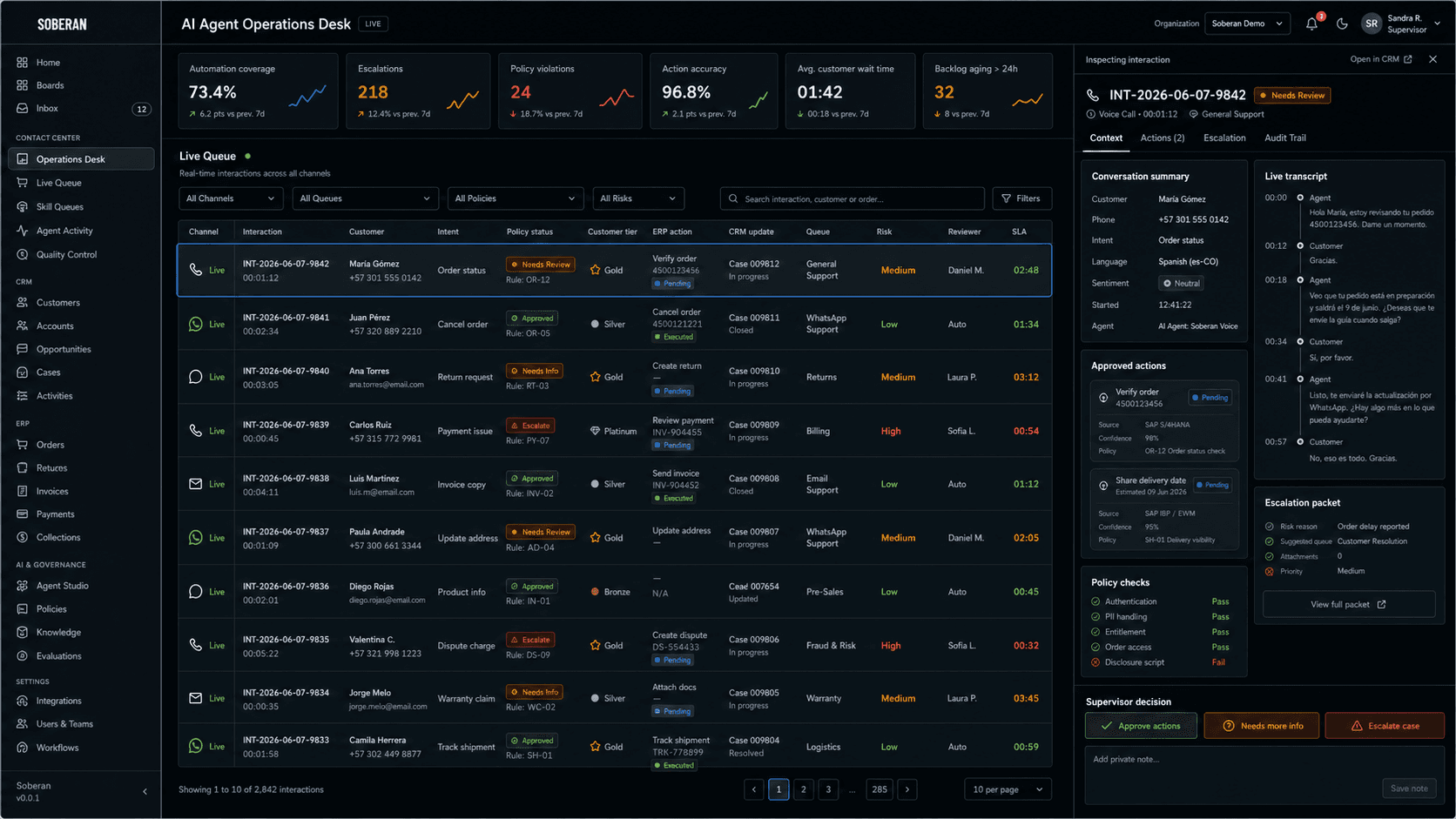
The answer: manage AI agents like an operations queue, not a chatbot fleet
The market signal is consistent. Salesforce is unifying voice, digital channels, CRM data, and AI agents in Agentforce Contact Center. Microsoft is packaging Customer Assist, Quality Assurance, and Service Operations agents across the contact-center lifecycle. SAP is positioning autonomous CX assistants across discovery, fulfillment, engagement, service, and issue resolution. McKinsey and Gartner both point to a contact-center shift where AI value depends on trust, new agent skills, knowledge quality, and operational governance.
For SOBERAN buyers, the operating point is simple: automation coverage is not the KPI unless the business can see the action, evidence, policy, reviewer, customer impact, and system update behind it. The first control layer should be an AI agent operations desk that supervises live conversations and back-office actions together.
Concrete workflow to automate first
- Create one live queue for AI-handled and human-handled interactions across voice, WhatsApp, chat, email, CRM cases, ERP exceptions, and order or finance actions.
- Classify each interaction by customer intent, channel, sentiment, customer tier, data confidence, required policy, CRM update, ERP action, monetary exposure, and escalation reason.
- Show supervisors the selected row with transcript, customer history, open orders, invoices, service tickets, approved knowledge, policy checks, and the agent action plan.
- Require approval before sensitive actions such as issuing a credit, changing an address, releasing a hold, creating a replacement order, changing payment terms, updating a high-value opportunity, or sending a policy-sensitive message.
- Update CRM, ERP, contact-center records, task queues, customer notifications, and audit history only when the action passes policy, evidence, permission, and review rules.
- Feed failures back into operations: missed intent, bad answer source, low confidence, wrong escalation, unresolved customer promise, poor agent behavior, duplicate CRM record, or ERP action blocked by policy.
Competitor landscape
- 01
Salesforce Agentforce Contact Center
Agentic contact center tied to Salesforce CRM dataSalesforce positions Agentforce Contact Center as a unified system for voice, digital channels, CRM data, AI agents, AI-to-human handoffs, and real-time interaction visibility.
- Best for
- Teams standardized on Salesforce that want contact-center automation, CRM context, supervisor visibility, and native voice or digital-channel orchestration.
- Note
- Validate how ERP actions, finance approvals, order exceptions, WhatsApp context, and non-Salesforce systems are governed when the service issue moves beyond CRM.
- 02
Microsoft Dynamics 365 Contact Center AI agents
Customer assist, quality, and service operations agentsMicrosoft describes a coordinated agent model spanning self-service across voice and digital channels, quality management, and service operations in Dynamics 365 Contact Center.
- Best for
- Organizations already invested in Dynamics 365, Microsoft contact-center tools, Copilot Studio, Teams, and Microsoft-managed service operations.
- Note
- Ask how the desk handles WhatsApp-specific policy, mixed ERP estates, LatAm service exceptions, and operational approvals outside the Microsoft stack.
- 03
SAP Autonomous CX and SAP Customer Experience
Autonomous customer workflows connected to enterprise executionSAP says autonomous CX assistants coordinate multiple agents across end-to-end customer workflows from discovery to fulfillment, engagement to service, and issue to resolution.
- Best for
- SAP-centered enterprises that want service, commerce, sales, and customer-experience agents close to SAP data, SAP processes, and SAP governance.
- Note
- Mid-market operators should test how quickly supervisors can govern mixed-channel conversations, non-SAP CRM records, regional policies, and ERP actions that require local approval.
- 04
SOBERAN
Agent operations desk across contact center, CRM, ERP, WhatsApp, voice, and approvalsSOBERAN connects live interactions, CRM records, ERP evidence, WhatsApp and voice context, approval queues, quality signals, and audit history so agents can act without hiding operational risk.
- Best for
- LatAm mid-market operators that need AI to resolve routine service work while humans keep control of refunds, credits, order changes, finance exposure, policy exceptions, and customer escalations.
- Note
- Use SOBERAN when the buyer needs more than containment: they need a governed operating desk that proves which agent action happened, why it was allowed, and who reviewed the exception.
Operating model, governance, and KPIs
- Operating model: customer operations owns the queue, supervisors own exception review, CRM owners define customer-record rules, ERP owners define transaction permissions, finance owns monetary thresholds, and compliance owns channel policy.
- Governance: classify every action by risk tier, required evidence, allowed system update, customer-facing language, consent requirement, monetary exposure, and approval requirement before expanding autonomy.
- Data policy: define source precedence for customer identity, order status, invoices, payment state, entitlement, warranty, product availability, contract terms, service history, and approved knowledge.
- KPIs: automation coverage, first-contact resolution, escalation quality, average wait time, backlog aging, action accuracy, CRM update accuracy, ERP action success, policy violations, rework rate, customer promise aging, and supervisor review load.
- Buyer intent: COOs, heads of customer experience, contact-center leaders, CRM owners, ERP owners, and finance operations leaders should start here when AI pilots are working in demos but risky in live operations.
- How SOBERAN fits: SOBERAN gives agents controlled access to conversation context, customer records, ERP evidence, approval policy, quality signals, and audit history so routine issues move fast while sensitive actions remain visible and reviewable.
Sources and trend signals
- Salesforce: Agentforce Contact CenterPrimary Salesforce signal on unifying voice, digital channels, CRM data, AI agents, AI-to-human handoffs, and real-time visibility across every interaction.
- Microsoft: Dynamics 365 Contact Center AI agentsPrimary Microsoft signal on Customer Assist Agent, Quality Assurance Agent, Service Operations Agent, coordinated agent models, and full-lifecycle contact-center AI.
- SAP: Autonomous CXPrimary SAP signal on autonomous CX assistants coordinating multiple agents across discovery, fulfillment, engagement, service, and issue resolution.
- McKinsey: customer care leaders and AI trustMcKinsey signal on AI-guided customer care, agent enablement, risk tolerance, regulatory compliance, trust, workforce management, coaching, and next-best actions.
- Gartner: customer-service leaders under AI pressureGartner signal on service leaders under pressure to implement AI, first-contact resolution, customer effort, new agent skills, and knowledge-management specialization.
- Harvard Business Review: companies need agent managersOperating-model signal that enterprises need people and structures to manage fleets of AI agents as those agents act across support, sales, marketing, and operations.
- Accenture and Google Cloud: agentic transformationConsulting and platform signal on agents orchestrating intelligent workflows across customer engagement, service, payments, fulfillment, and partner collaboration.
- a16z: enterprise orchestration layerMarket perspective considered for the move from isolated copilots to coordinated multi-agent systems that plan, analyze, and execute work across teams and tools.
- Sequoia: context for agents at scaleMarket perspective considered for why agents need company-specific context, executable knowledge, process memory, and permissioned information before they act.