The answer: keep the operating screen in the loop
A fresh market signal is forming around how agents touch enterprise systems. TechRadar Pro argued on June 23, 2026 that direct backend access can bypass approval paths and legacy controls, while agents that emulate human behavior through existing interfaces can preserve permissions, validations and audit artifacts. McKinsey shows the broader tension: AI and agent experimentation is widespread, but scaled impact still depends on workflow redesign, human validation and KPI tracking. SAP is positioning agent hubs around centralized governance, inventory, performance, business impact and organizational context. UI-CUBE research adds a hard reality check: computer-use agents still face reliability cliffs in complex enterprise interfaces, so screen-level execution needs controls, not blind trust.
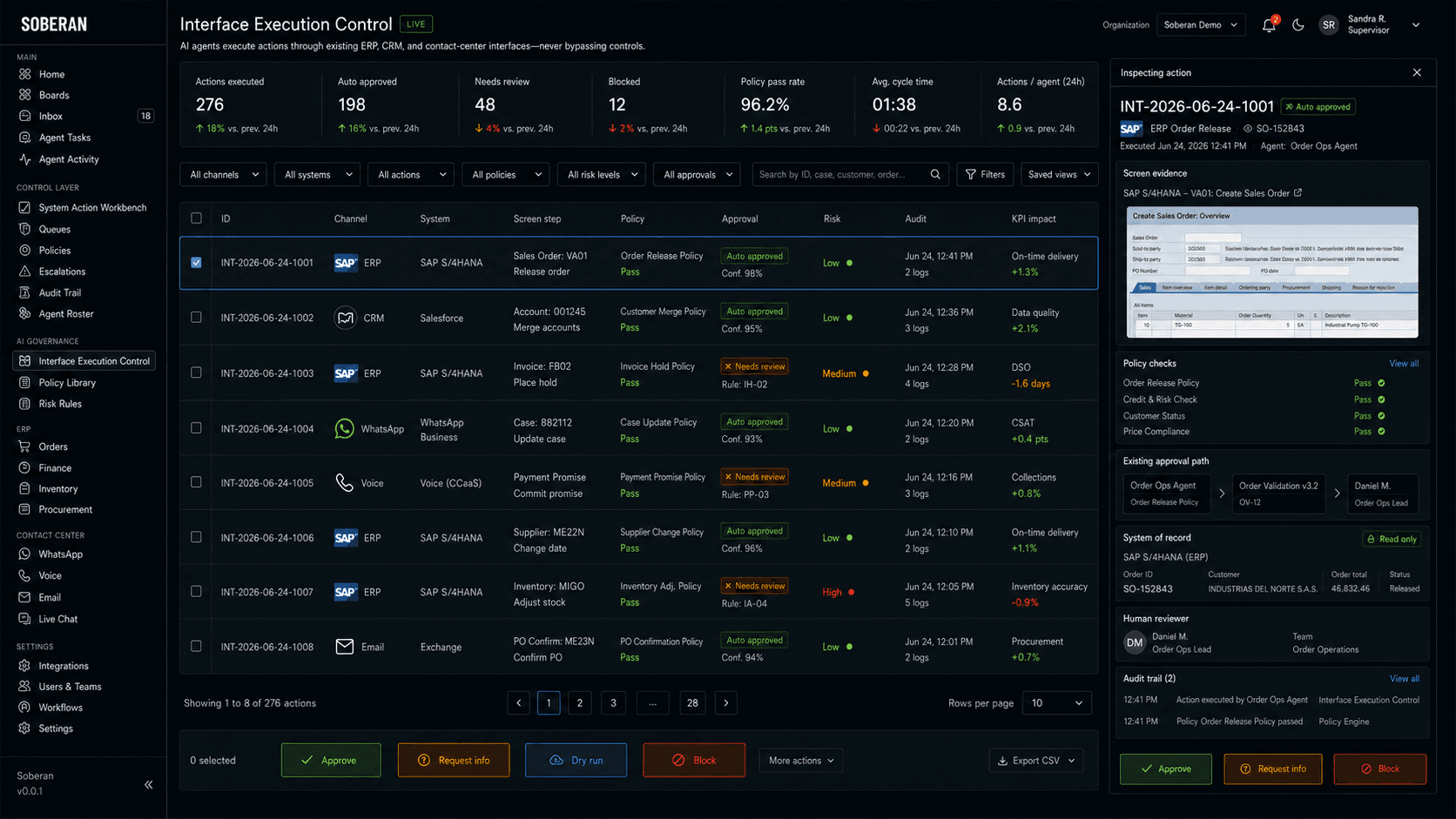
For SOBERAN buyers, the point is direct: when the ERP, CRM or contact-center interface is the place where the business proves policy, the agent should not quietly route around it. A SOBERAN agent should be able to read the screen, assemble evidence, propose the action, respect the existing approval path and leave an audit trail that the operating team can inspect.
What operators should do differently
Do not assume the fastest integration is the safest integration. Direct API access is powerful when the policy model is mature. But in many LatAm mid-market environments, the real controls live inside SAP screens, local ERP forms, CRM layouts, contact-center dispositions, spreadsheets, tax documents, payment portals and supervisor approvals. Bypassing those surfaces can make the agent faster while making the business less defensible.
The better operating move is to classify each automation by control location. If the approval, validation, segregation-of-duties check or customer-impact warning lives in the user interface, start with a UI-first agent. Use deeper system actions only after the team can prove the same evidence, policy, permission and audit result outside the screen.
Workflows where UI-first execution matters
- Order release where the agent checks ERP availability, credit status, delivery date, sales commitment and release approval before confirming the customer update.
- Vendor bank-detail changes where finance policy, maker-checker approval, supplier evidence and payment-risk checks must stay visible before any record changes.
- Invoice holds where the agent reads the invoice, PO, receipt, tax fields and tolerance messages in the same AP surface used by reviewers.
- CRM merge or enrichment where duplicate warnings, account hierarchy, consent and territory rules are visible in the CRM interface before a record changes.
- WhatsApp service cases where the agent must connect the customer message to order state, case status and approved response language before sending a reply.
- Voice collections promises where the screen shows consent, balance, aging, policy limits, payment options and required review before the promise is recorded.
- Supplier date updates where procurement needs to see PO state, promised date, variance reason, buyer approval and downstream order impact in one place.
Buyer intent: ask where the agent acts
A serious buyer should ask vendors to show the action path, not only the conversation. Does the agent update the ERP through a governed screen, a vetted API, a connector, a queue, or a background script? Which path preserves the existing approval rule? Which path creates the audit record? Which path can supervisors replay when the customer, finance team or auditor asks why the action happened?
The right answer may differ by workflow. Read-only lookups can often use APIs. High-volume low-risk updates may use a controlled connector. High-impact actions such as releasing orders, changing vendor data, merging customer records, issuing credit notes, altering payment terms or sending regulated customer messages often need a screen-level or approval-level control until the policy model is proven.
Operating model and governance
- Map each queue by control location: interface, API, connector, document, supervisor review or finance approval.
- Give every agent a named operating identity with the same role-based permissions a person would need for that queue.
- Record screen evidence for sensitive actions: field state, warning messages, policy result, approval status and timestamp.
- Separate read, suggest, draft, submit-for-review and automatic execution modes by queue and system.
- Use supervisor review for screen changes that touch cash, credit, delivery promise, customer status, supplier data or compliance language.
- Measure reliability at the state level, not just task completion: did the right field change, did the approval fire, did the audit log close, and did the KPI move?
- Retire brittle screen paths when a governed API can reproduce the same evidence, policy and audit result with lower operating risk.
KPIs that prove the interface path works
- Screen-action success rate by ERP, CRM, contact-center, finance and procurement queue.
- Policy warning detection rate and blocked-action rate.
- Approval preservation rate: actions where existing approval paths fired correctly.
- Field-level correction volume after agent execution.
- Cycle time for reviewed screen actions versus manual work.
- Customer-impact metrics: repeat contact, complaint rate, delivery accuracy, promise kept and case reopening.
- Audit completeness: source evidence, screen state, reviewer, system change and KPI outcome attached to the action.
Risks to govern
The first risk is false confidence. A computer-use agent may complete a simple screen task and still fail on a messy exception with pop-ups, missing fields, duplicated records, stale session state or a changed layout. The second risk is control theater: the agent appears to use the interface, but the evidence, approval and final system state are not captured together. The third risk is overusing UI automation where a governed API would be cleaner, faster and more reliable.
The operating discipline is to choose the action path by risk. UI-first execution is useful when the interface is the control boundary. It should not become a permanent excuse for brittle automation. The target state is a governed action layer where screens, APIs and connectors all prove the same policy result.
How SOBERAN fits
SOBERAN fits when the buyer needs agents to work across real operating surfaces: ERP, CRM, contact center, WhatsApp, voice, finance, procurement, documents and approvals. A SOBERAN deployment can keep the screen, record, policy, evidence, reviewer and KPI in one operating view so teams can see exactly how an agent acted.
That matters in LatAm mid-market operations because replacement projects are slow, data is distributed and many critical controls already exist in the tools people use every day. SOBERAN can start with UI-first assistance where controls live in the interface, then move actions into governed connectors or APIs as the business proves reliability, auditability and outcome impact.
Sources and trend signals
- TechRadar Pro: Secure AI will be defined by emulated human behaviorUsed for the current UI-first signal: direct backend access can bypass legacy approvals, controls and audit trails, while interface-based execution can preserve existing operating safeguards.
- McKinsey: The State of AI in 2025Used for the adoption-and-scaling signal: AI and agent experimentation is broad, but enterprise value still depends on workflow redesign, human validation and KPI tracking.
- SAP: Joule Agents and SAP AI Agent HubUsed for the enterprise-agent signal around centralized discovery, inventory, governance, performance visibility, business impact and organizational context.
- a16z: Big Ideas 2026, the enterprise orchestration layerUsed for the market context that AI is moving from isolated copilots toward coordinated systems that execute work across teams and tools.
- arXiv: UI-CUBE computer-use agent benchmarkUsed for the reliability signal: enterprise computer-use agents need state-level validation and operational reliability checks, not only task-completion demos.
- arXiv: Controlled agentic AI for small and medium-sized companiesUsed for the mid-market signal that near-term agent value comes from controlled partial autonomy, measurable impact, governance and human accountability.