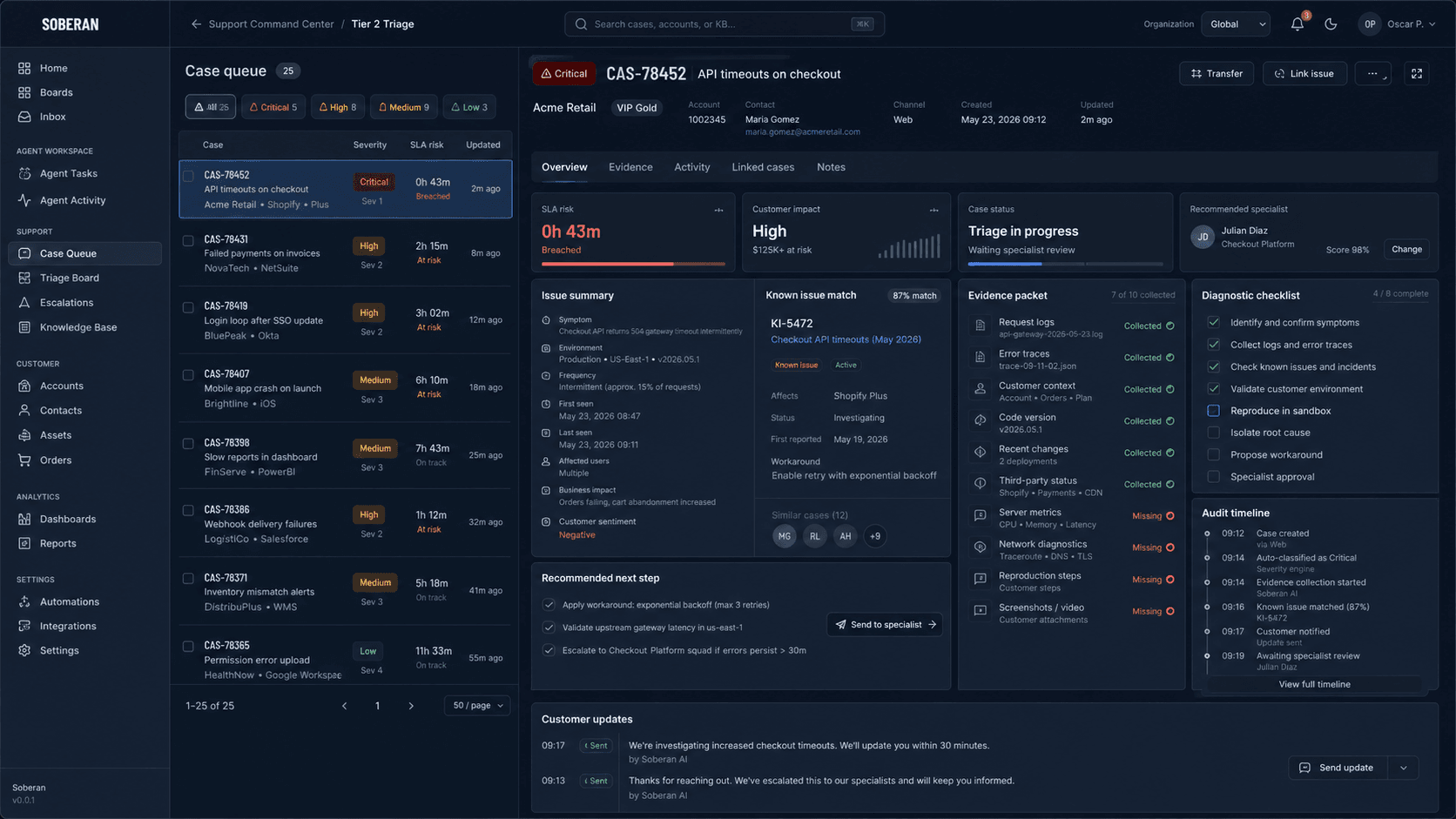
The answer: automate diagnostic triage, not blind resolution
The first workflow should happen before a specialist touches the case. The agent should determine whether the issue is routine, known, missing evidence, customer-impacting, engineering-related, billing-related, or unsafe for automation. Then it should prepare a structured packet with symptoms, timeline, evidence, confidence, and recommended next action.
Buyer intent comes from support operations, technical support, CX leaders, and product operations teams that need faster resolution without letting AI invent root cause, overpromise fixes, or take destructive actions in production systems.
Concrete workflow to automate first
- Classify the case by product, severity, SLA, customer tier, channel, sentiment, business impact, prior escalations, and current service state.
- Collect evidence from ticket history, CRM, ERP, order records, product logs, error events, screenshots, attachments, release notes, and known-issue records.
- Identify missing data such as account identifiers, timestamps, reproduction steps, device details, affected users, permissions, and customer authorization.
- Match symptoms to known issues, incidents, defects, recent releases, approved troubleshooting steps, and similar resolved cases.
- Route the case to the right specialist or squad with impact, evidence, missing-data checklist, confidence level, and recommended first diagnostic action.
- Draft customer updates from approved language and update ticket, CRM, engineering issue, escalation queue, and audit trail after review.
Competitor landscape
- 01
ServiceNow Customer Service Management
Enterprise CSM and AI agentsServiceNow positions Customer Service Management around AI agents that handle routine tasks, complete processes, and help scale contact center operations.
- Best for
- Large enterprises that want customer service processes, case management, knowledge, field service, and enterprise governance on the Now Platform.
- Note
- For tier 2 support, test how technical evidence from product logs, ERP, engineering systems, and customer channels becomes specialist-ready context.
- 02
Atlassian Jira Service Management
ITSM and virtual service agentAtlassian describes a Jira Service Management virtual service agent configured through intent flows and AI answers for service requests.
- Best for
- IT, support, and engineering teams already coordinating incidents, changes, service requests, and knowledge in Atlassian tools.
- Note
- Buyers should validate customer-facing update controls, CRM/order context, and non-Atlassian evidence capture before relying on virtual-agent triage.
- 03
Freshdesk Freddy AI
AI copilot for customer supportFreshworks describes Freddy AI Copilot for prioritizing and routing customer queries, recognizing sentiment, summarizing situations, and helping agents respond.
- Best for
- Support teams that want agent assistance, summaries, response help, and ticket productivity inside Freshdesk.
- Note
- For complex cases, inspect whether diagnostic evidence, specialist routing, approval gates, and technical-system updates are complete enough for tier 2 work.
- 04
SOBERAN
Diagnostic triage across support, product, ERP, CRM, and audit controlsSOBERAN connects case data, customer context, operational records, logs, known issues, specialist routing, approved updates, and audit history in one loop.
- Best for
- Operators that need tier 2 support to move faster without losing evidence quality, ownership, customer trust, or operational control.
- Note
- Use SOBERAN when the bottleneck is incomplete escalation context across ticketing, CRM, ERP, product systems, and customer channels.
Operating model, governance, and metrics
- Operating model: tier 1 owns initial intake, support operations owns triage rules, specialists own diagnosis, product or engineering owns defects, and CX owns customer communication quality.
- Governance: require human approval for root-cause statements, service credits, destructive actions, account changes, production configuration changes, security-sensitive evidence, and customer-facing commitments.
- Metrics: evidence completeness, missing-data rate, specialist rework, time to first useful diagnosis, SLA recovery, customer update latency, reopen rate, escalation accuracy, and repeat incident detection.
- How SOBERAN fits: SOBERAN gives the AI agent read access, action limits, approval gates, source-linked evidence, and update history so tier 2 work becomes faster without becoming opaque.
- Internal links to prioritize: /automate/tier-2-technical-support, /automate/chat-email-support, /automate/inbound-phone-support, /contact-center, and /how-it-works.
Sources and trend signals
- Gartner: AI agent governance by autonomy levelGartner warns that governance must vary by agent autonomy and scope, which is directly relevant to tier 2 support agents that can advise, draft, or act with approval.
- Gartner: customer service leaders under AI pressure in 2026Gartner reports strong pressure on customer service leaders to implement AI, reinforcing the need to prioritize governed use cases rather than broad automation claims.
- ServiceNow Customer Service ManagementOfficial ServiceNow page used to verify Customer Service Management and AI agent positioning.
- Atlassian Jira Service Management virtual service agentOfficial Atlassian page used to verify virtual service agent, intent flow, and AI answer positioning.
- SOBERAN tier 2 technical support automationInternal SOBERAN use case page for diagnostic evidence, specialist routing, and escalation controls.