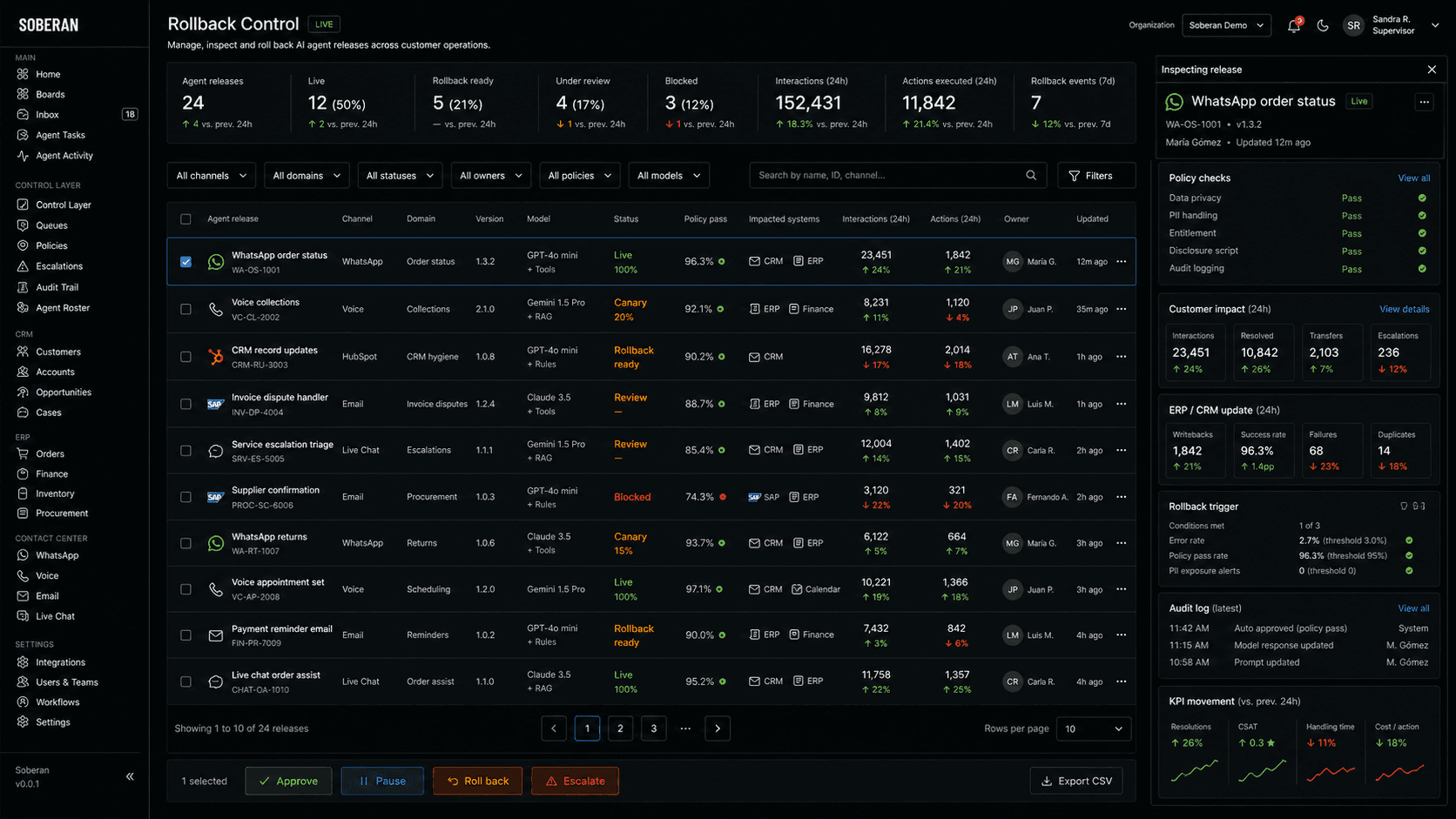
The answer: treat agents like reversible releases
Adobe reported on June 25, 2026 that nearly 78% of organizations expect agentic AI to directly handle customer-support interactions within 18 months, while only 16% have deployed it organization-wide. ITPro and TechRadar both covered Sinch research showing that 74% of companies have rolled back or shut down at least one customer-communications agent because of governance failures. SAP is also positioning enterprise agents around business-process context, SAP and non-SAP applications, and coordinated actions across functions.
For SOBERAN buyers, the practical lesson is not to slow down AI. It is to launch customer-facing agents with release discipline: a defined scope, customer-impact threshold, ERP and CRM evidence, approval rules, audit trail, rollback trigger and recovery path. If an agent can speak to customers, update records or influence money movement, it needs a way to be paused, corrected and redeployed without losing operational control.
What operators should do differently
Do not launch a WhatsApp, voice, chat or email agent as a permanent channel change. Launch it as a controlled release with a narrow case type, explicit policy, measurable customer impact and a known fallback. The question is not simply whether the agent resolves more cases; it is whether the team can detect bad patterns quickly and reverse them before customers, finance or operations absorb the damage.
This matters in LatAm mid-market operations because customer conversations often depend on fragmented context: ERP order status, CRM history, payment promises, tax documents, delivery evidence, supplier dates, manual approvals and channel consent. An agent can sound helpful while creating silent rework if it answers from stale data, updates the wrong record, misses a collection policy or hides the reason for escalation.
Workflows that need rollback playbooks first
- WhatsApp order status where the agent reads ERP fulfillment state, shipment evidence, CRM history and service policy before replying, with rollback triggers for repeat contact, wrong ETA patterns or unresolved delivery exceptions.
- Voice collections where the agent validates balance, aging, consent, customer history, negotiation range and payment promise before updating finance or CRM, with pause rules when promise quality or complaint rate deteriorates.
- CRM record updates where the agent merges duplicates, fills missing fields and creates next actions, with release gates for duplicate creation, account mismatch and bad field updates.
- Invoice dispute handling where the agent compares order, invoice, receipt, tax data, credit note and approval policy, with review triggers when evidence conflicts or finance risk rises.
- Service escalation triage where the agent summarizes the case, classifies severity and routes a person when policy requires it, with customer-impact limits for missed severity, late response or poor escalation timing.
- Supplier confirmation where the agent follows up on delivery date, price variance and buyer approval, with rollback rules if supplier responses stop matching purchase-order reality.
Buyer intent: ask for rollback evidence
A serious automation vendor should be able to show what happens when the agent is wrong, not only what happens in a clean demo. Ask for the release history by channel and queue: version, prompt change, policy change, allowed actions, affected systems, customer-impact metrics, blocked actions, human review rate and rollback events.
The release record should connect the customer conversation to the system result. For example: which WhatsApp reply came from which ERP state, which CRM record changed, which finance policy applied, which reviewer approved an exception, and which KPI moved afterward. Without that chain, a rollback becomes a manual cleanup project instead of an operating control.
Operating model and governance
- Assign one responsible team for each agent release, including channel, queue, policy and KPI ownership.
- Start with one repeatable case type before expanding the agent to adjacent intents or higher-risk actions.
- Define release gates: data quality, policy pass rate, review accuracy, system-update success, customer-impact threshold and audit completeness.
- Use progressive autonomy: read-only response, suggested action, reviewed update, limited automatic update and broader automatic execution only after evidence supports it.
- Create rollback triggers before launch, including hallucination rate, data exposure risk, repeat contact, complaint rate, duplicate record creation, failed system update and finance exception rate.
- Keep a recovery playbook: pause the agent, route active cases to people, freeze risky updates, notify supervisors, correct affected records and redeploy only after the release review closes.
KPIs that prove release control works
- Rollback events by channel, queue and release version.
- Time to detect and time to pause after a policy or data-quality failure.
- Repeat contact, reopened case and complaint rate after agent interaction.
- ERP and CRM update success rate, duplicate creation rate and correction volume.
- Human review minutes per release and per completed action.
- Resolved case quality, kept promise rate, delivery accuracy and service-level compliance.
- Customer impact during a rollback window: affected conversations, transfers, escalations and revenue-at-risk or cash-at-risk where relevant.
- Recovery completeness: records corrected, customers recontacted, audit entries closed and release notes approved.
Risks to govern
The first risk is false confidence. A narrow pilot can pass because the case mix is easy, then fail when live customers bring mixed intent, missing data, sarcasm, urgency, payment pressure or delivery exceptions. The second risk is hidden damage: a wrong answer can create repeat contact, a bad CRM update can corrupt segmentation, and a premature finance update can create collection or audit exposure.
The third risk is rollback without recovery. Pausing an agent is only half the job. Operators also need to know which customers were affected, which records changed, which cases need human follow-up, which prompts or policies caused the issue, and whether the next release actually removed the failure pattern.
How SOBERAN fits
SOBERAN is built for operations where customer channels and systems of record have to be controlled together. A SOBERAN agent can sit across contact center, WhatsApp, voice, CRM, ERP, finance, procurement and service operations while keeping the release, policy, source evidence, allowed action, reviewer and audit trail visible.
That lets operators move faster without treating customer-facing autonomy as a blind launch. Each agent queue can show what changed, why it changed, which systems were touched, whether policy passed, who reviewed exceptions, what customer impact appeared and when the release should pause or roll forward.
Sources and trend signals
- Economic Times: Adobe customer-support agent adoption gapUsed for the current adoption signal: most organizations expect AI agents to handle customer support soon, while organization-wide deployment and data readiness lag.
- ITPro: AI agents rolled back in customer serviceUsed for the rollback signal: customer-service agent deployments are being paused or shut down because of governance, data exposure, accuracy and auditability issues.
- TechRadar Pro: mature teams see failures soonerUsed for the monitoring signal: rollback events can indicate stronger detection and control, not simply weaker AI performance.
- TechRadar Pro: Adobe agentic AI readiness gapUsed for the customer-experience signal: data quality, integration, trust and transparency are central to scaling agentic customer interactions.
- SAP: Joule Agents and SAP AI Agent HubUsed for the enterprise-process signal: agents are being positioned around business-process context, application actions and cross-functional automation.