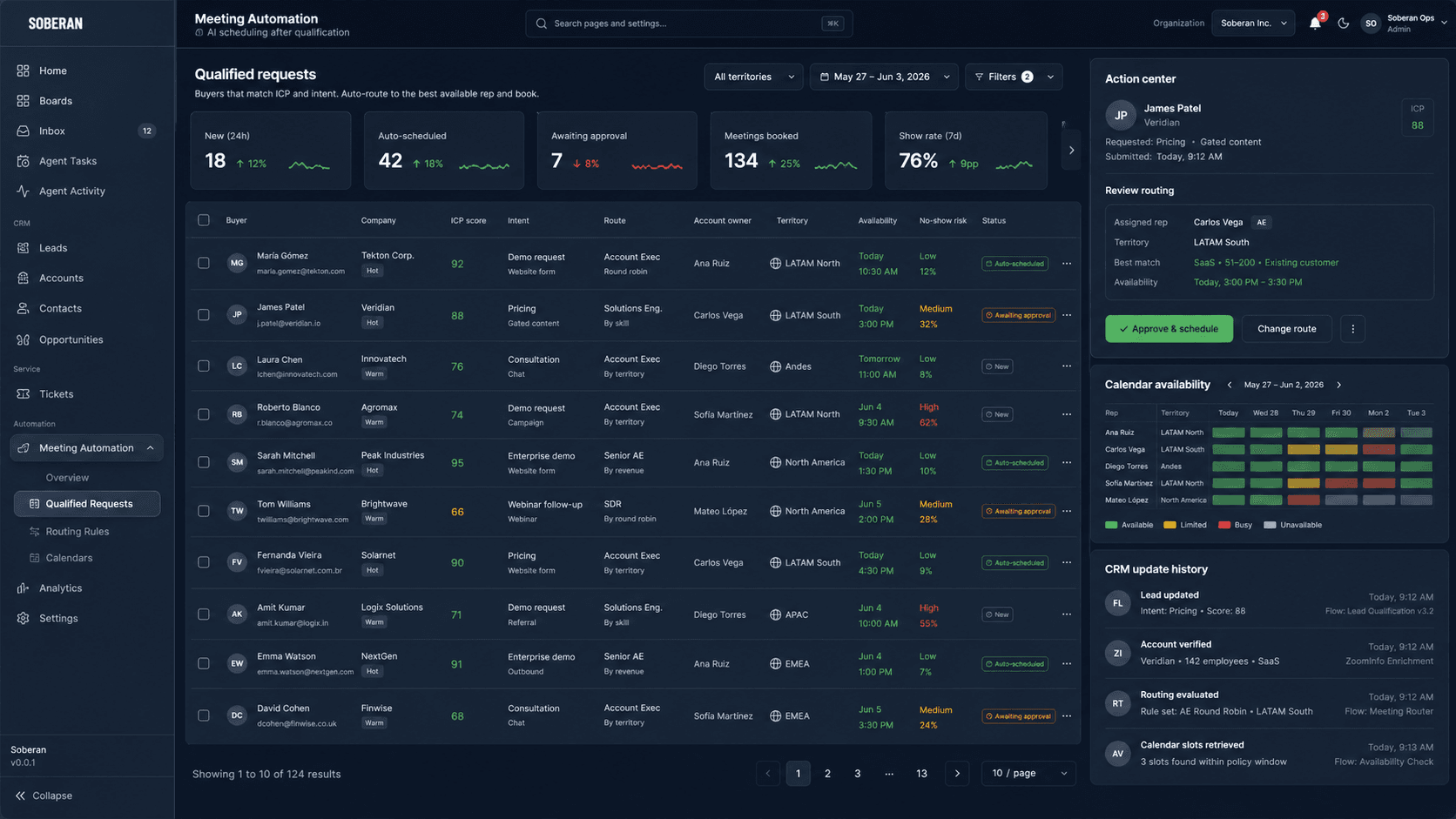
The answer: automate the post-qualification scheduling loop
The best first workflow is the moment after a form, WhatsApp conversation, call, or campaign response becomes qualified enough for a meeting. The agent should decide whether the buyer is eligible to book, which team should receive the meeting, what calendar rules apply, what prep context must travel with the invite, and what happens if the buyer reschedules or no-shows.
Buyer intent usually comes from revenue operations, demand generation, SDR leaders, and sales managers who already have forms and booking links but still lose speed through round-robin exceptions, account ownership conflicts, territory mismatch, missing context, and poor follow-up after a missed meeting.
Concrete workflow to automate first
- Capture the request source, campaign, product interest, company size, region, urgency, account status, prior owner, and consent state.
- Check qualification rules before exposing calendars: ICP fit, existing customer status, deal stage, partner conflict, support request, duplicate account, and disqualification reason.
- Match the buyer to a calendar by territory, segment, product specialty, named-account owner, language, availability, workload, and escalation policy.
- Offer approved time slots, create the invite, attach meeting context, notify the internal owner, and schedule reminders through the right channel.
- Detect no-show and reschedule risk from source, time-to-meeting, previous attendance, missing prep fields, and buyer engagement after booking.
- Update CRM with meeting type, owner, source, qualification evidence, no-show status, reschedule reason, next task, and audit history.
Competitor landscape
- 01
Calendly
Form-to-calendar scheduling automationCalendly positions its routing capability around qualifying visitors, matching known leads or customers from Salesforce and HubSpot, and booking the right person on the spot.
- Best for
- Teams that need fast website scheduling, simple qualification forms, and CRM ownership lookup without replacing their sales stack.
- Note
- For governed AI scheduling, inspect how exceptions, no-show recovery, consent, and downstream CRM updates are controlled after the meeting is booked.
- 02
Chili Piper Concierge
Inbound conversion and meeting bookingChili Piper describes Concierge as a way to qualify, route, and schedule meetings from web forms and other demand sources, with emphasis on speed-to-lead and show rate.
- Best for
- Revenue teams optimizing inbound conversion, web-form scheduling, account matching, and sales team distribution rules.
- Note
- Buyers should validate how account exceptions, regional rules, human approval, and CRM evidence packets behave when qualification is handled outside the core CRM.
- 03
HubSpot Meetings
CRM-connected meeting schedulerHubSpot describes meeting scheduling that syncs with Google and Office 365 calendars and helps teams book meetings through shareable scheduling links.
- Best for
- Sales teams already standardized on HubSpot that want lightweight calendar booking tied to CRM activity.
- Note
- HubSpot can reduce booking friction, but teams should still define routing governance, no-show recovery, and handoff rules for complex buying motions.
- 04
SOBERAN
AI scheduling tied to qualification, CRM, and operating policySOBERAN connects qualification evidence, account context, calendar rules, owner assignment, reminder policy, and CRM updates in one governed scheduling loop.
- Best for
- B2B teams that need meeting automation to respect account ownership, regional coverage, language, specialty, and auditability.
- Note
- Use SOBERAN when the problem is not creating a calendar link, but converting qualified demand into the right meeting with clean records and recoverable no-shows.
Operating model, governance, and metrics
- Operating model: demand generation owns source and qualification context, sales operations owns routing policy, sales leaders own capacity and ownership rules, and reps own meeting outcomes.
- Governance: require human review for enterprise accounts, named-account conflicts, partner-sourced opportunities, regulated buyer data, unusual meeting requests, and repeated no-shows before automated reassignment.
- Metrics: speed to book, qualified request to meeting conversion, show rate, reschedule rate, calendar utilization, incorrect-owner rate, no-show recovery rate, CRM completeness, and sourced opportunity conversion.
- How SOBERAN fits: SOBERAN treats scheduling as an operating workflow connected to CRM, calendars, WhatsApp, email, voice, routing policy, reminders, and audit history.
- Internal links to prioritize: /automate/meeting-scheduling, /automate/lead-qualification, /automate/inbound-lead-conversion, /crm, and /how-it-works.
Sources and trend signals
- McKinsey: B2B buyers reset the barMcKinsey’s 2026 B2B research highlights AI-enabled personalization, engagement, conversion, sales governance, and measurable impact as linked growth levers.
- McKinsey: unlocking gen AI in B2B salesMcKinsey frames gen AI for B2B selling around profitable growth, seller productivity, internal process streamlining, and tightly linked business and technology teams.
- Calendly routing pageOfficial Calendly page used to verify qualification, CRM lookup, and immediate scheduling positioning.
- Chili Piper Concierge pageOfficial Chili Piper page used to verify inbound qualification, routing, scheduling, conversion, and show-rate claims.
- SOBERAN meeting scheduling automationInternal SOBERAN use case page for calendar coordination, CRM updates, and meeting operations.