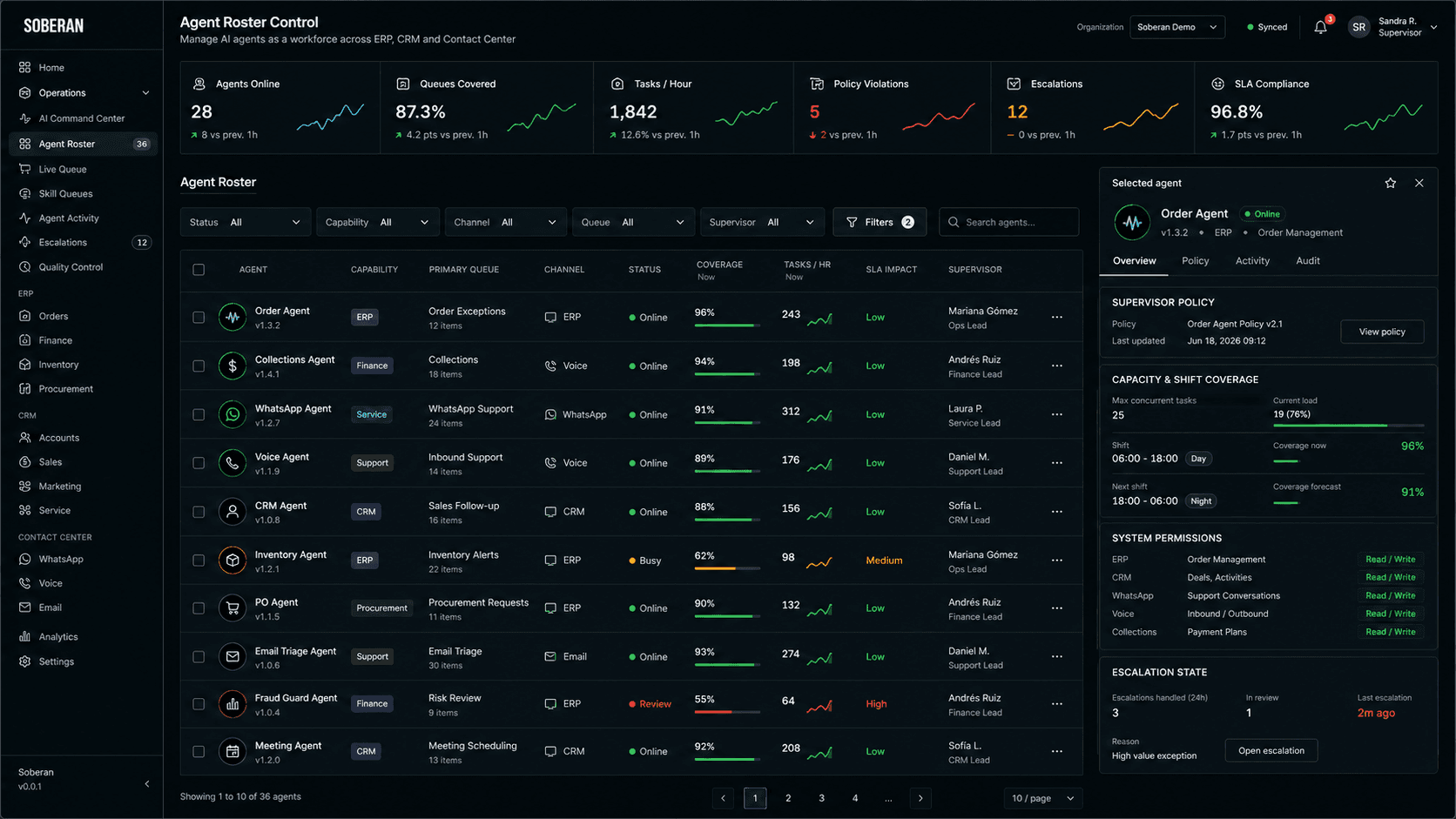
The answer: manage agents as a roster, not as unlimited automation
A fresh market signal is forming around AI agents as labor. Business Insider reported that McKinsey described a workforce model with tens of thousands of personalized agents working alongside people. The Financial Times reported Accenture leadership saying HR teams may need to manage AI agents as well as human staff, including onboarding and training. SAP positions Joule Agents and SAP AI Agent Hub around context-aware agents, a unified view of agents in use, governance, adoption, ROI, and business impact. ITPro's coverage of Oracle Fusion Agentic Applications points to agent teams with their own role, authority, expertise, and security guardrails inside enterprise applications. Recent research on delegated execution observability argues that standard logs can fail to show which delegated agent actually did what across tools.
The practical point for SOBERAN buyers is direct: do not treat agent capacity as infinite just because software can run all day. Every agent that touches ERP, CRM, contact-center, finance, procurement, collections, WhatsApp, or voice work needs a roster entry with a queue, supervisor, permission set, capacity limit, escalation rule, and measurable shift result.
What operators should do differently
Stop asking only whether the agent can answer, search, summarize, or update a record. Those are technical abilities. The operating question is whether the agent can be scheduled into a business queue without hiding responsibility. A supervisor should be able to open the roster and see which agent is covering order exceptions, which one is handling WhatsApp service, which one is preparing payment-plan follow-up, which one is cleaning CRM records, and which actions are waiting for human review.
A roster makes AI manageable because it turns autonomy into assigned work. It defines when the agent is active, what load it can carry, which policies apply, which systems are read-only or read-write, what happens when confidence drops, and who owns the result when a customer, invoice, order, or opportunity is affected.
Workflows to roster first
- WhatsApp and voice service coverage where agents answer order status, delivery changes, warranty questions, returns, refunds, and billing requests only when ERP and CRM evidence is current.
- Collections shifts where agents prioritize overdue accounts, validate payment-plan policy, record promises, schedule follow-up, and send disputes to a finance owner with evidence.
- Order exception coverage where agents prepare actions for allocation gaps, credit holds, address issues, substitution options, and shipment delays without bypassing approval thresholds.
- CRM hygiene coverage where agents resolve duplicates, enrich missing fields, assign account responsibility, and propose updates that sales operations can accept or reject.
- Procurement and invoice shifts where agents compare purchase order, receipt, supplier confirmation, tolerance policy, tax data, and payment status before recommending action.
- Sales follow-up coverage where agents convert missed interactions, stale opportunities, service signals, and recent account activity into next actions for CRM owners.
Buyer intent: ask to see the roster sheet
A COO, CFO, head of customer experience, RevOps lead, ERP owner, CRM owner, collections leader, or contact-center director should ask vendors for the roster sheet before approving production. The sheet should show every active agent, primary queue, backup queue, supervisor, allowed systems, read-write permissions, policy version, current load, SLA exposure, and exception path.
For a contact-center agent, the roster should show whether it can answer in WhatsApp, voice, email, or chat; whether it can update CRM cases; whether it can read ERP order state; and when a human must approve the reply. For a finance agent, the roster should show which receivables actions it can prepare, which payment terms are blocked, and which disputes go to a named finance owner. For an ERP agent, the roster should show exactly which fields it may propose changing and which changes require approval.
Operating model and governance
- Roster owner: one business leader owns the roster for a function, and every agent has a named supervisor and backup supervisor.
- Queue assignment: agents are assigned to specific queues such as order exceptions, CRM hygiene, WhatsApp service, voice support, collections, procurement, or invoice review.
- Capacity limit: each agent has a maximum concurrent workload, priority rule, retry limit, and pause condition so automation does not create hidden backlog.
- Permission map: ERP, CRM, contact-center, finance, procurement, inventory, and channel actions are marked as read-only, prepare, execute, or blocked.
- Policy version: every action ties back to the policy version used at decision time, including approval thresholds and customer communication rules.
- Supervisor review: refunds, discounts, credit changes, payment terms, sensitive messages, supplier changes, and customer-impacting commitments route to a person.
- Delegation trace: the audit record identifies the agent, the supervisor, the delegated task, the evidence used, the action attempted, and the system state after completion.
KPIs that prove the roster is working
- Coverage rate by queue, channel, and shift.
- Capacity utilization without SLA deterioration.
- Average age of unresolved exceptions.
- Human review acceptance rate and rejection reasons.
- ERP and CRM update acceptance rate.
- Repeat contact rate after AI-assisted service.
- Promise-to-pay kept rate and dispute escalation quality.
- Unauthorized action attempts, policy violations, reversals, and customer-impact incidents.
- Supervisor time spent on review versus manual triage.
How SOBERAN fits
SOBERAN fits when the buyer wants agents to work inside operating queues instead of floating above the business. The platform connects ERP, CRM, contact center, WhatsApp, voice, finance, procurement, inventory, policies, approvals, and audit history so each agent has a defined assignment and a visible result.
For LatAm mid-market operators, the roster matters because demand is uneven. WhatsApp spikes after a campaign, voice queues peak around delivery exceptions, collections cycles move by calendar, and finance work clusters around close. SOBERAN gives teams a way to assign agents to those queues with capacity controls, supervisor review, evidence, and system updates rather than buying a broad AI assistant and hoping work stays controlled.
The starting point is narrow: choose one queue, define the roster entry, connect the evidence, set the permission map, name the supervisor, and measure one KPI. Expand only after the roster shows that the agent improved coverage without increasing risk.
SOBERAN pages to connect this work
- AI automationUse this page for the broader agent execution layer across systems, approvals, and audit.
- Contact centerConnect agent rosters to WhatsApp, voice, service, collections, and customer-operation coverage.
- WhatsApp customer service automationRoster WhatsApp service agents around order status, returns, warranty, billing, and escalation queues.
- Inbound phone support automationDefine voice-agent capacity, review rules, CRM updates, and ERP evidence checks.
- ERPTie rostered agents to order, inventory, finance, procurement, and exception work in systems of record.
- CRMControl customer records, cases, opportunities, activity updates, and sales follow-up.
- AI collections automationApply roster controls to payment promises, payment-plan policy, disputes, and finance updates.
- CRM data hygiene automationAssign data-quality agents to duplicate resolution, missing fields, owners, and accepted updates.
Sources and trend signals
- Business Insider: McKinsey's CEO on AI reshaping its workforceUsed for the signal that large firms are starting to staff human work alongside large numbers of AI agents.
- Financial Times: HR must manage AI bots as well as humans, says Accenture executiveUsed for the leadership signal that agents require onboarding, training, and organizational ownership.
- SAP: Joule Agents and SAP AI Agent HubUsed for the enterprise signal around context-aware agents, central agent visibility, governance, adoption, ROI, and business impact.
- ITPro: Oracle Fusion Agentic ApplicationsUsed for the signal that enterprise suites are packaging agent teams with defined roles, authority, expertise, and security guardrails.
- arXiv: Observability for Delegated Execution in Agentic AI SystemsUsed for the research signal that standard traces can miss delegation context across tools, which makes roster-level attribution important.