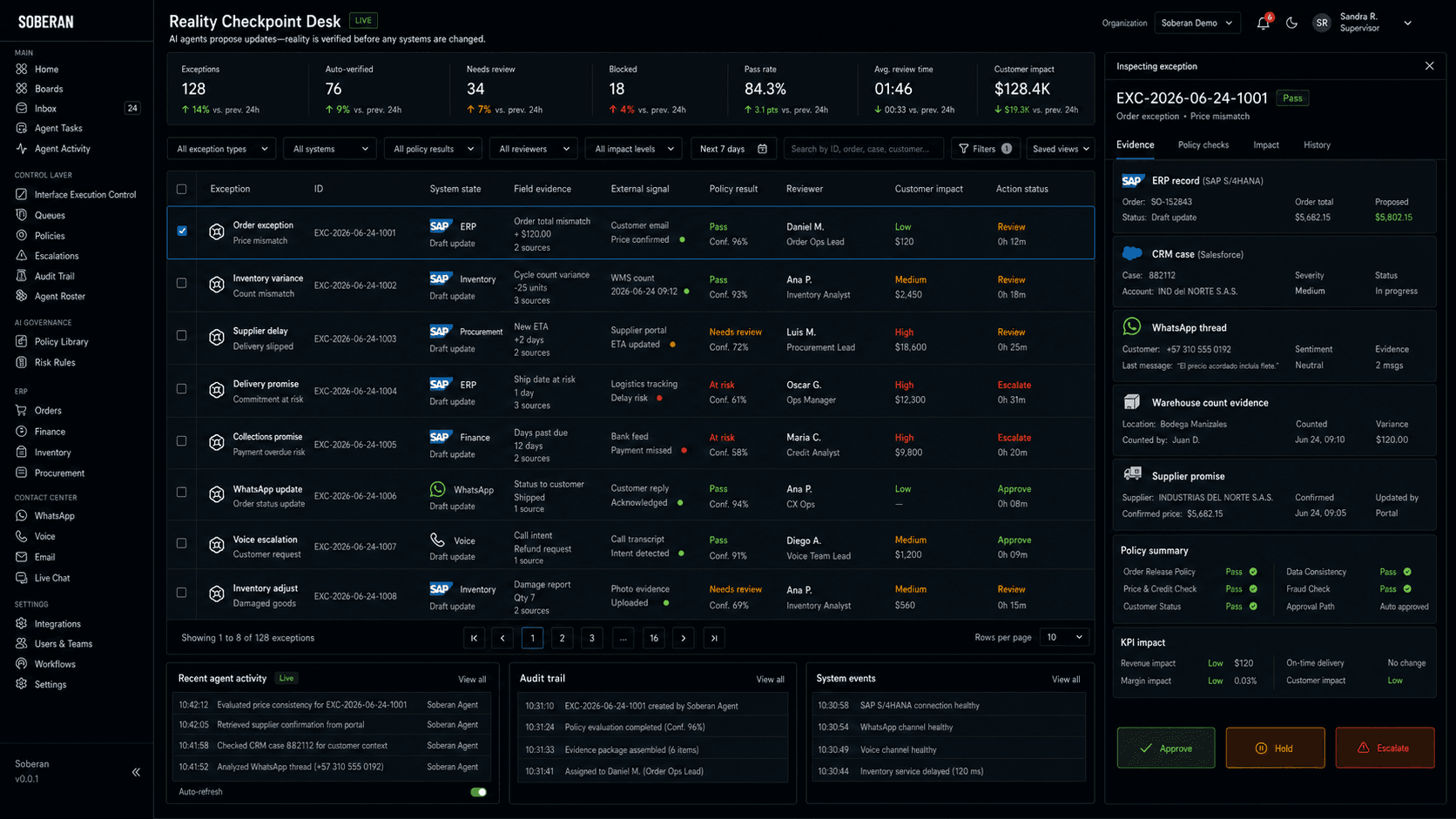
The answer: add a reality checkpoint
The external signal is clear. Enterprise AI agents are being positioned to coordinate work across systems, but high-authority coverage keeps returning to the same limit: supply chains, customer operations and finance processes still depend on messy physical events, partner updates, exceptions and human trade-offs. TechRadar Pro warned that agents should not be trusted to run supply chains without human oversight. SAP is positioning Joule agents and SAP AI Agent Hub around business context, governance, trusted data and cross-application action. WSJ coverage of SAP's automation suite reinforces the market direction: ERP vendors are moving toward autonomous enterprise execution, not just assistant features.
For SOBERAN buyers, the operating point is specific. The agent should not send a WhatsApp delivery update, release an order, change a CRM case, adjust inventory, escalate a supplier delay or propose a collections action until it has passed a reality checkpoint: system state, physical or partner evidence, policy result, customer impact, responsible reviewer and audit trail.
What operators should do differently
Stop treating ERP truth as complete truth. ERP, CRM and contact-center systems often know what was entered, not what is happening. The warehouse count may be late. The supplier promise may be informal. A carrier exception may sit outside the ERP. A customer may have changed the delivery priority in WhatsApp. A finance hold may be visible in one screen but not reflected in the sales workflow.
The better move is to make every agent action prove its operating context before the system update. That means the agent shows the record it read, the outside signal it used, the policy it applied, the customer or cash impact, the reviewer path and the final update it wants to make. If one of those pieces is missing, the agent can draft, summarize or escalate, but it should not close the action automatically.
Workflows where checkpoints matter
- Order exceptions where the agent checks available stock, credit status, warehouse confirmation, promised ship date, carrier risk and customer priority before updating the customer.
- Inventory variance closure where the agent reconciles ERP quantity, WMS movement, cycle count photo or scan evidence, location ownership and finance impact before posting an adjustment.
- Supplier delay management where procurement needs PO state, supplier message, alternate vendor options, production impact and customer exposure before changing promised dates.
- WhatsApp service updates where the agent should compare customer intent with ERP order status, CRM case history, policy language and delivery evidence before responding.
- Voice support or collections calls where the agent needs consent, balance, promise history, payment status, dispute flags and supervisor rules before recording a commitment.
- Invoice exception handling where AP needs PO, receipt, tax data, tolerance result, supplier evidence and approval owner before releasing or rejecting the invoice.
- Sales follow-up where CRM timing, quote status, inventory availability, price validity and service history should shape the next message.
Buyer intent: ask what evidence blocks autonomy
Buyers should ask vendors to show the checkpoint, not only the agent answer. Which fields must be present before autonomy is allowed? Which outside signals can block the update? What happens when supplier data conflicts with ERP state? Can the supervisor see the evidence, policy and proposed record change in the same view? Does the agent know when to hold the action instead of forcing resolution?
This is especially important for LatAm mid-market operators because operational data often lives across ERP, spreadsheets, WhatsApp, voice notes, local tax documents, supplier portals, payment providers and warehouse practices. The agent's value is not only speed. It is knowing when the business record is not ready to be changed.
Operating model and governance
- Define required evidence by queue: ERP record, CRM case, channel transcript, warehouse confirmation, supplier message, payment state or approval document.
- Separate safe actions from checkpoint actions: read, draft and summarize can happen earlier; system changes need a complete evidence set.
- Assign one responsible team for each checkpoint so exceptions do not drift between operations, sales, finance, procurement and customer service.
- Create hold reasons that agents can use consistently: missing evidence, conflicting dates, stale stock, policy breach, customer risk, cash impact or reviewer required.
- Log the full action chain: source record, external signal, policy result, reviewer, customer message, system update and KPI outcome.
- Review checkpoint failures weekly to find the data gaps that should become integrations, policy rules or cleaner operating routines.
- Expand autonomy only after the checkpoint shows fewer conflicts, faster resolution and lower correction volume.
KPIs that prove the checkpoint works
- Autonomous update rate after evidence completeness is met.
- Hold rate by missing evidence type: stock, supplier, payment, customer, approval or policy.
- Exception cycle time from detection to safe system update.
- Correction rate after agent-updated ERP, CRM or contact-center records.
- Customer-impact metrics: repeat contact, delivery accuracy, promise kept, complaint rate and case reopening.
- Finance-impact metrics: invoice holds cleared, credit releases, collection promises kept and adjustment reversals.
- Audit completeness: record, evidence, policy, reviewer, update and KPI outcome attached to each action.
Risks to govern
The first risk is premature confidence. An agent can make a clean decision from stale ERP data and still damage the customer promise. The second risk is silent conflict: supplier, warehouse, payment or customer evidence disagrees with the system, but the agent treats the system value as final. The third risk is automation theater, where a human still repairs bad updates after the agent marks the work complete.
The checkpoint reduces those risks by making uncertainty visible. It does not stop automation. It gives operators a controlled path for deciding when the agent can act, when it should draft, when it should ask for evidence and when it should escalate.
How SOBERAN fits
SOBERAN fits when the buyer needs agents that operate across ERP, CRM, contact center, WhatsApp, voice, procurement, finance, inventory and documents without losing operating discipline. A SOBERAN deployment can make the reality checkpoint visible in one work surface: source record, evidence, policy, reviewer, proposed update, customer message and KPI impact.
That is the practical bridge for LatAm mid-market teams. SOBERAN can start with high-friction queues such as order exceptions, inventory variance, supplier follow-up, invoice holds, WhatsApp service, collections promises and sales follow-up, then expand autonomy only where the checkpoint proves the action is complete enough to update the system.
Sources and trend signals
- TechRadar Pro: AI agents shouldn't run your supply chainUsed for the current supply-chain signal: agentic automation can help operations, but physical constraints, exceptions and human trade-offs still require operating oversight.
- SAP: Joule Agents and SAP AI Agent HubUsed for the enterprise-agent signal around business context, trusted data, governance, cross-application action and centralized agent visibility.
- WSJ: SAP launches unified AI automation suiteUsed for the high-authority ERP market signal that major enterprise software vendors are moving toward autonomous automation suites.
- a16z: Big Ideas 2026, the enterprise orchestration layerUsed for the market context that enterprise AI is moving from isolated copilots toward orchestration layers that coordinate work across teams and tools.
- arXiv: Flowr, advanced agentic workflow automation for supply-chain operationsUsed for the research signal that agentic supply-chain automation needs multi-step operational reasoning, workflow execution and measurable performance controls.
- McKinsey: The State of AI in 2025Used for the broad adoption-and-scaling signal: value depends on workflow redesign, human validation and KPI tracking, not just model availability.