The answer: automate the quality evidence loop
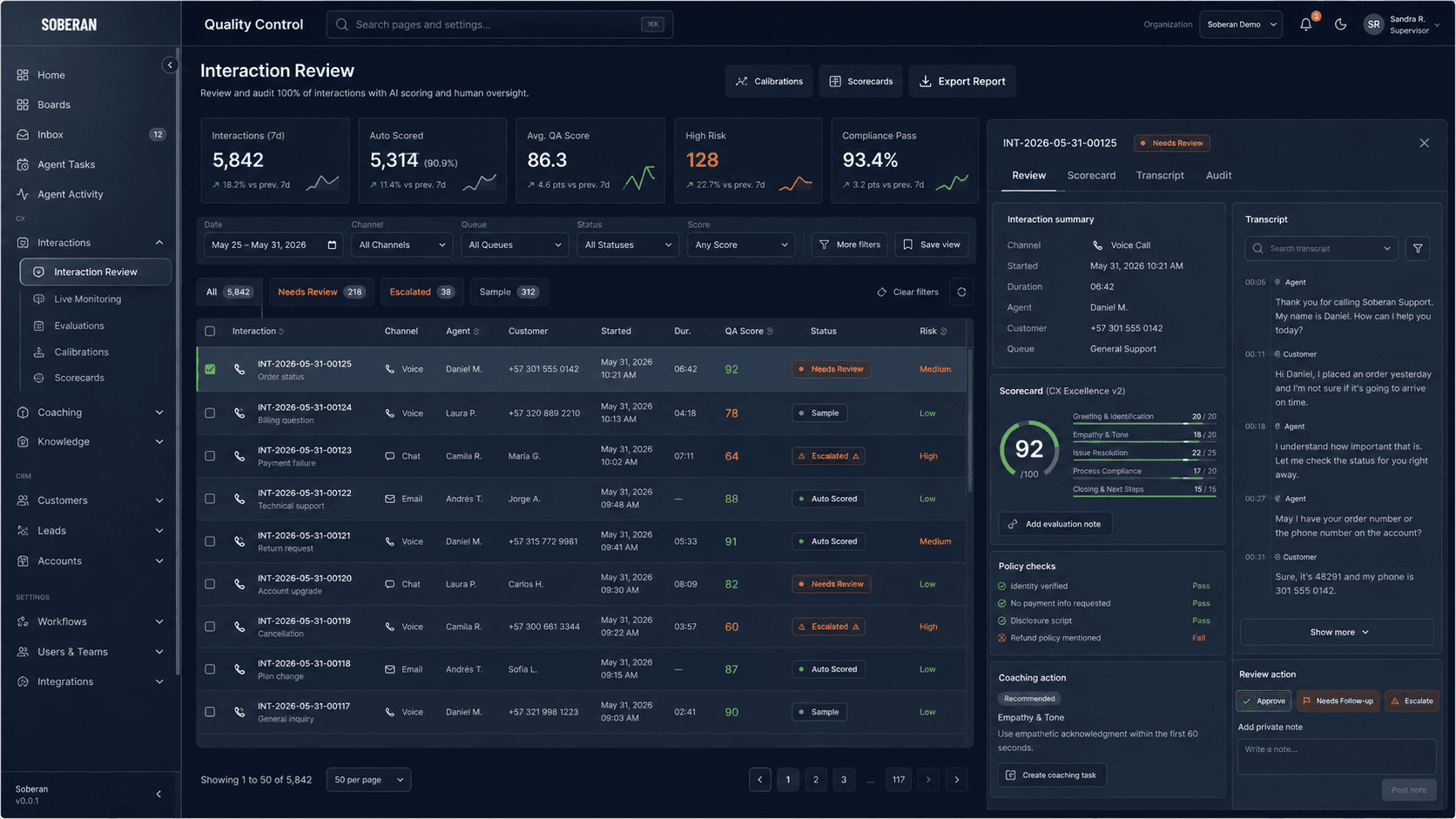
The first workflow to automate is not the final score. It is the evidence packet behind the score: transcript, policy rule, customer sentiment, required disclosure, resolution quality, escalation reason, and supervisor calibration state. The agent should show why an interaction passed or failed before it changes a QA record.
Buyer intent sits with customer experience leaders, contact center directors, QA managers, compliance teams, and BPO operators that need broader coverage without losing human review over sensitive interactions.
Concrete workflow to automate first
- Ingest interactions from voice, chat, email, WhatsApp, CRM, ticketing, and call recording systems with consent and retention metadata attached.
- Classify interactions by channel, queue, customer intent, agent, risk, language, policy scope, sentiment, and whether a human review is mandatory.
- Apply the approved scorecard: greeting, identity verification, empathy, product accuracy, disclosure, resolution, next step, escalation, and closing quality.
- Generate an evidence packet with transcript snippets, missing requirements, score rationale, confidence, review priority, coaching recommendation, and audit status.
- Route low-risk samples to auto-QA, send risky or contested results to supervisor review, and keep calibration history visible by team and evaluator.
- Create the coaching action, assign the responsible supervisor, record completion, and measure whether the same issue recurs in future interactions.
Competitor landscape
- 01
NICE Enlighten
Enterprise contact center AI and quality intelligenceNICE positions Enlighten around AI models for customer experience, interaction understanding, automation, and agent performance improvement.
- Best for
- Large contact centers standardized on NICE CXone or a broader NICE contact center stack.
- Note
- Evaluate how QA evidence, supervisor calibration, and coaching tasks move into the operating tools your team already uses.
- 02
Observe.AI
AI quality assurance for contact centersObserve.AI describes AI-powered QA that reviews interactions, automates evaluations, finds coaching opportunities, and supports compliance monitoring.
- Best for
- Contact centers that want a focused quality, conversation intelligence, and supervisor coaching layer.
- Note
- Ask how non-voice channels, CRM context, policy exceptions, and operational follow-up are handled outside the QA platform.
- 03
Calabrio Auto QM
Automated quality managementCalabrio markets Auto QM as automated interaction evaluation using analytics and quality management controls.
- Best for
- Teams already investing in workforce engagement management and quality management capabilities.
- Note
- Validate calibration transparency, escalation controls, multilingual coverage, and how coaching actions are tracked to closure.
- 04
SOBERAN
QA scoring connected to CRM, service, policy, and coaching executionSOBERAN connects interaction evidence, service context, policy rules, supervisor review, coaching tasks, and audit records in one operating flow.
- Best for
- Operators that need QA decisions to trigger real service, compliance, and team actions across mixed contact center and CRM systems.
- Note
- Use SOBERAN when the bottleneck is not scoring accuracy alone, but getting a governed coaching and compliance loop to run every day.
Operating model, governance, and metrics
- Operating model: separate scorecard ownership, policy ownership, supervisor calibration, coaching assignment, and compliance review so the AI agent does not become the policy maker.
- Governance: require human review for regulated disclosures, complaints, payment issues, vulnerable customers, legal language, escalations, low-confidence transcripts, and contested evaluations.
- Calibration: compare AI evaluations against supervisor samples by queue, language, agent tenure, policy area, and interaction type before expanding automation scope.
- Metrics: interaction coverage, evaluation turnaround time, calibration variance, coaching completion, repeat defect rate, compliance exception rate, customer sentiment, and supervisor review load.
- How SOBERAN fits: SOBERAN turns QA scoring into an operating loop: detect, explain, review, coach, record, and monitor recurrence across contact center and CRM data.
Sources and trend signals
- McKinsey - Contact center crossroadsTrend signal on balancing humans and AI in contact centers, including operating design and performance improvement.
- Gartner - AI agent governanceCurrent Gartner governance signal warning that agent controls should match autonomy level and operational risk.
- Observe.AI quality assuranceOfficial Observe.AI page for AI-powered contact center quality assurance, evaluations, coaching opportunities, and compliance monitoring.
- Calabrio Auto QMOfficial Calabrio page for automated quality management and interaction evaluation.
- SOBERAN QA call scoring automationMatching SOBERAN use-case page for QA, call scoring, contact center quality, coaching, and audit controls.
- SOBERAN contact centerRelated internal page for contact center automation across voice, WhatsApp, chat, email, policy, and service execution.