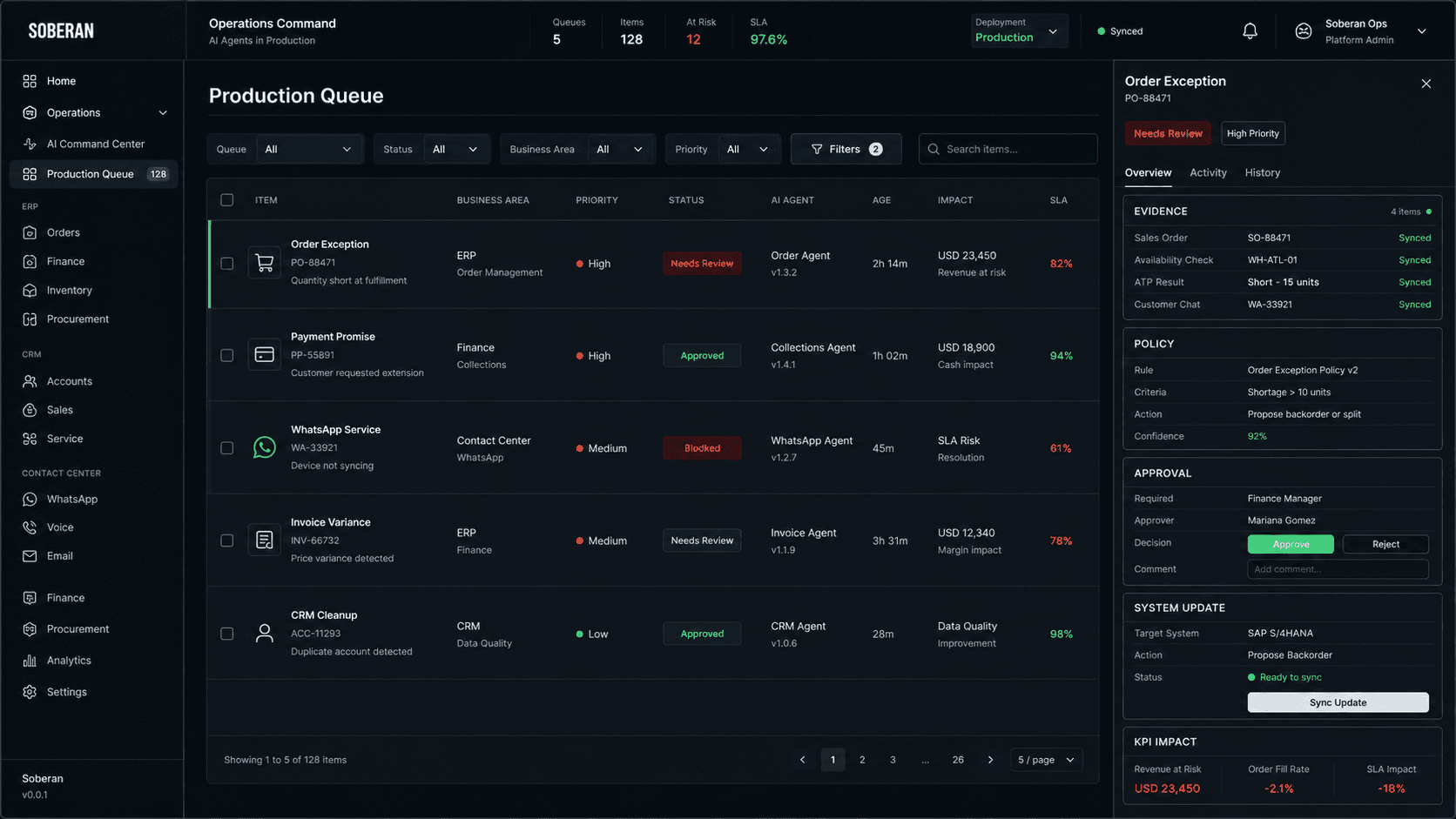
The answer: deploy agents by production queue, not by platform promise
Recent signals show the tension clearly. TechRadar coverage of enterprise operating models points to a gap between AI access and AI embedded in workflows, citing McKinsey, MIT, and HBR-adjacent research on broad experimentation but limited workflow integration. A separate TechRadar Pro perspective on live operations argues that agents require decision boundaries, orchestration, intervention points, accountability, policy enforcement, and monitoring as they move into real work. SAP positions Joule Agents around context-aware workflows, business process grounding, governance, and cross-functional execution. Google Cloud is pushing the agentic enterprise and Gemini Enterprise as a way to build, deploy, manage, audit, and orchestrate agents across systems. At the same time, Business Insider reports that Accenture leaders say enterprise AI scaling will take time, even as clients move beyond pilots into production.
The most operational signal comes from research on enterprise GUI agents. EntWorld, a 2026 benchmark spanning CRM, IT service, and ERP tasks, argues that enterprise systems have dense interfaces, strict business logic, and state-consistent information requirements that general agents still struggle with. That matters because many buyers are being sold agentic reach across every app, while the hard value sits in narrower operating queues where the state change can be verified.
What operators should do differently
Stop asking whether the agent can use the ERP, read CRM, answer WhatsApp, or summarize a service case in isolation. Those are capabilities, not operating outcomes. The better question is whether a named queue improves after the agent starts working: fewer aged exceptions, faster cycle time, cleaner records, more accepted updates, fewer repeat contacts, lower rework, and clearer accountability.
A production queue has a beginning, a responsible team, a policy, a target system state, an escalation rule, and a KPI. That makes it a better unit than a broad AI transformation program. It is small enough to govern, visible enough to improve weekly, and concrete enough for supervisors to audit.
The first queues to put into production
- Order exceptions where the agent detects allocation gaps, blocked shipments, address issues, substitution options, or credit holds, then prepares the next action and customer update.
- WhatsApp and voice service queues where the agent answers only after checking ERP order status, CRM account history, delivery evidence, warranty policy, and escalation thresholds.
- Collections queues where the agent prioritizes overdue accounts, validates payment-plan policy, records promises, schedules follow-up, and escalates disputes with evidence.
- Invoice and procurement exceptions where the agent compares purchase order, receipt, supplier confirmation, tolerance policy, tax data, and payment status before recommending action.
- CRM hygiene queues where the agent merges duplicates, enriches missing fields, assigns a responsible person, and proposes updates without overwriting commercial judgment.
- Sales follow-up queues where the agent turns missed interactions, stale opportunities, customer signals, and service context into next actions that CRM owners can accept or reject.
Buyer intent: ask to see the queue contract
A COO, CFO, head of customer experience, ERP owner, CRM owner, RevOps lead, or contact-center director should ask vendors for the queue contract before approving production. The contract should define the exact exception class, input evidence, source precedence, allowed actions, approval thresholds, target system update, customer communication rule, and KPI.
For an order exception queue, the contract might specify which ERP status fields the agent can read, which delivery events count as evidence, when finance must approve, when the customer can be notified, and what creates a supervisor task. For a CRM hygiene queue, it might define source priority, duplicate confidence, accepted updates, rejected updates, and the responsible person who owns final approval. For collections, it might define allowed payment terms, dispute language, consent, follow-up timing, and finance status updates.
Operating model and governance
- Queue owner: every production queue has a named business owner and backup owner, not only an IT sponsor.
- Source precedence: ERP, CRM, contact-center, finance, procurement, inventory, and channel data have explicit rules for which record wins when fields disagree.
- Allowed action map: the agent knows which actions it may recommend, prepare, execute, or escalate, and which actions are blocked.
- Approval threshold: discounts, refunds, credit changes, delivery promises, payment terms, supplier changes, and sensitive customer messages require policy-based review.
- Verification rule: the queue counts work as completed only when the target state is visible in the system of record and the audit record ties back to evidence.
- Incident path: every queue has a pause, rollback, supervisor review, and customer-impact process before live volume expands.
KPIs that prove the queue is healthier
- Queue aging: exceptions past SLA, average age by reason, and oldest unresolved items.
- Cycle time: time from detection to recommendation, approval, system update, and customer communication.
- Acceptance rate: percentage of agent recommendations accepted by supervisors and system owners.
- State accuracy: accepted ERP and CRM updates, rejected updates, stale-data incidents, and mismatched records.
- Customer impact: repeat contact rate, first-contact resolution, promise-kept rate, dispute reopening, and escalation quality.
- Cost and risk: manual touches removed, rework avoided, policy violations, reversals, and exceptions reopened after closure.
How SOBERAN fits
SOBERAN is built for production queues across ERP, CRM, contact center, WhatsApp, voice, finance, procurement, inventory, sales operations, and customer operations. The agent is not a detached chat layer. It works in the queue where the exception, evidence, policy, approval, system update, customer message, owner, and KPI stay connected.
That is the practical path for LatAm mid-market operators. The goal is not to automate every process at once. It is to put one painful queue into production, prove the state change, govern the risky actions, and expand only after supervisors can see that the queue is getting cleaner, faster, and safer.
Sources and trend signals
- TechRadar Pro: How AI is exposing enterprise operating modelsUsed for the signal that AI access is widespread but workflow integration remains limited; the operating-model gap matters more than tool availability.
- TechRadar Pro: AI agents in live operations require new standards and managementUsed for the live-operations signal around decision boundaries, orchestration, accountability, policy enforcement, monitoring, and bounded autonomy.
- SAP: Joule Agents and Joule AssistantsUsed for SAP's official positioning around context-aware agents, business process grounding, governance, trusted data, and cross-functional workflows.
- TechRadar Pro: Google Cloud hails the agentic enterpriseUsed for the Google Cloud signal that enterprises are moving from AI experiments toward real implementation, with culture, responsibility, and human accountability still central.
- Business Insider: Accenture CEO says AI transformation will take some timeUsed for the market tension that large AI transformation demand exists, but scaling from pilots into production is slower and more operationally demanding than the hype suggests.
- arXiv: EntWorld benchmark for verifiable enterprise GUI agentsUsed for the research signal that ERP and CRM tasks require strict business logic, dense interfaces, and deterministic state-transition verification that general agents still struggle to satisfy.