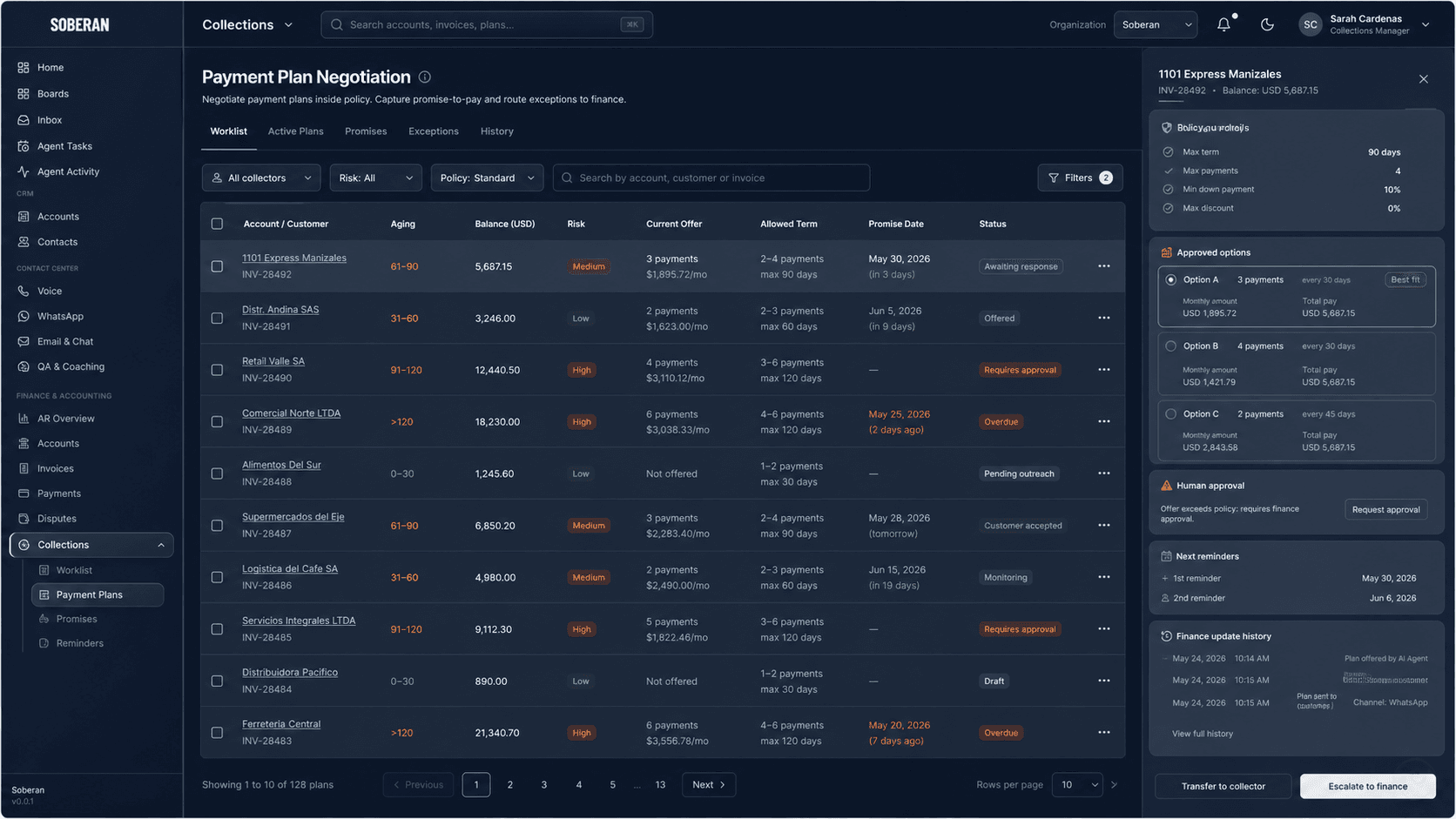
The answer: automate the policy decision before the conversation
The useful pattern is an AI agent that reads balance, aging, risk, dispute status, customer history, consent, and channel policy before offering terms. The agent proposes only approved options, captures the accepted plan, routes hardship or exception cases to finance, and updates AR with the offer history.
Buyer intent is strongest when collections leaders want more payment plans without giving every collector discretion to improvise discounts, due dates, and follow-up commitments.
Concrete workflow to automate first
- Segment accounts by balance, aging bucket, risk, prior payment behavior, active dispute status, channel consent, and customer tier.
- Calculate allowed options from policy: down payment, number of installments, maximum term, minimum monthly payment, discount ceiling, and finance approval threshold.
- Run the conversation over WhatsApp, voice, email, or customer portal with approved language and a clear explanation of the available plan choices.
- Capture promise-to-pay details: amount, dates, channel, customer confirmation, failed payment rule, reminder schedule, and agreed consequence if the plan breaks.
- Route exceptions to a human when hardship, legal language, identity uncertainty, disputed invoice, high-value account, or out-of-policy term appears.
- Update AR, CRM, billing, and service records with the proposed plan, accepted plan, reminder status, first payment, missed payment, and escalation reason.
Competitor landscape
- 01
HighRadius Credit and Collections
Autonomous receivables and collections automationHighRadius positions agentic AI for collections decisions, including escalation, payment plan offers, rerouting, and receivables prioritization.
- Best for
- Enterprise AR teams standardizing credit, collections, deductions, and invoice-to-cash workflows on a finance platform.
- Note
- Validate how payment-plan policy limits, hardship exceptions, and non-email channels are governed.
- 02
Tesorio
AR automation and promise-to-pay extractionTesorio describes AI agents that draft collections follow-up, extract payment promises, manage dunning, and improve AR prioritization.
- Best for
- Finance teams that want AR visibility, payment follow-up, portal payments, and promise extraction in one receivables motion.
- Note
- Ask whether the system negotiates approved terms or mainly records promises and automates follow-up.
- 03
InDebted
Digital collections infrastructureInDebted markets modern collections infrastructure with payment-plan setup, customer self-service, and AI-led collections direction.
- Best for
- Organizations seeking outsourced or platform-led consumer collections infrastructure at scale.
- Note
- Confirm operating control, policy configuration, and how accepted terms return to billing and finance systems.
- 04
SOBERAN
Policy-based payment plan agent across finance and contact center systemsSOBERAN focuses on allowed-term calculation, channel execution, exception approval, reminders, payment monitoring, and finance record updates.
- Best for
- Operators that need WhatsApp, voice, CRM, billing, ERP, and collections status connected in one governed loop.
- Note
- The differentiator is policy-controlled negotiation with source-system updates, not a standalone dunning script.
Operating model, governance, and metrics
- Operating model: finance owns the policy table, collections owns conversation design, legal or compliance owns restricted language, and operations owns escalation SLAs.
- Governance: require human approval for hardship claims, disputed invoices, discounts above ceiling, long terms, vulnerable-customer signals, legal language, and high-value accounts.
- Metrics: promise-to-pay capture rate, first-payment success, broken-plan rate, recovery rate, days sales outstanding, collector touches per account, exception approval time, and writeback completeness.
- Quality controls: audit offers against policy, sample transcripts, compare accepted plans with AR records, monitor opt-out handling, and review every plan that breaks within the first payment cycle.
- How SOBERAN fits: SOBERAN can connect NetSuite, QuickBooks, Stripe, CRM, WhatsApp, voice, and service tools so the agent negotiates within policy and leaves finance with a complete record.
Sources and trend signals
- McKinsey - The contact center crossroadsTrend signal on the growing mix of AI and human work in contact centers where routine volume exceeds human capacity.
- Gartner - Customer service trendsAnalyst reference for customer service automation pressure, agentic AI, and changing customer expectations.
- CFPB - Debt collection communicationsOfficial regulatory reference for communication controls, opt-out methods, and consumer contact governance in US debt collection contexts.
- HighRadius Credit and CollectionsOfficial competitor page for AI-supported credit and collections decisions, including payment-plan and escalation language.
- TesorioOfficial competitor page for AR automation, AI collections follow-up, promise extraction, and cash visibility.
- SOBERAN payment plan negotiationMatching SOBERAN use-case page for policy-based payment plan negotiation, reminders, monitoring, and finance updates.