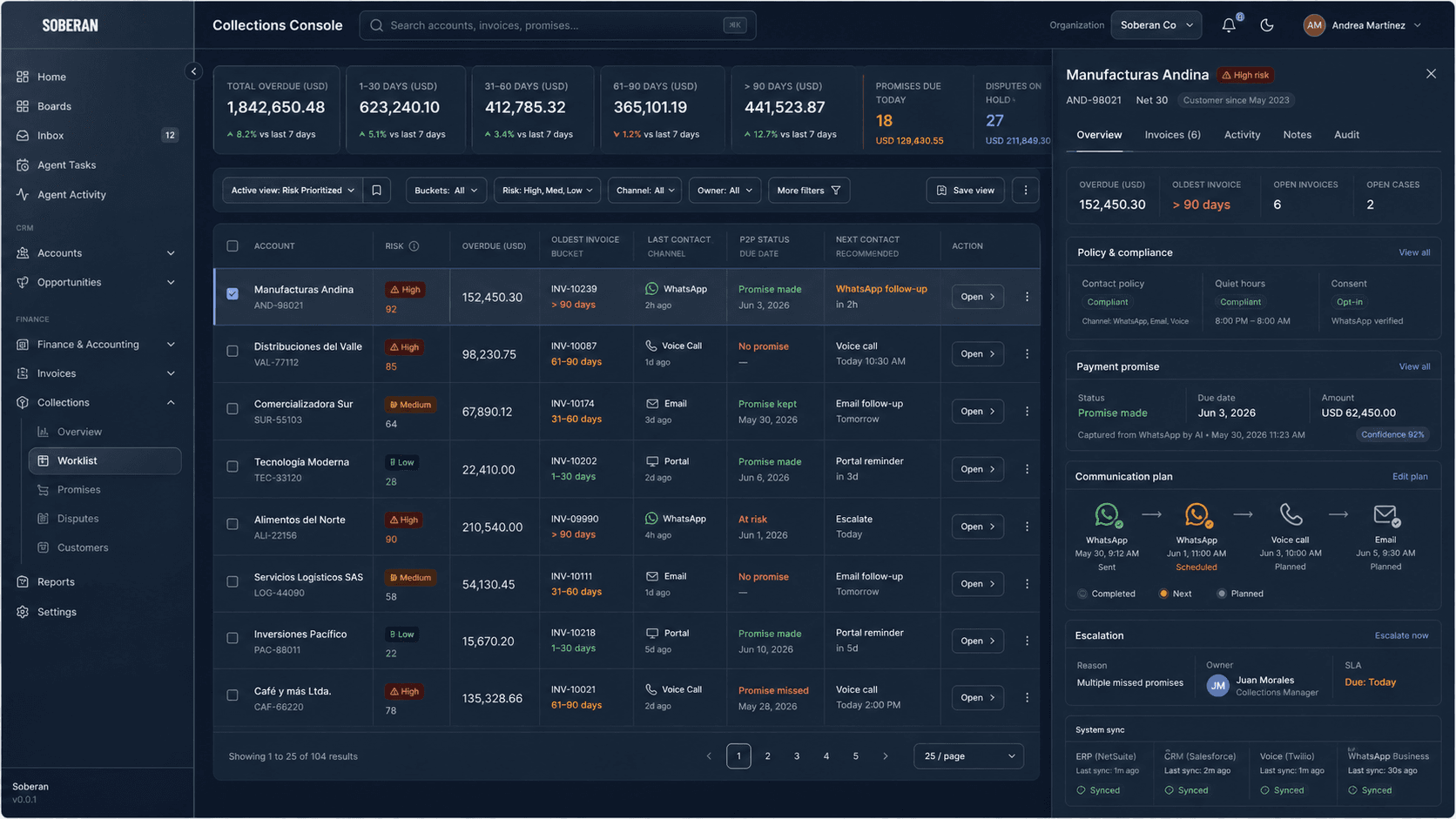
The answer: automate the next-best collections action, not the blast
The first workflow to automate is the daily collections worklist. The agent should decide which accounts need action today, why they rank above others, which channel is allowed, what policy applies, what message or call script is approved, and when a collector or finance manager must take over.
Buyer intent comes from AR leaders, finance operations, collections managers, and contact center teams that need better cash discipline without creating compliance risk or damaging customer relationships.
Concrete workflow to automate first
- Segment overdue accounts by aging bucket, amount, payment history, open disputes, customer value, channel preference, prior promises, risk, and legal or policy constraints.
- Prioritize the worklist by cash impact, days overdue, broken promise risk, contactability, dispute state, customer tier, and expected collector effort.
- Choose the next action: WhatsApp reminder, email follow-up, voice call, invoice resend, payment link, plan offer, receipt request, dispute intake, or human escalation.
- Apply channel policy, opt-in, quiet-hour rules, identity checks, approved language, and payment-plan limits before any outreach.
- Capture the outcome: promise date, promised amount, payment proof, dispute reason, no-response, hardship signal, callback request, or escalation reason.
- Update AR, ERP, CRM, voice, WhatsApp, and collector task records so the account history matches the customer conversation.
Competitor landscape
- 01
Tesorio Collections Agent
AI collections and AR automationTesorio describes AI-prioritized worklists, email triage, AI response drafting, promise-to-pay extraction, and escalation for at-risk invoices.
- Best for
- Finance teams focused on AR automation, collections email operations, risk prioritization, and promise tracking.
- Note
- Validate how voice, WhatsApp, regional policy, hardship handling, and dispute pauses are governed outside email-centric flows.
- 02
HighRadius Collections Automation
Autonomous receivables and collectionsHighRadius positions collections automation around AI agents, payment links, smart follow-up recommendations, risk prioritization, and autonomous receivables workflows.
- Best for
- Enterprise AR teams that want broad order-to-cash automation across collections, cash application, deductions, credit, and payments.
- Note
- Buyers should inspect day-to-day collector controls, local channel rules, and how disputed or sensitive accounts stop automation.
- 03
CFPB Regulation F
Regulatory communication referenceCFPB Regulation F gives official rules for debt collection communications, including electronic communication opt-out requirements and contact constraints.
- Best for
- US consumer debt contexts and compliance teams designing communication controls.
- Note
- B2B and LatAm teams still need their own legal review, but the operating lesson is universal: collections agents need channel, timing, and opt-out controls.
- 04
SOBERAN
Collections prioritization across AR, voice, WhatsApp, CRM, and policySOBERAN connects aging, payment history, policy, channel choice, promise capture, dispute pause, human escalation, and AR updates in one collections loop.
- Best for
- Finance and contact center teams that need compliant prioritization and structured outcomes across mixed channels.
- Note
- Use SOBERAN when the goal is not more contact volume, but higher-quality actions, cleaner records, and earlier escalation of risk.
Operating model, governance, and metrics
- Operating model: AR owns aging and payment policy, collections leaders own contact strategy, legal or compliance owns channel constraints, and finance managers own exceptions such as disputes and hardship.
- Governance: require human review for disputes, hardship language, legal threats, identity uncertainty, vulnerable customers, unusual terms, discount requests, and repeated broken promises.
- Metrics: cash collected per compliant contact, promise capture rate, promise kept rate, dispute pause accuracy, time to escalate, account aging movement, collector productivity, and writeback completeness.
- Buyer intent: teams evaluating this use case usually have stale aging reports, inconsistent follow-up, promises trapped in messages, and disputes that keep receiving the wrong reminders.
- How SOBERAN fits: SOBERAN turns collections into a governed operating loop: segment, prioritize, contact, capture outcome, pause or escalate, update AR, and audit every decision.
Sources and trend signals
- Tesorio Collections AgentOfficial Tesorio page for AI-prioritized collections worklists, email triage, promise extraction, and at-risk invoice escalation.
- HighRadius collections automationOfficial HighRadius page for collections automation, AI agents, follow-up recommendations, payment links, and autonomous receivables workflows.
- CFPB Regulation F communicationsOfficial CFPB rule page for debt collection communications, electronic opt-out requirements, and communication constraints.
- Gartner - AI agent governanceGovernance signal for matching agent controls to autonomy, access, compliance risk, and operational impact.
- SOBERAN AI collections automationMatching internal use-case page for segmentation, approved outreach, negotiation policy, promises, disputes, and AR updates.
- SOBERAN WhatsApp collectionsRelated internal page for collections over WhatsApp with policy, payment links, promises, dispute handling, and finance updates.