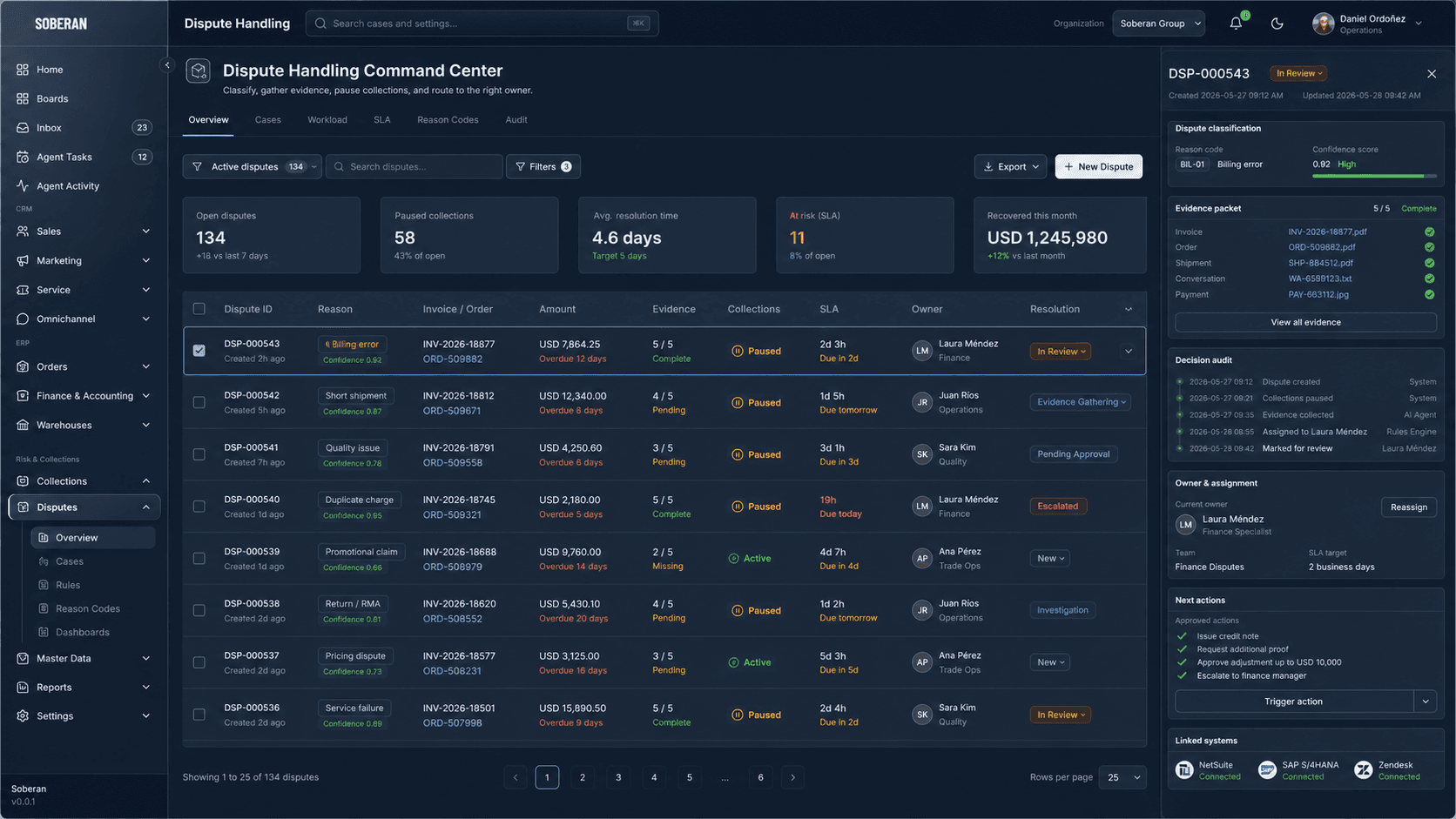
The answer: classify the reason and change the operating state
A useful dispute agent classifies the reason, retrieves invoice, order, shipment, payment, conversation, and service evidence, pauses inappropriate collections, assigns the right owner, and records every decision. The key is that a dispute is not just a message. It is a state change across finance and service operations.
Buyer intent is strongest when the current process relies on shared inboxes, spreadsheets, generic case queues, or collectors manually deciding whether an account should still be contacted.
Concrete workflow to automate first
- Detect dispute signals across WhatsApp, email, voice transcripts, tickets, payment portal notes, invoice inquiries, and collector conversations.
- Classify the reason code: billing error, duplicate charge, short shipment, damaged goods, quality issue, contract term, return, credit memo, tax issue, or service failure.
- Gather evidence from ERP, CRM, WMS, ecommerce, payment, ticketing, shipment, proof-of-delivery, and conversation systems before assigning the case.
- Pause the wrong collections motion when the dispute is valid or unresolved, while keeping undisputed invoices and payment plans active.
- Assign the case to finance, service, logistics, sales, or operations with SLA, evidence packet, value at risk, and recommended next action.
- Update dispute status, collections status, customer notes, resolution decision, adjustment request, credit memo, and audit trail after every step.
Competitor landscape
- 01
HighRadius Dispute Management
AI-based dispute and deductions automationHighRadius describes dispute intake, document linking, reason-code classification, ownership assignment, and ERP synchronization for dispute resolution.
- Best for
- Large AR, deductions, and order-to-cash teams with high-volume claims and complex receivables workflows.
- Note
- Validate whether the platform handles service disputes and customer conversations beyond finance-led deductions.
- 02
SAP Collections and Dispute Automation
Receivables management inside SAP S/4HANA CloudSAP documents collections and dispute automation for collecting receivables, handling financial disputes, and reducing the operational impact of outstanding receivables.
- Best for
- SAP-centered finance organizations that want dispute and collections process control inside S/4HANA Cloud.
- Note
- Ask how customer conversations, service evidence, logistics data, and non-SAP systems enter the case packet.
- 03
Salesforce Financial Services Cloud for Service
AI-assisted service and dispute lifecycle managementSalesforce positions intelligent dispute resolution and AI service agents for routine disputes, case management, and connected front-, middle-, and back-office work.
- Best for
- Service organizations already standardizing customer cases, data, and AI assistance in Salesforce.
- Note
- Confirm how invoice, shipment, and AR state changes are executed in ERP systems, not just summarized in CRM.
- 04
SOBERAN
Cross-system dispute agent with evidence and collections controlSOBERAN connects dispute classification, evidence retrieval, collections pause, owner assignment, and source-system updates across finance, service, and operations.
- Best for
- Physical-goods and service operators where disputes depend on ERP, shipment, payment, ticket, conversation, and customer context.
- Note
- The differentiator is turning a dispute into operational state across systems, not only creating a case.
Operating model, governance, and metrics
- Operating model: finance owns dispute policy and financial adjustments, service owns customer communication, operations owns delivery or quality evidence, and legal owns restricted categories.
- Governance: automatically pause collections only when reason, evidence, and policy meet thresholds; require human review for credits, refunds, contract changes, legal language, and high-value accounts.
- Metrics: dispute cycle time, evidence completeness, collections touches on disputed invoices, recovered invalid deductions, write-off rate, owner response SLA, repeat disputes, and decision audit completeness.
- Quality controls: sample reason-code accuracy, review false pauses, compare evidence packets with final decisions, monitor aging of unresolved disputes, and track whether customers repeat information after escalation.
- How SOBERAN fits: SOBERAN can pull invoice, order, shipment, payment, ticket, and conversation context into one case packet, change collections status, and assign accountable work with full audit.
Sources and trend signals
- SAP Collections and Dispute AutomationOfficial SAP reference for collections and dispute automation in receivables management.
- HighRadius Automated Dispute ManagementOfficial competitor page for AI-based dispute intake, document linking, reason classification, and ERP synchronization.
- Salesforce Financial Services Cloud for ServiceOfficial Salesforce page describing intelligent dispute resolution, AI service agents, and connected case management.
- Gartner - Customer service trendsAnalyst trend signal for automation, AI assistants, and customer service moving upstream into broader customer journeys.
- SOBERAN dispute handling automationMatching SOBERAN use-case page for dispute classification, evidence retrieval, collections pause, and owner assignment.