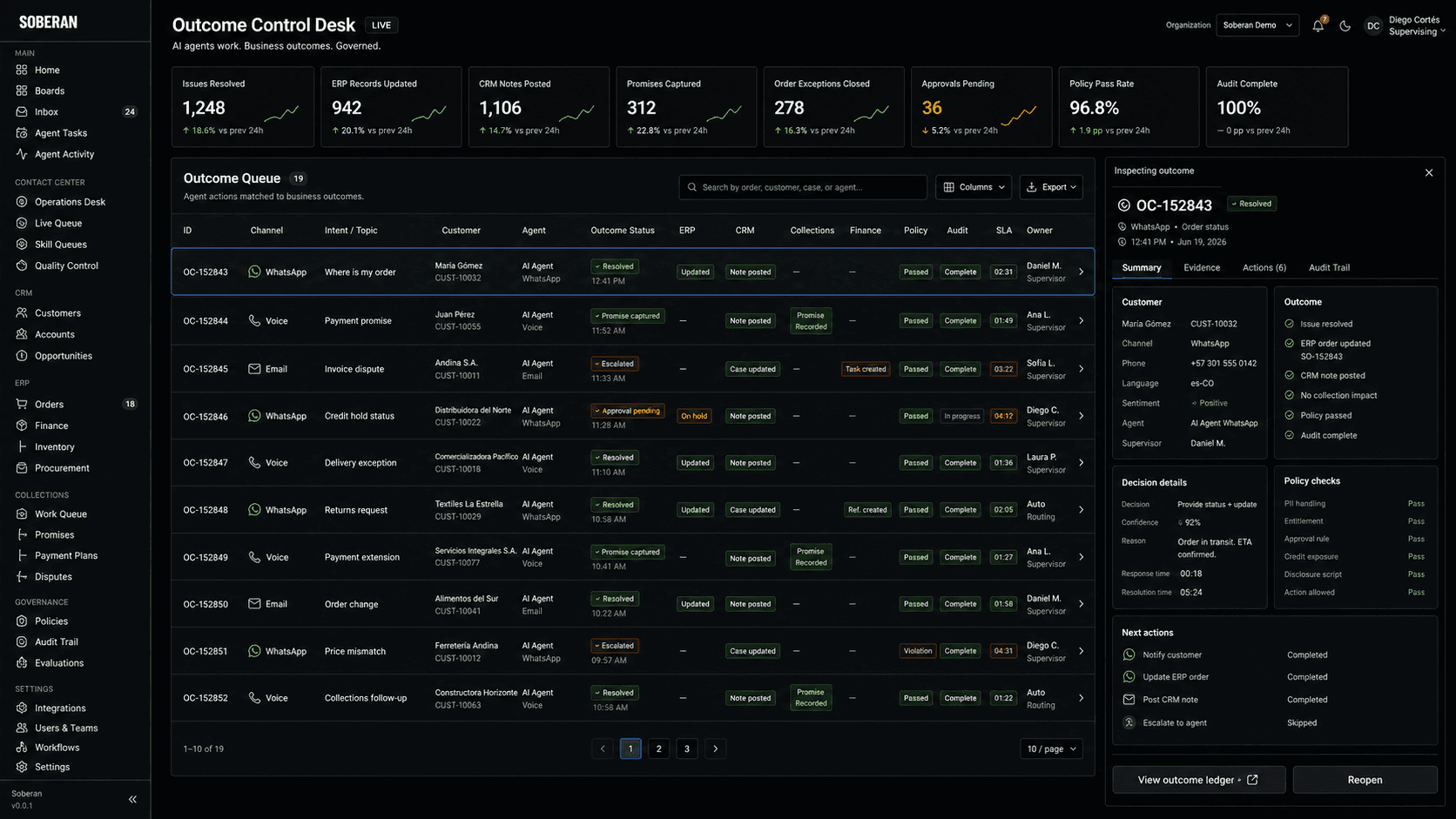
The answer: make every agent outcome-accountable
Recent market signals point in the same direction. Salesforce is buying Fin for customer service agents that work across live chat, email, WhatsApp, SMS, phone, and Slack, with emphasis on autonomous resolution and measurable outcomes. Zendesk has linked AI pricing to verified customer-service resolutions. ITPro's coverage of outcome as agentic solution frames a broader enterprise shift from buying tool access to contracting for executed outcomes. SAP positions Joule around end-to-end workflows across SAP and non-SAP systems, grounded in business data, governance, and process context. Business Insider's coverage of Convey's a16z-led round shows the same language entering startup funding: AI teammates are responsible for an outcome, not just a task.
For SOBERAN buyers, the practical point is sharper than pricing. If an AI agent says an issue is resolved, the operator should be able to inspect the outcome record. Did the customer receive the right answer? Did the ERP order, invoice, inventory, or payment state change? Did CRM capture the context? Did the contact-center timeline update? Did policy pass? Did a human approve the risky part? Did the KPI improve without creating rework?
What operators should do differently
Stop measuring agent value only by containment, call deflection, average handle time, or conversation closure. Those metrics can reward shallow automation. A WhatsApp bot can end a conversation while the order remains blocked. A voice agent can promise a follow-up while CRM stays empty. A collections agent can capture a payment promise that finance never sees. A service agent can mark a case resolved while the customer calls again tomorrow.
The better operating model is an outcome ledger. Each agent action should create a single record that joins the customer request, source evidence, allowed action, system update, approval state, customer communication, and downstream KPI. The ledger turns AI from an answer layer into an operating layer.
Workflows to rebuild first
- WhatsApp and voice service queues where the agent answers order status, delivery changes, returns, refunds, warranty questions, and billing requests only after checking ERP and CRM context.
- Collections and payment-plan work where the agent captures a promise, validates policy, updates finance status, schedules follow-up, and escalates disputes with evidence.
- Order exceptions where the agent detects a blocked shipment, allocation gap, credit hold, or address issue, then prepares the next action and synchronizes customer updates.
- CRM data hygiene where the agent enriches records, resolves duplicates, assigns a responsible person, and records accepted field changes without overwriting commercial judgment.
- Procurement and invoice exceptions where the agent compares purchase order, receipt, supplier confirmation, tolerance policy, and payment status before recommending action.
Buyer intent: ask for proof of closure
A COO, head of customer experience, CRM owner, ERP owner, finance leader, or contact-center director should ask vendors one concrete question: what counts as an outcome, and where can I see it? The answer should not be a dashboard of conversations avoided. It should be an operating record with before-and-after state.
For a resolved order-status case, proof of closure might include the authenticated customer, original channel, ERP order state, shipment evidence, approved customer message, CRM note, contact-center timeline, and recontact check. For a payment plan, it might include balance, aging, allowed terms, customer acceptance, finance update, next reminder, dispute flag, and promise-kept tracking. For CRM hygiene, it might include duplicate evidence, source precedence, accepted field updates, responsible person, and rejected changes.
Governance controls and KPIs
- Outcome definition: every workflow has a strict rule for what counts as resolved, updated, collected, escalated, cleared, or rejected.
- System evidence: outcomes must link to ERP, CRM, contact-center, finance, procurement, inventory, and customer-communication records where relevant.
- Approval policy: refunds, credit changes, payment terms, delivery commitments, discounts, legal language, and sensitive customer changes require explicit approval rules.
- Operational KPIs: verified resolution rate, repeat contact rate, ERP and CRM update acceptance, promise-to-pay kept rate, order exception cycle time, first-contact resolution, and manual rework.
- Risk KPIs: false closure, unauthorized action attempts, stale-data usage, policy violations, customer-impact incidents, reversals, and unresolved exceptions aging past SLA.
How SOBERAN fits
SOBERAN is designed for outcome-accountable automation across ERP, CRM, contact center, WhatsApp, voice, finance, procurement, inventory, and customer operations. The agent does not live as a disconnected chatbot. It works inside governed queues where the evidence packet, policy result, allowed action, approval owner, system update, customer message, and audit history remain connected.
That matters in LatAm mid-market operations because the highest-value work is rarely a clean ticket. It is a messy operating event: a customer asking by WhatsApp about a delayed order, a finance team holding release for credit risk, a warehouse missing stock, a sales rep needing account context, or a collections team negotiating inside policy. SOBERAN helps convert those events into closed outcomes that supervisors can inspect and improve.
Sources and trend signals
- Salesforce: definitive agreement to acquire FinUsed for the primary signal that customer-service agents are moving toward multichannel autonomous resolution, measurable outcomes, trusted data, governance, and integration.
- TechRadar: Zendesk links AI pricing to verified resolution outcomesUsed for the signal that customer-service AI is being commercially tied to verified resolutions rather than seats, tokens, or access alone.
- ITPro: What is outcome as agentic solution?Used for the enterprise software framing of agentic services that shift value from tools to executed, auditable business outcomes.
- SAP Joule Business AI solutionsUsed for SAP's positioning around end-to-end workflows, SAP and non-SAP systems, business process context, governance, and enterprise actions.
- Business Insider: Convey raises $38 million led by a16zUsed for the venture signal that AI work is being framed as outcome responsibility, not only task automation.