The answer: automate change-request evidence before approval
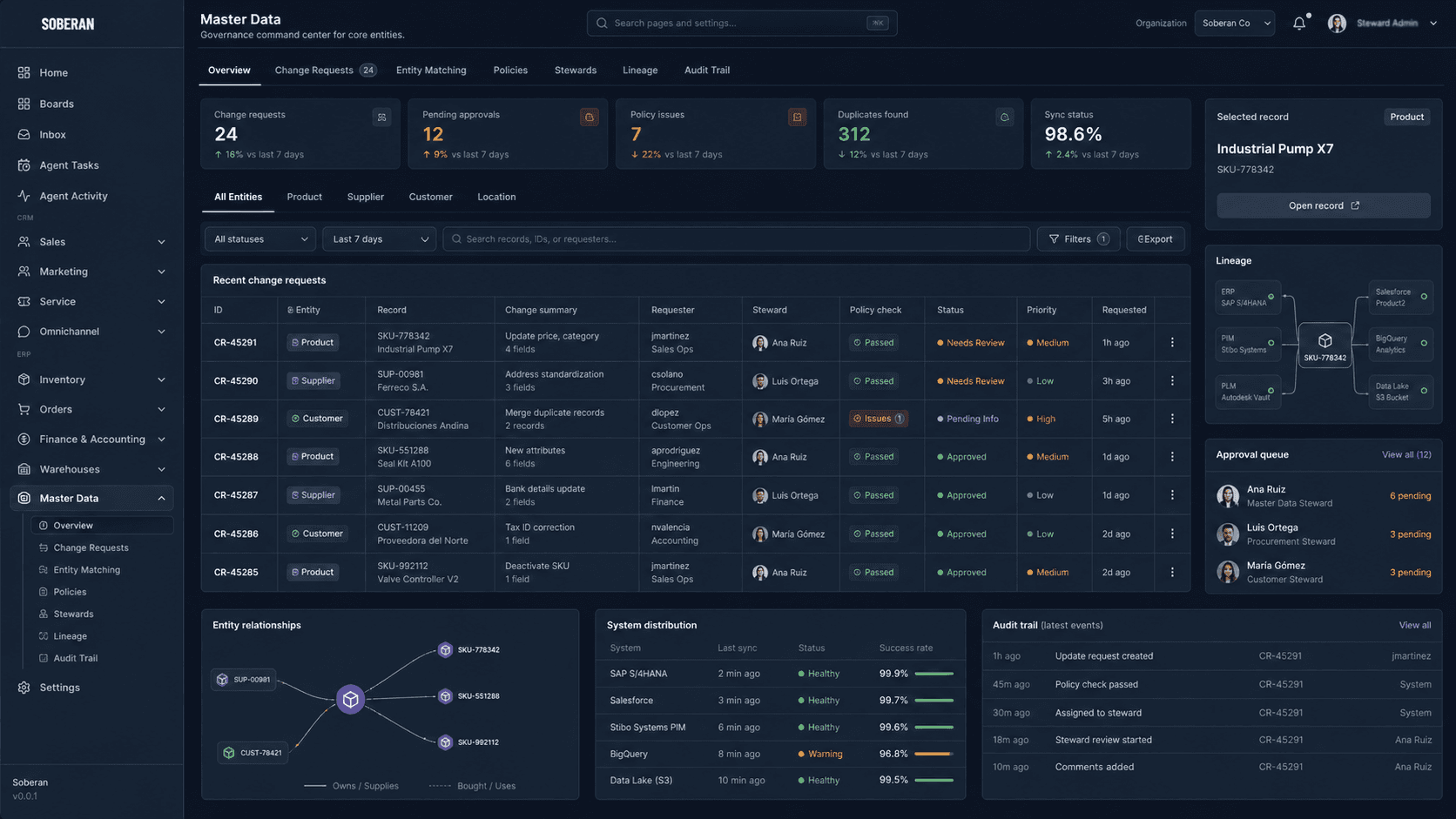
The practical AI agent receives a master data change request, compares it against policy and source records, finds duplicates, checks lineage, prepares steward evidence, and distributes only approved changes to connected systems. It accelerates review without removing data steward control.
Buyer intent sits with operations leaders, data stewards, procurement operations, finance, IT, and ERP owners that need fewer blocked launches, fewer duplicate suppliers, cleaner item records, and safer customer master updates.
Concrete workflow to automate first
- Capture change requests for product, supplier, customer, location, tax, bank, pricing, unit-of-measure, category, and account hierarchy records.
- Pull evidence from ERP, CRM, procurement, finance, PIM, commerce, WMS, data lake, supplier portal, and prior approved records.
- Detect duplicates, missing attributes, prohibited values, inconsistent naming, source conflicts, tax or bank risk, hierarchy conflicts, and impacted downstream systems.
- Apply policy by record type, entity risk, field sensitivity, geography, supplier tier, product category, accounting impact, and approval threshold.
- Prepare the steward packet with requested change, source evidence, current value, recommended value, affected systems, lineage, risk, and required approvals.
- After approval, distribute the update to ERP, CRM, PIM, WMS, commerce, reporting, and integration queues with a clear audit trail.
Competitor landscape
- 01
SAP Master Data Governance
Enterprise master data governance for SAP landscapesSAP positions Master Data Governance around centralized governance, consolidation, mass processing, data quality, and master data maintenance.
- Best for
- Large SAP-centric organizations standardizing master data controls across enterprise processes.
- Note
- Evaluate non-SAP system participation, business-user review speed, and how operational exceptions are handled around the core MDM process.
- 02
Informatica MDM
Enterprise master data management and data intelligenceInformatica describes master data management for trusted, governed, AI-ready views of business-critical data across domains.
- Best for
- Organizations with complex enterprise data programs, multiple domains, and strong data management teams.
- Note
- Ask how frontline operators, stewards, and system owners collaborate on daily change requests.
- 03
Reltio Data Cloud
Cloud-native data unification and MDMReltio positions its data cloud around entity resolution, trusted data, relationships, data quality, and real-time operational data unification.
- Best for
- Data teams that need cloud-native entity resolution and trusted data across customer, product, supplier, and other domains.
- Note
- Validate governance fit for field-level approvals, ERP distribution, and operational accountability in mixed systems.
- 04
SOBERAN
Master data change governance connected to operational executionSOBERAN prepares master data change evidence, applies policy, assigns stewards, records approvals, and distributes updates across ERP, CRM, inventory, finance, and commerce systems.
- Best for
- Operators that need master data controls to move at business speed without letting unsafe changes reach production systems.
- Note
- Use SOBERAN when the master data problem is operational: change requests, evidence, approvals, and system updates must stay connected.
Operating model, governance, and metrics
- Operating model: name stewards by domain and field family: product, supplier, customer, pricing, tax, bank, unit of measure, location, and hierarchy.
- Governance: require approval for sensitive fields, bank data, tax identifiers, supplier status, item category, pricing attributes, customer hierarchy, and any value that affects payments or reporting.
- Lineage controls: show source system, prior value, requester, steward, approval state, affected integrations, and distribution status for every governed change.
- Metrics: change-request cycle time, duplicate entities prevented, missing attributes, policy exceptions, steward backlog, downstream sync success, rejected changes, and audit completeness.
- How SOBERAN fits: SOBERAN turns master data governance into a daily operating flow: collect request, gather evidence, check policy, assign steward, approve, distribute, and monitor impact.
Sources and trend signals
- McKinsey - Data governance for generative AITrend signal on data governance, ownership, quality, and control as prerequisites for scaling AI.
- Gartner - AI agent governanceCurrent Gartner governance signal for matching AI agent controls to risk and autonomy.
- SAP Master Data GovernanceOfficial SAP page for master data governance, consolidation, data quality, and data maintenance.
- Informatica Master Data ManagementOfficial Informatica page for governed, trusted, AI-ready master data across business domains.
- Reltio Data CloudOfficial Reltio page for entity resolution, relationship intelligence, data quality, and operational data unification.
- SOBERAN master data management automationMatching SOBERAN use-case page for SKU, supplier, customer, governance, approvals, and system updates.
- SOBERAN ERPRelated internal page for ERP operations where master data changes affect purchasing, inventory, orders, finance, and reporting.