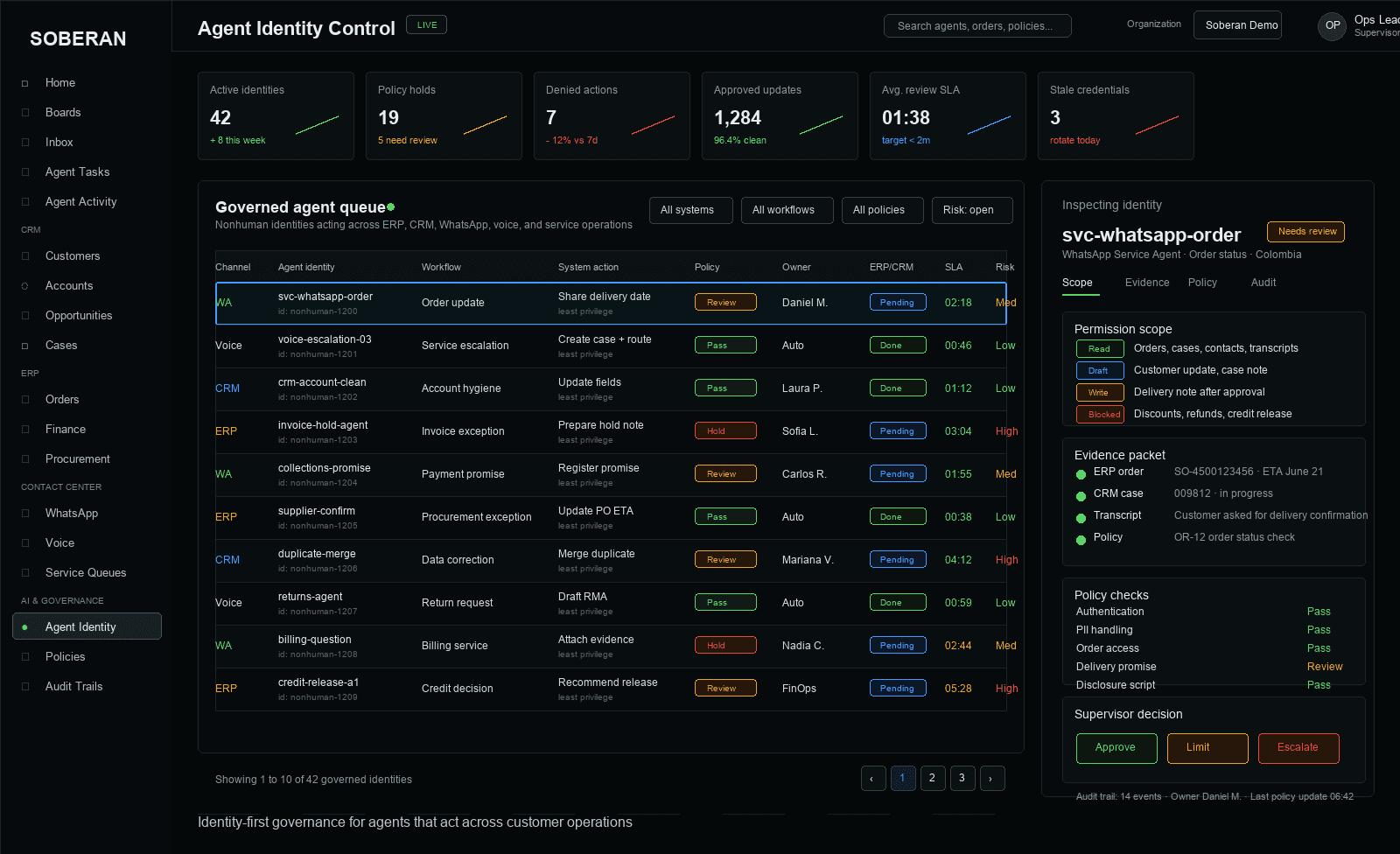
The answer: give every AI agent a governed operating identity
The external signal is clear. Forrester argues that agentic AI is technically real in 2026, but most enterprises are not ready to operationalize it because long-running agents behave like distributed systems. SAP is positioning Joule Agents around end-to-end workflows grounded in business data and governance. Salesforce is bringing AI agents, voice, telephony, CRM context, routing, and supervisor analytics into the contact center. TechRadar points to the same divide: AI is widely available, but only the mature operators embed it into workflows, systems of record, observability, and policy.
For SOBERAN buyers, the takeaway is not to buy more agents. It is to stop treating agents as anonymous automation scripts. A WhatsApp service agent, a voice escalation agent, a CRM hygiene agent, a collections agent, and an ERP exception agent should each have a named identity, scope, owner, permissions, approval thresholds, audit trail, and rollback path. Without that layer, automation coverage rises while operating trust falls.
What this means for ERP, CRM, and contact-center operators
The most exposed teams are not the ones experimenting with prompts. They are the ones letting AI touch records, conversations, and commitments. In a LatAm mid-market operation, an agent may answer a WhatsApp order-status question, update a CRM account, open a service case, validate an invoice exception, recommend a credit release, or route a voice escalation before a supervisor sees the queue.
That work crosses system boundaries. Customer operations needs CRM context, contact-center transcripts, ERP order status, finance policy, inventory reality, payment commitments, and service rules in one decision record. Agent identity governance gives the company a way to ask: which agent acted, under which policy, against which customer or order, with what evidence, and who is accountable if the action is challenged?
Workflows to rebuild first
- WhatsApp and voice service queues where agents answer order status, delivery changes, returns, billing questions, and escalation requests using ERP and CRM context.
- CRM data hygiene where agents enrich account records, deduplicate contacts, assign a responsible person, and prepare field updates without overwriting commercial judgment.
- Collections and payment-promise flows where agents negotiate within policy, capture commitments, escalate disputes, and prepare finance updates only after approval rules are satisfied.
- Order and invoice exceptions where agents assemble evidence from ERP, CRM, warehouse, procurement, and contact-center history before recommending the next operational action.
- Procurement and supplier follow-up where agents chase confirmations, compare dates, flag risk, and prepare purchase-order updates with a named owner and audit history.
Operating model: identity first, autonomy second
The practical operating model starts with a registry of agent identities, not a catalog of prompts. Each identity should map to one job family, one workflow boundary, one system-access profile, one approval policy, and one human owner. The agent can then be measured and governed like an operating role instead of a black-box tool.
Autonomy should widen in stages. Start with read-only evidence gathering and recommendations. Add draft updates when the source data is clean and the policy is explicit. Allow system updates only for bounded actions such as case creation, status notes, approved contact changes, payment-promise registration, or low-risk order updates. Keep finance-impacting, legal, customer-credit, discount, refund, and shipment-commitment actions behind approval gates until the control data proves the agent is reliable.
Governance controls and KPIs
- Identity and scope: each agent has unique credentials, least-privilege access, a lifecycle owner, and a clear list of allowed systems and actions.
- Evidence and policy: every recommendation links to the source records, transcript, policy version, confidence threshold, and exception reason.
- Approval and rollback: higher-risk actions require a named reviewer, reversible update path, and a visible history of changed fields.
- Operational KPIs: containment rate, escalation quality, first-contact resolution, promise-to-pay kept rate, data correction acceptance rate, exception cycle time, and rework caused by agent actions.
- Risk KPIs: policy violations, unauthorized action attempts, stale-data usage, unresolved exceptions, customer-impact incidents, and manual overrides by owner or workflow.
How SOBERAN fits
SOBERAN is built for this control layer. It connects ERP, CRM, contact-center, WhatsApp, voice, and operational data so agents can work from the same evidence packet supervisors use. The point is not to let a model improvise across systems. The point is to turn high-friction work into governed queues with permissions, policy checks, human approvals, and audit history.
For buyers comparing ERP, CRM, and contact-center automation, the useful question is concrete: can the platform show the agent identity, source evidence, allowed action, approval owner, system update, customer impact, and KPI outcome in one place? If it cannot, the agent may answer faster, but the business still cannot operate faster with confidence.
Sources and trend signals
- Forrester: The State Of Agentic AI In 2026Used for the signal that enterprises are adopting agentic AI but struggling with orchestration, nonhuman identity, executable governance, and auditability.
- ITPro coverage of Forrester agentic AI readinessUsed to verify the operationalization gap and the practical recommendation to treat every agent as a governed identity.
- SAP Joule Business AI solutionsUsed for SAP’s positioning around Joule Agents, trusted governance, SAP and non-SAP workflows, and end-to-end business action.
- ITPro: Salesforce Agentforce Contact CenterUsed for the contact-center signal: AI agents, telephony, CRM context, routing, analytics, escalation, voice, and WhatsApp voice expansion.
- TechRadar: How AI is exposing enterprise operating modelsUsed for the broader operating-model signal that AI value depends on integration into core workflows, systems of record, governance, and observability.