The answer: measure agent economics by operating queue
A fresh market signal is coming from enterprise AI cost control. TechRadar Pro's June 23, 2026 analysis argues that AI consumption is spreading across organizations faster than traditional forecasting and governance models can follow. McKinsey's latest State of AI survey shows broad AI use and growing experimentation with agents, but most organizations are still early in scaling enterprise value. SAP is also positioning agent hubs around governance, performance, business impact, and ROI visibility.
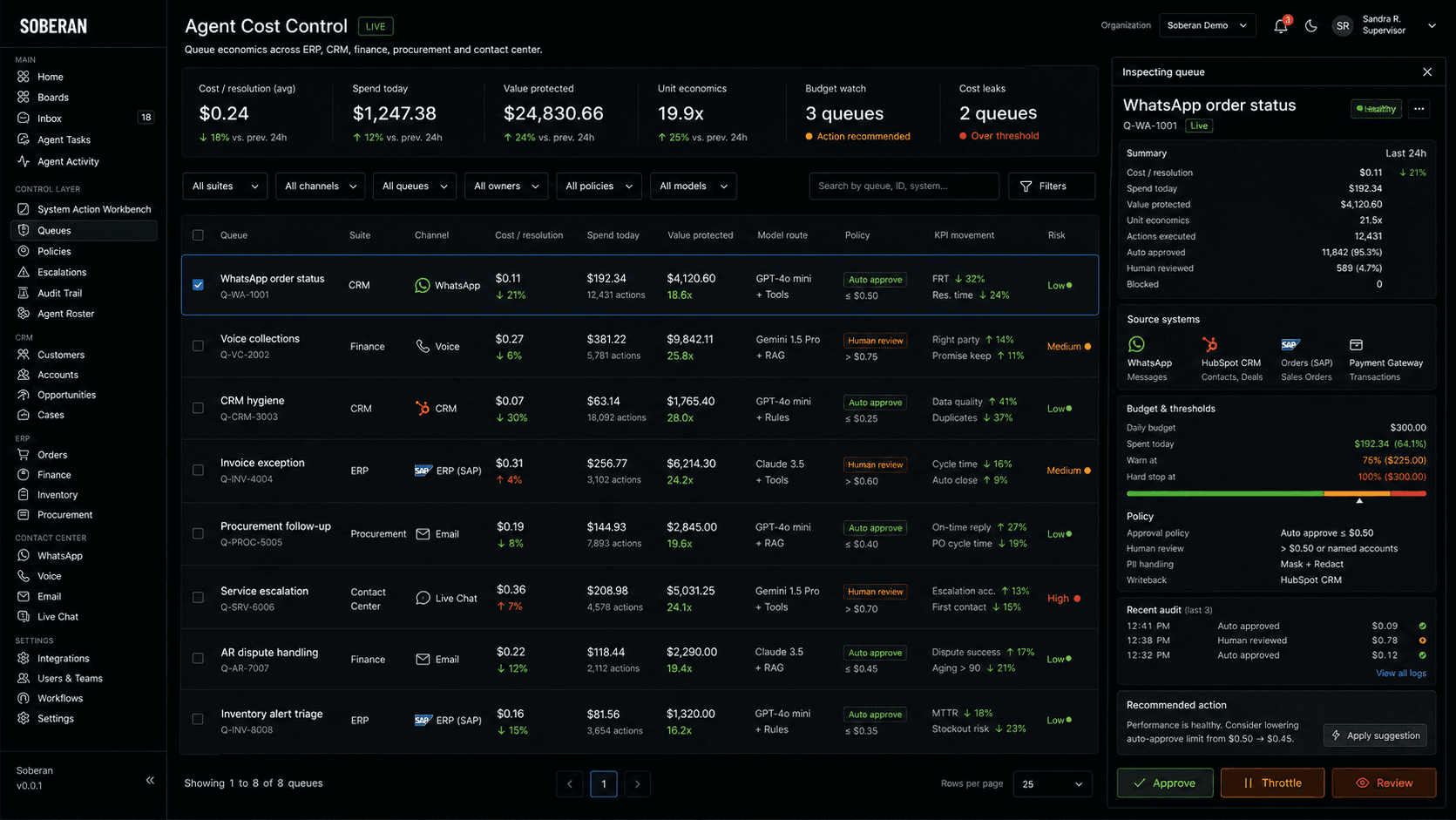
For SOBERAN buyers, the practical answer is queue-level agent economics. A WhatsApp order-status agent, a voice collections agent, a CRM hygiene agent, an invoice exception agent, and a procurement follow-up agent should each have its own cost ceiling, value metric, policy threshold, reviewer rule, and KPI target. Otherwise, usage can look successful while margin, service quality, or control quietly deteriorates.
What operators should do differently
Do not evaluate AI automation only through model usage, conversation volume, seat adoption, or tokens consumed. Those metrics describe activity, not operating value. The useful question is: how much did the agent spend to close a verified order update, collect a payment promise, correct a customer record, clear an invoice exception, or prevent a service escalation?
LatAm mid-market operations make this especially important because teams often combine ERP, CRM, WhatsApp, voice, spreadsheets, payment tools, tax rules, and manual approvals. A low-cost answer can become expensive if it triggers rework. A higher-cost model can be justified if it protects cash, prevents a delivery mistake, or reduces repeat contact. Cost control has to live next to workflow control.
Workflows to put under cost control first
- WhatsApp order status where the agent reads ERP order state, shipment evidence, customer history, and service policy before replying, with cost per resolved inquiry and repeat-contact rate visible by queue.
- Voice collections where the agent validates balance, aging, consent, customer history, negotiation range, and payment promise before updating finance or CRM, with cost per kept promise and human review cost tracked.
- CRM data hygiene where the agent deduplicates records, fills missing fields, updates account context, and creates next actions, with data-quality lift and correction cost measured together.
- Invoice and purchase order exceptions where the agent compares PO, receipt, invoice, tax data, credit note, and approval policy, with cost per cleared exception and blocked-risk value visible.
- Procurement follow-up where the agent checks supplier confirmation, delivery date, price variance, buyer approval, and inventory exposure, with cost per supplier response and cycle-time reduction tracked.
- Service escalation triage where the agent gathers evidence, classifies severity, summarizes the case, and routes a person only when policy requires it, with deflection savings and customer-impact risk in the same view.
Buyer intent: ask for the unit economics ledger
A serious AI automation vendor should be able to show more than demos and aggregate usage. Ask for a unit economics ledger by queue: approved actions, blocked actions, human review minutes, model route, tool calls, retry rate, cost per verified outcome, value protected, and KPI movement.
The ledger should also make model routing visible. Some queues can run on a smaller model plus rules. Others need a stronger model, retrieval, ERP reads, CRM context, voice transcription, or human review. The operator should see why the route was chosen and when the system throttles, escalates, or downgrades autonomy.
Operating model and governance
- Assign one responsible team for each queue, with budget authority and KPI ownership.
- Set a cost ceiling for each resolved action, not only a monthly AI budget.
- Tie every cost metric to a system-of-record outcome such as ERP order updated, CRM record corrected, promise to pay logged, invoice exception cleared, or supplier response captured.
- Use policy tiers: auto-run low-risk work, send medium-risk work to review, and block high-risk actions until a person approves.
- Separate experimentation spend from production spend so pilots cannot hide inside live operations.
- Review cost leaks weekly: retries, duplicate messages, unnecessary model upgrades, failed tool calls, repeated escalations, and cases reopened by customers.
KPIs that prove agent cost control is working
- Cost per verified resolution by queue.
- Value protected per dollar of AI spend.
- Human review minutes per completed action.
- Repeat contact, reopened case, or rework rate after agent action.
- Model route mix by risk tier and queue.
- Cycle time reduction for order, invoice, procurement, and service exceptions.
- Cash collected, promise kept, or aging reduction for collections workflows.
- Blocked-risk value from actions that the agent correctly refused or escalated.
Risks to govern
The first risk is cost drift: a queue starts with clean economics, then extra context, larger models, unnecessary retries, or poor data quality make every action more expensive. The second risk is false savings: the agent looks cheap because it pushes work downstream into human cleanup, customer repeat contact, finance corrections, or operational rework.
The third risk is model-route opacity. If the operator cannot explain why a voice collections case used one model, a WhatsApp order case used another, and an invoice exception required human review, cost control will become a finance spreadsheet instead of an operating system.
How SOBERAN fits
SOBERAN is built for operations where ERP, CRM, contact center, finance, procurement, WhatsApp, and voice work have to be governed together. Instead of treating AI spend as a generic platform cost, SOBERAN connects each agent queue to the source record, allowed action, review policy, system update, audit trail, and KPI outcome.
That lets operators compare queues on the economics that matter: how much the agent spent, what business result closed, what risk was avoided, which system changed, who reviewed exceptions, and whether the queue became cleaner, faster, and safer.
Sources and trend signals
- TechRadar Pro: enterprise AI cost controlUsed for the central cost-control signal: enterprise AI consumption is spreading across functions while forecasting, governance, and business-value measurement remain difficult.
- McKinsey: The state of AI in 2025Used for the adoption signal: AI and agents are being used broadly, but most organizations remain early in scaling enterprise-level value.
- SAP: Joule Agents and SAP AI Agent HubUsed for the enterprise-suite signal: agent hubs are being positioned around governance, performance, business impact, ROI, and cross-functional business operations.
- Business Insider: Accenture and AI transformation timingUsed for the scaling tension: major AI transformation demand exists, but moving beyond pilots into production takes time and requires operating readiness.
- a16z: The Enterprise Orchestration LayerUsed as market context: enterprise AI is shifting from isolated copilots toward coordinated systems that run workflows and deliver outcomes across tools.