Plan acceptance rate
Eligible negotiation conversations that result in a valid, recorded plan.
B2C collections use case · Negotiation
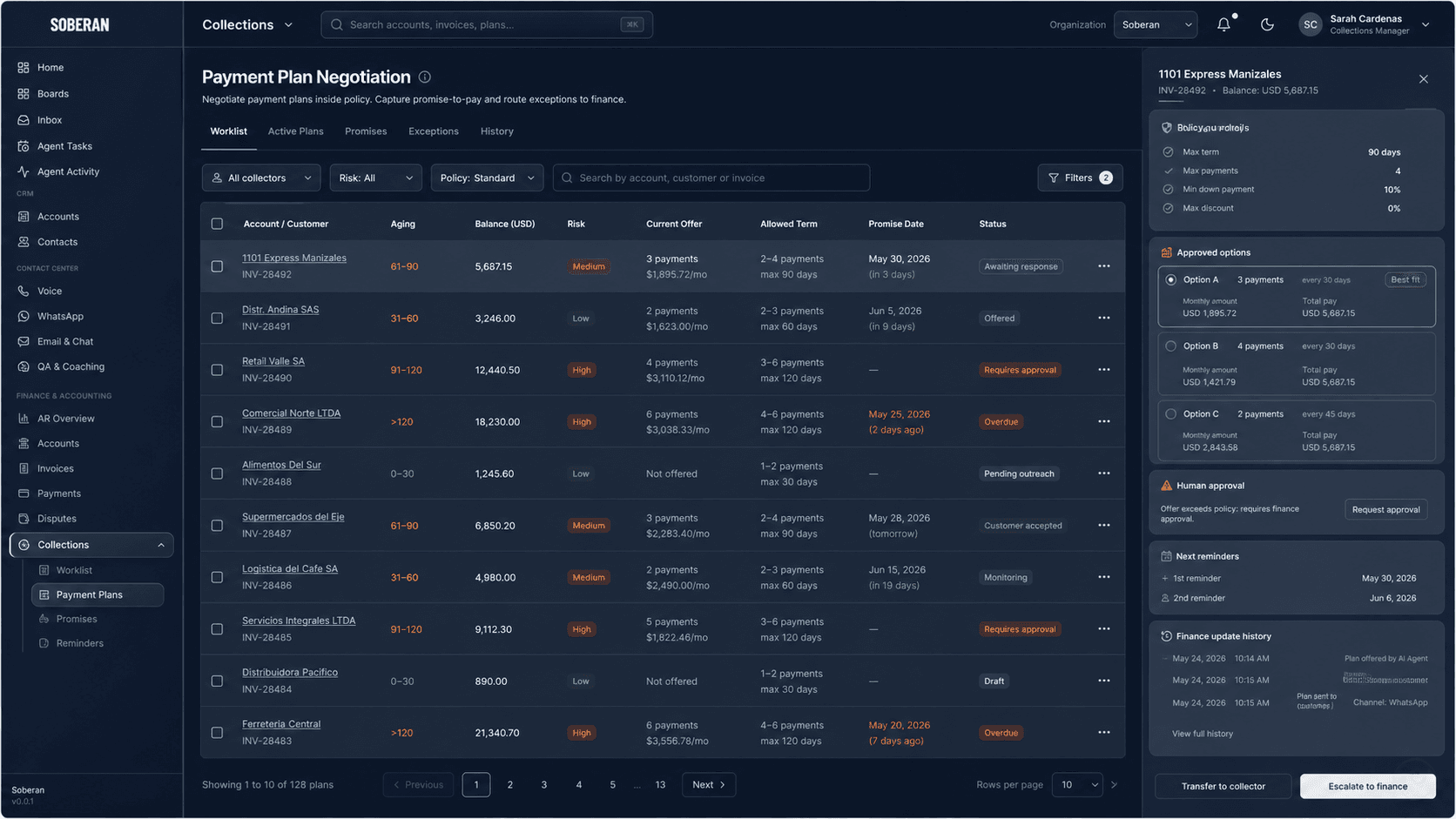
AI payment-plan negotiation lets a voice or WhatsApp agent propose dates, installments, or settlement options that have already been approved for a customer segment. The agent verifies affordability inputs, explains the offer, captures explicit acceptance, schedules follow-up, and writes the plan back. Anything outside policy requires human approval.
01 / Problem
A customer intends to pay but cannot meet the original due date or full amount. The operational risk is not the conversation—it is presenting an unauthorized option, missing a hardship signal, recording ambiguous acceptance, or creating a plan in one channel that never reaches the finance or lending system.
02 / Workflow
Retrieve balance, aging, existing plans, eligibility, minimum payment, maximum term, allowed dates, and approval thresholds.
Result: A bounded set of options the agent may discuss for this customer.
Ask only the permitted questions needed to distinguish timing difficulty, affordability constraints, dispute, refusal, or a request for human help.
Result: A structured reason code and a safe negotiation path.
Offer approved dates or installments, explain amounts and consequences accurately, and never improvise a concession outside policy.
Result: A customer-selectable option with an evidence-backed calculation.
Record explicit terms, consent, channel, timestamp, and any supervisor authorization required by the offer.
Result: An auditable agreement rather than an ambiguous conversational promise.
Write the schedule to the authoritative system, send confirmation, create reminders, and define the path if a payment fails.
Result: The channel promise and finance record remain synchronized.
03 / Control
SOBERAN connects voice and WhatsApp with identity, policy, CRM, ERP, and the human queue. The agent can execute the routine path through approved tools; exceptions preserve evidence, ownership, the decision, and structured writeback.
04 / Measurement
Eligible negotiation conversations that result in a valid, recorded plan.
Accepted plans whose first scheduled payment is completed on time.
Plans fully satisfied without an ungoverned restructuring or silent default.
Time required for a human to decide offers beyond the agent’s authority.
Accepted plans that exactly match the terms recorded in the authoritative finance system.
The demo test
Ask the agent to negotiate a three-installment plan when policy allows only two without approval. It should present the two approved option, route the three-installment request to a supervisor, preserve the conversation, and confirm nothing until the system records the authorized plan.
05 / FAQ
Yes, when the agent is limited to an approved offer envelope and supported by identity, policy, consent, approval, and system-writeback controls. It should not invent terms or make unrestricted affordability decisions.
A promise usually records one expected payment amount and date. A payment plan defines multiple scheduled obligations and often requires additional eligibility, disclosures, approvals, and system records.
Escalate when the customer disputes the balance, signals hardship or vulnerability, fails identity checks, requests prohibited terms, or needs an option above the agent’s configured authority.
06 / Sources
Current product evidence for AI agents discussing overdue balances and payment plans within preset parameters.
Official United States communications rule used as a control-design reference; jurisdiction-specific legal review remains necessary.
Detailed SOBERAN operating model for policy checks, approval, promise capture, and accounts-receivable writeback.
07 / Next
B2C collections use case · Days 1–30
AI collections for early delinquency use voice and WhatsApp agents to contact eligible customers during the first 1–30 overdue days, explain the verified balance, offer policy-approved payment options, capture a payment or promise, and update the collection system. Sensitive, disputed, or unaffordable cases move to a person with context.
B2C collections use case · Promise recovery
AI follow-up for broken payment promises compares the promised amount and date with actual payment evidence, then chooses the next permitted action. The agent can verify a pending transfer, request a receipt, reschedule within policy, call after WhatsApp non-response, or escalate repeated failure, dispute, or hardship with the full account history.
B2C collections use case · Payment evidence
AI payment-receipt validation lets a customer send a transfer receipt through WhatsApp, extracts the amount, date, payer, reference, and destination, and compares them with the account and bank or ERP evidence. Clear matches suppress further contact and move to reconciliation; duplicates, altered images, partial payments, or mismatches go to review.
Bring your anonymized offer matrix and one representative account. We will map what the agent can propose, where approval begins, how acceptance is captured, and which fields must reach the finance system.
30 minutes · Anonymized data · One concrete workflow
Review one workflow with our team — 30 minutes, no commitment.
Book a demo