Verified resolution rate
Eligible accounts that end in confirmed payment, valid promise, approved plan, or correctly routed exception—not merely a completed conversation.
B2C collections use case · Days 1–30
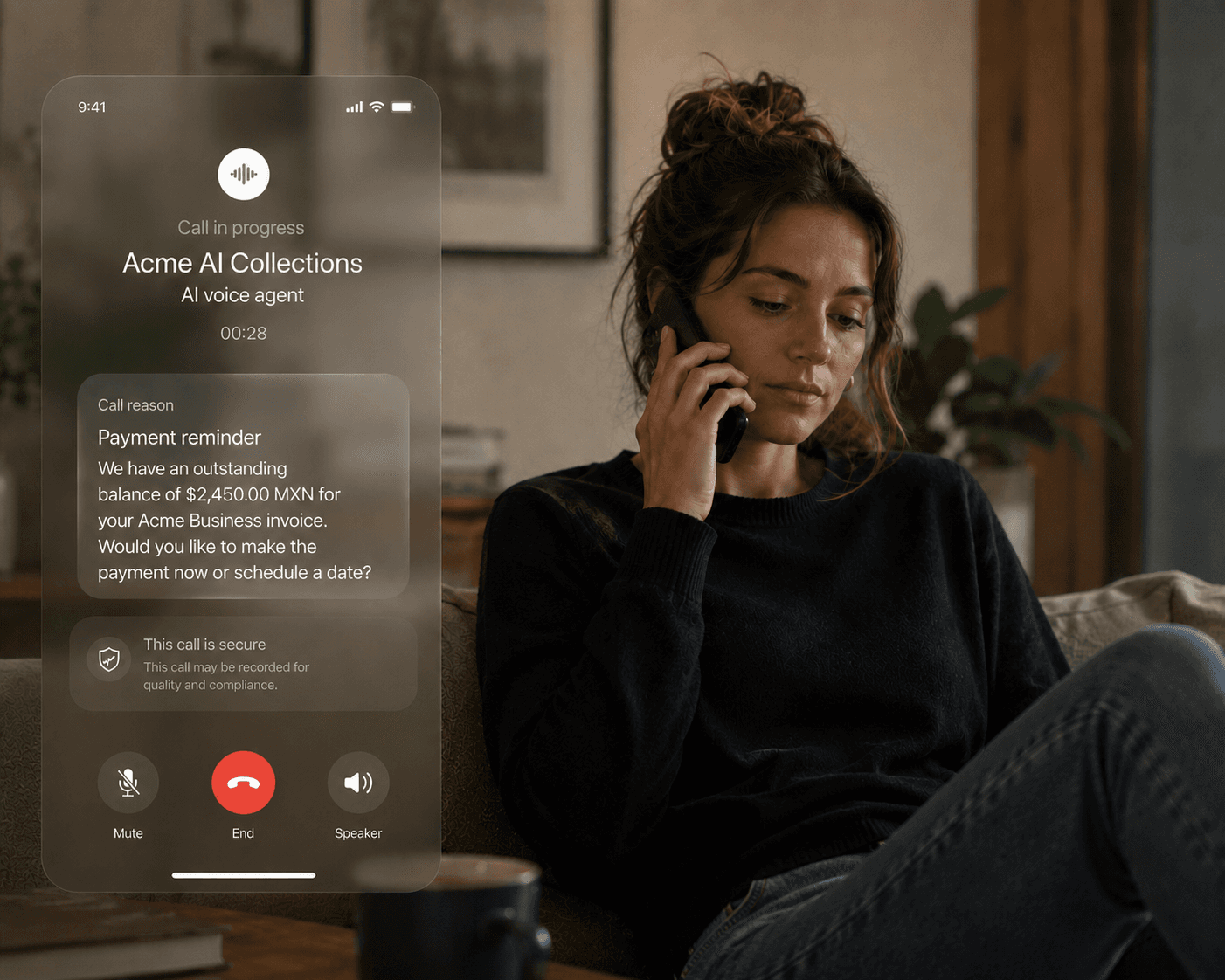
AI collections for early delinquency use voice and WhatsApp agents to contact eligible customers during the first 1–30 overdue days, explain the verified balance, offer policy-approved payment options, capture a payment or promise, and update the collection system. Sensitive, disputed, or unaffordable cases move to a person with context.
01 / Problem
A lender, telecom, utility, insurer, school, or retail-credit program has thousands of recently overdue accounts. Human collectors cannot contact every customer quickly, while generic reminder campaigns ignore consent, prior promises, disputes, customer value, and channel response. The highest-value automation is a governed first-resolution loop before the account becomes harder and more expensive to recover.
02 / Workflow
Read aging, balance, consent, timezone, prior contact, dispute, vulnerability, and active-plan flags before any outreach.
Result: A policy-approved daily contact queue with an explicit reason for inclusion.
Use response history and policy to decide whether WhatsApp, voice, SMS, email, or human review is appropriate now.
Result: One coordinated contact decision rather than simultaneous channel blasts.
Verify the customer, explain the balance, resend the invoice or payment link, and offer only the dates or options allowed by policy.
Result: Payment, promise-to-pay, callback, documented refusal, or a clearly classified exception.
Route disputes, hardship, identity failure, legal language, vulnerability, or requested concessions beyond policy to the right person.
Result: A human receives the account context, transcript, policy result, and recommended next step.
Update the collections platform, CRM, ERP, or lending core with the disposition and calculate the next permitted action.
Result: One authoritative account history that drives the next contact.
03 / Control
SOBERAN connects voice and WhatsApp with identity, policy, CRM, ERP, and the human queue. The agent can execute the routine path through approved tools; exceptions preserve evidence, ownership, the decision, and structured writeback.
04 / Measurement
Eligible accounts that end in confirmed payment, valid promise, approved plan, or correctly routed exception—not merely a completed conversation.
Attempts that reach and appropriately verify the intended customer without exposing account information.
Promises completed by the agreed date and amount, measured by segment and channel.
Movement from early delinquency into later aging compared with a defensible baseline or control group.
Collector and supervisor time required after automation, including exception review and corrections.
The demo test
Give the vendor an anonymized account that is seven days overdue, has an unanswered WhatsApp reminder, a valid phone number, and no dispute. Then add a hardship signal during the call. The agent should authenticate, explain the balance, stay inside policy, stop autonomous negotiation when hardship appears, transfer the full case, and write the final disposition to the system of record.
05 / FAQ
It is governed automation for recently overdue consumer accounts, commonly within days 1–30. An AI agent selects eligible accounts, contacts customers through approved channels, handles routine payment outcomes, and escalates disputes or hardship while preserving a complete audit trail.
Start with the channel your customers have authorized and already answer. Use one shared policy and account history so WhatsApp can handle asynchronous reminders and payment links while voice addresses non-response, urgency, or more complex explanations.
People should retain policy ownership and review for hardship, vulnerability, disputes, legal threats, identity failures, concessions beyond limits, and any case where the agent lacks reliable account evidence.
06 / Sources
Current market evidence for voice and digital AI agents focused on early delinquency for Latin American lenders.
Official United States reference showing why channel, timing, identity, opt-out, and communication controls must be explicit. Local legal review is still required in every market.
SOBERAN evaluation of B2C collections platforms, channels, hardship handling, compliance, and system integration.
07 / Next
B2C collections use case · Negotiation
AI payment-plan negotiation lets a voice or WhatsApp agent propose dates, installments, or settlement options that have already been approved for a customer segment. The agent verifies affordability inputs, explains the offer, captures explicit acceptance, schedules follow-up, and writes the plan back. Anything outside policy requires human approval.
B2C collections use case · Promise recovery
AI follow-up for broken payment promises compares the promised amount and date with actual payment evidence, then chooses the next permitted action. The agent can verify a pending transfer, request a receipt, reschedule within policy, call after WhatsApp non-response, or escalate repeated failure, dispute, or hardship with the full account history.
B2C collections use case · Payment evidence
AI payment-receipt validation lets a customer send a transfer receipt through WhatsApp, extracts the amount, date, payer, reference, and destination, and compares them with the account and bank or ERP evidence. Clear matches suppress further contact and move to reconciliation; duplicates, altered images, partial payments, or mismatches go to review.
Bring an anonymized sample of recently overdue accounts. We will map eligibility, channel policy, payment outcomes, exception routing, writeback, and the measurements required for a controlled pilot.
30 minutes · Anonymized data · One concrete workflow
Review one workflow with our team — 30 minutes, no commitment.
Book a demo