Straight-through validation rate
Submitted receipts matched and resolved without manual review.
B2C collections use case · Payment evidence
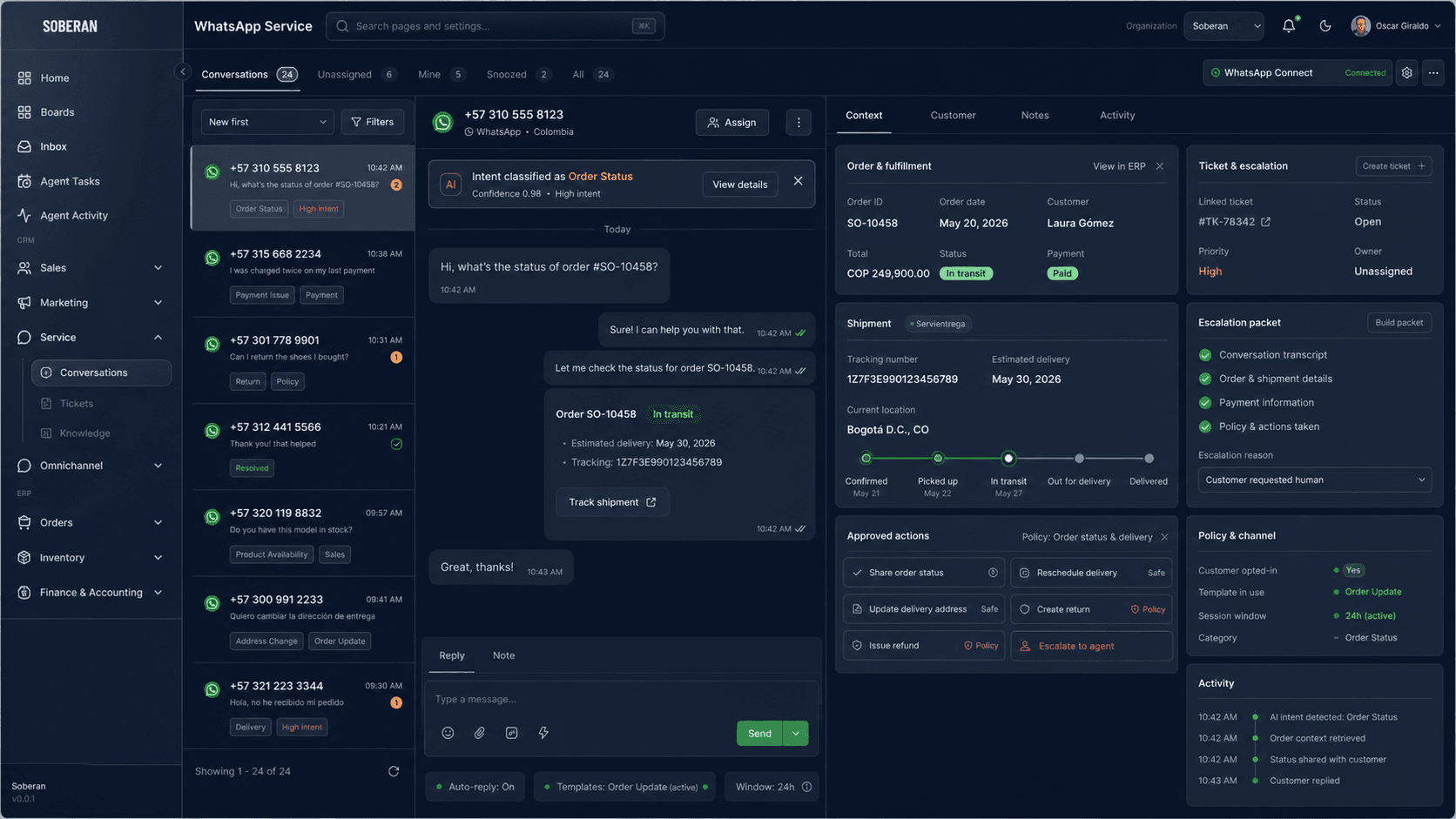
AI payment-receipt validation lets a customer send a transfer receipt through WhatsApp, extracts the amount, date, payer, reference, and destination, and compares them with the account and bank or ERP evidence. Clear matches suppress further contact and move to reconciliation; duplicates, altered images, partial payments, or mismatches go to review.
01 / Problem
Customers frequently reply “I already paid” and send an image or PDF. Collectors then inspect the receipt, search bank movements, identify the account, and manually stop campaigns. The valuable automation is not OCR alone: it is evidence capture, matching, exception classification, suppression, reconciliation, and customer confirmation as one controlled workflow.
02 / Workflow
Store the receipt, channel identity, message, timestamp, file hash, and conversation context without treating the image as proof by itself.
Result: A traceable evidence packet linked to the claimed account.
Read amount, date, reference, payer, destination, bank, status, and any visible transaction identifier with confidence values.
Result: Machine-readable payment evidence with uncertainty exposed.
Compare the extracted fields with balance, customer identity, expected amount, bank movements, gateway events, and previously submitted receipts.
Result: Matched, partial, duplicate, pending, mismatched, unreadable, or suspicious classification.
Pause further contact for credible pending or matched payments and send ambiguous, suspicious, or partial cases to the correct reconciliation queue.
Result: Customers are not chased while payment evidence is being resolved.
Post or associate the payment only after authoritative verification, update the account, and tell the customer what was confirmed or what information is missing.
Result: Collections, bank evidence, and customer communication reach one consistent state.
03 / Control
SOBERAN connects voice and WhatsApp with identity, policy, CRM, ERP, and the human queue. The agent can execute the routine path through approved tools; exceptions preserve evidence, ownership, the decision, and structured writeback.
04 / Measurement
Submitted receipts matched and resolved without manual review.
Elapsed time from customer submission to verified association with the correct account.
Customers contacted again after a valid payment or credible pending-payment claim.
Cases routed to review that genuinely require human judgment rather than simple system matching.
Change in payments that reach the bank but remain unassociated with a customer or obligation.
The demo test
Send three receipts: a valid transfer, the same receipt submitted twice, and an image whose amount does not match the account. The platform should match the first, identify the duplicate, route the mismatch, suppress inappropriate follow-up, and avoid confirming payment until the authoritative transaction is verified.
05 / FAQ
AI can extract and compare receipt fields, but the receipt image should remain a payment claim until bank, gateway, ERP, or other authoritative transaction evidence confirms it. Safe automation exposes confidence and routes ambiguous cases to review.
It can compare transaction identifiers, file hashes, payer, account, amount, date, and prior submissions. Duplicate detection should happen before any payment is posted or campaign status changes.
A credible payment claim should normally suppress further automated contact while validation is pending. Final confirmation and account closure should wait for authoritative payment verification and the organization’s policy.
06 / Sources
Current LATAM market evidence for WhatsApp reminders, receipt validation, and account reconciliation as one collection workflow.
Official Meta technical documentation for WhatsApp Business Platform implementation.
SOBERAN product workflow for payment links, promise capture, evidence, escalation, and system context over WhatsApp.
07 / Next
B2C collections use case · Days 1–30
AI collections for early delinquency use voice and WhatsApp agents to contact eligible customers during the first 1–30 overdue days, explain the verified balance, offer policy-approved payment options, capture a payment or promise, and update the collection system. Sensitive, disputed, or unaffordable cases move to a person with context.
B2C collections use case · Negotiation
AI payment-plan negotiation lets a voice or WhatsApp agent propose dates, installments, or settlement options that have already been approved for a customer segment. The agent verifies affordability inputs, explains the offer, captures explicit acceptance, schedules follow-up, and writes the plan back. Anything outside policy requires human approval.
B2C collections use case · Promise recovery
AI follow-up for broken payment promises compares the promised amount and date with actual payment evidence, then chooses the next permitted action. The agent can verify a pending transfer, request a receipt, reschedule within policy, call after WhatsApp non-response, or escalate repeated failure, dispute, or hardship with the full account history.
Bring anonymized examples of valid, duplicate, partial, unreadable, and mismatched receipts. We will map extraction, authoritative verification, suppression, review queues, and reconciliation writeback.
30 minutes · Anonymized data · One concrete workflow
Review one workflow with our team — 30 minutes, no commitment.
Book a demo