Kept-promise rate
Promises matched to the correct amount and date, not promises merely captured.
B2C collections use case · Promise recovery
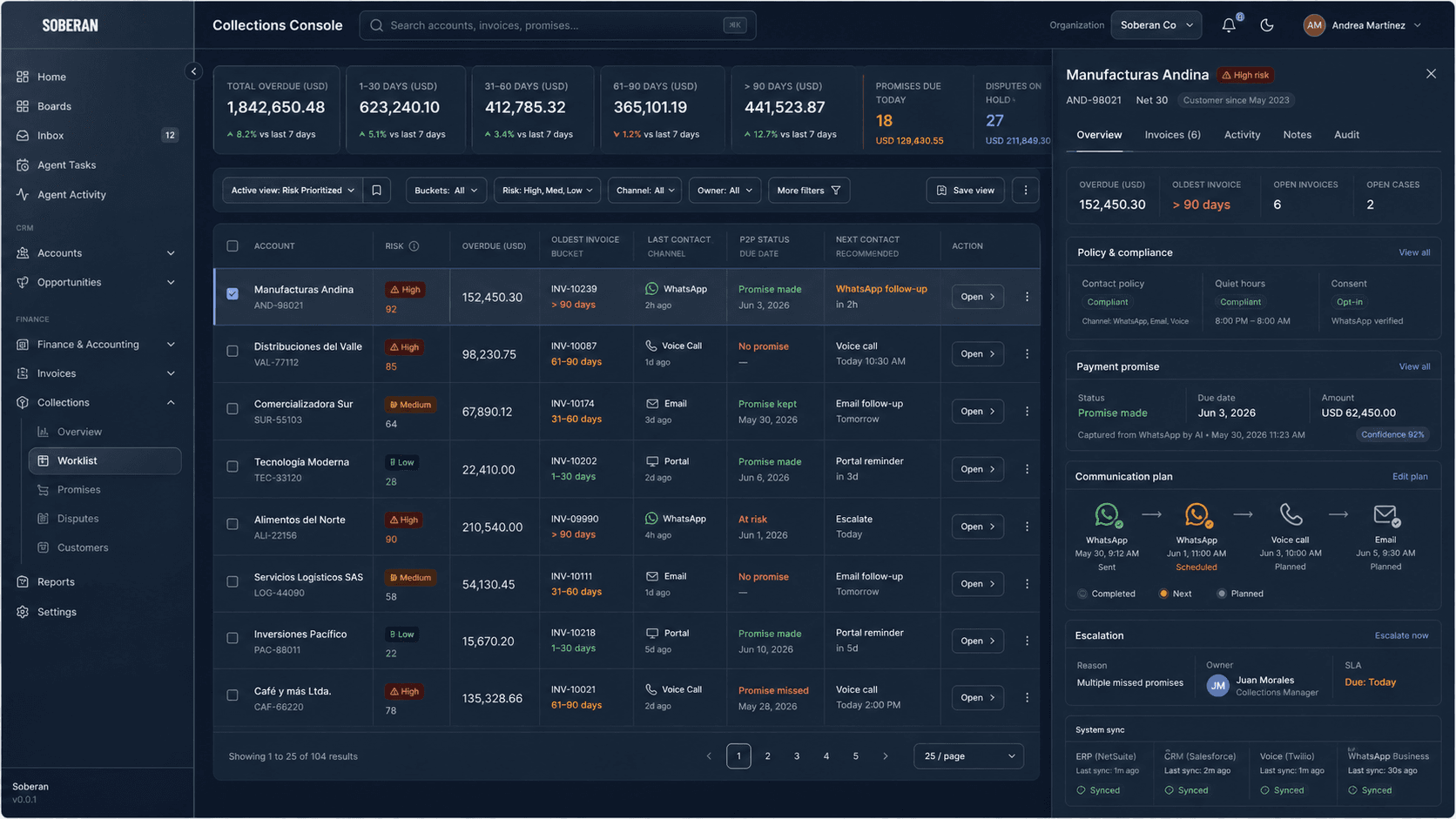
AI follow-up for broken payment promises compares the promised amount and date with actual payment evidence, then chooses the next permitted action. The agent can verify a pending transfer, request a receipt, reschedule within policy, call after WhatsApp non-response, or escalate repeated failure, dispute, or hardship with the full account history.
01 / Problem
The customer previously committed to pay, but the promise date passed without a matched payment. A generic reminder can damage trust when a transfer is merely pending, while a collector may waste time reconstructing the prior conversation. The agent should resolve the evidence gap first and only then decide how to follow up.
02 / Workflow
Compare the promised amount, date, and account with posted payments, pending bank evidence, reversals, and reconciliation status.
Result: A verified broken promise or a payment-matching exception—not an assumption.
Load the original conversation, terms, channel, consent, prior failures, dispute history, and reason given by the customer.
Result: The next contact acknowledges what was actually agreed.
Request a receipt, resend a link, ask for a revised date within policy, initiate a voice callback, or route the case to a collector.
Result: A proportionate next action based on evidence and customer history.
Pause and escalate when the customer reports payment, disputes the balance, signals hardship, or repeatedly breaks promises.
Result: Sensitive cases leave automation with a complete decision packet.
Write the outcome back, close false misses, update the account risk, and calculate the next allowed contact.
Result: Promise performance becomes usable operating data.
03 / Control
SOBERAN connects voice and WhatsApp with identity, policy, CRM, ERP, and the human queue. The agent can execute the routine path through approved tools; exceptions preserve evidence, ownership, the decision, and structured writeback.
04 / Measurement
Promises matched to the correct amount and date, not promises merely captured.
Promises flagged as broken when payment was already made, pending, misapplied, or awaiting reconciliation.
Broken promises that become verified payments or valid revised commitments after follow-up.
Elapsed time between verified promise failure and the next policy-compliant contact or review.
Accounts repeatedly moved to a new date without payment, useful for tightening escalation policy.
The demo test
Use an account whose promise expired yesterday but whose bank transfer is pending reconciliation. The agent should check payment evidence before contacting the customer. Then remove the pending payment: it should reference the prior promise, offer only the allowed recovery action, and update the account without duplicating outreach.
05 / FAQ
It compares the promised amount and date with posted payments, bank or receipt evidence, reversals, and reconciliation status. A safe system verifies this evidence before changing account risk or contacting the customer.
The next action depends on payment evidence, consent, prior failures, customer response, policy, and sensitivity. The system may request proof, resend a link, allow a bounded reschedule, switch channels, or escalate to a human.
Contacting someone who already paid creates complaints and brand damage. False-miss measurement exposes reconciliation delays, identity mismatches, and bad system integration that conversation automation alone cannot solve.
06 / Sources
Current market evidence for promise tracking, prioritization, disputes, follow-up, and ERP updates in collections.
SOBERAN workflow for next-best collections action, promises, escalation, and system writeback.
Transparent calculator for modeling recovery, operating cost, and payback assumptions.
07 / Next
B2C collections use case · Days 1–30
AI collections for early delinquency use voice and WhatsApp agents to contact eligible customers during the first 1–30 overdue days, explain the verified balance, offer policy-approved payment options, capture a payment or promise, and update the collection system. Sensitive, disputed, or unaffordable cases move to a person with context.
B2C collections use case · Negotiation
AI payment-plan negotiation lets a voice or WhatsApp agent propose dates, installments, or settlement options that have already been approved for a customer segment. The agent verifies affordability inputs, explains the offer, captures explicit acceptance, schedules follow-up, and writes the plan back. Anything outside policy requires human approval.
B2C collections use case · Payment evidence
AI payment-receipt validation lets a customer send a transfer receipt through WhatsApp, extracts the amount, date, payer, reference, and destination, and compares them with the account and bank or ERP evidence. Clear matches suppress further contact and move to reconciliation; duplicates, altered images, partial payments, or mismatches go to review.
Bring an anonymized sample of kept, broken, and disputed promises. We will map payment matching, follow-up rules, channel escalation, false misses, and the authoritative writeback.
30 minutes · Anonymized data · One concrete workflow
Review one workflow with our team — 30 minutes, no commitment.
Book a demo