LATAM Guide · Updated 2026
WhatsApp Collections in LATAM: the definitive 2026 guide
WhatsApp is the dominant collections channel in LATAM. This guide covers the legal framework across five countries, templates that don't get blocked, how to segment by aging, how to integrate with your ERP, and how to choose among the available platforms. Written for collections, finance, and operations teams migrating from calls and BPOs to a higher-margin asynchronous channel.
1. What is WhatsApp collections?
WhatsApp collections is the practice of managing portfolio recovery through LATAM's most-used messaging channel: payment reminders, payment links, dispute capture, plan negotiation, and reconciliation — all inside the inbox the debtor checks several times a day. Unlike a call (intrusive, low contact rate, expensive) or email (ignored), WhatsApp combines open rates above 90% with near-zero marginal cost.
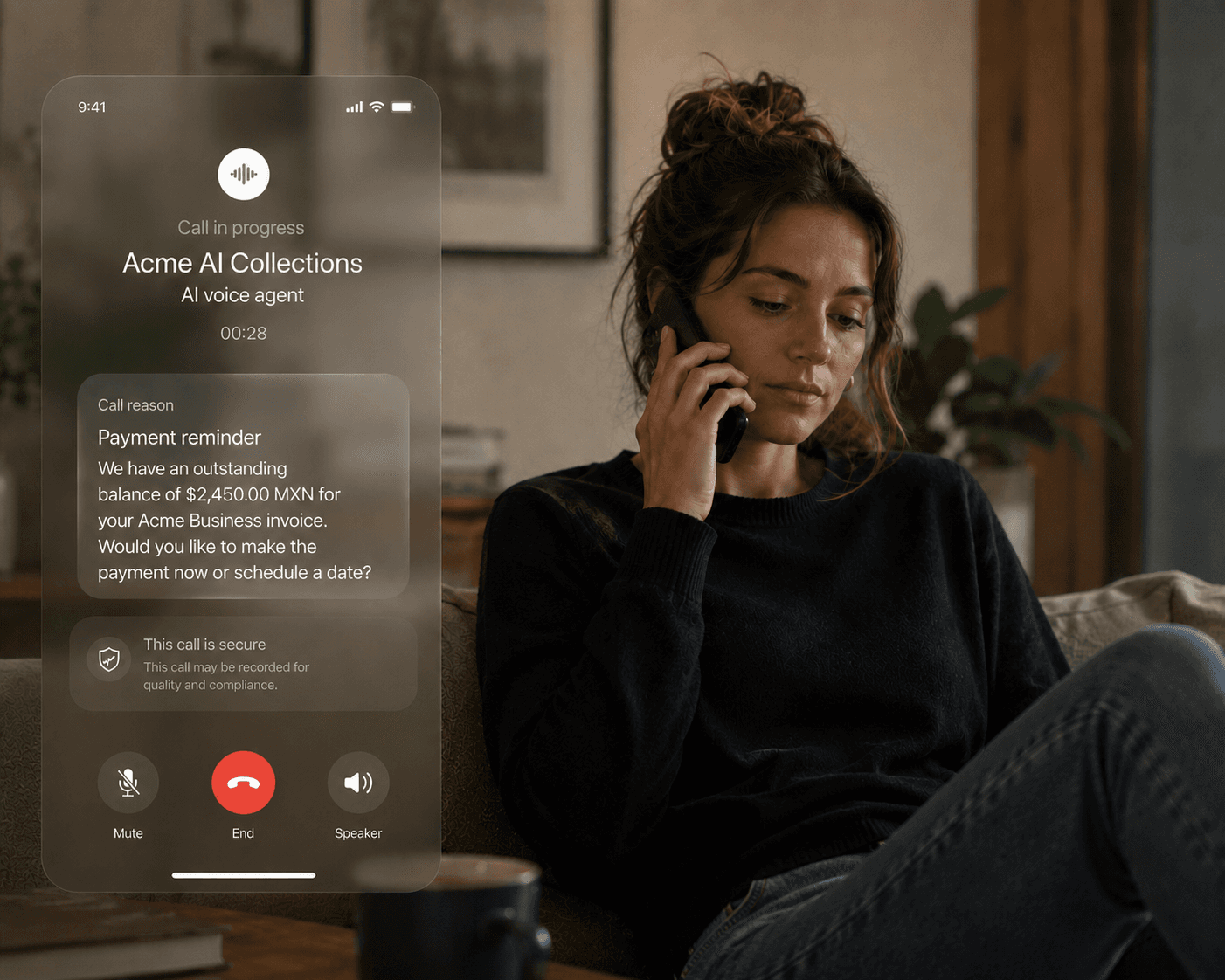
The shift isn't only the channel. Modern WhatsApp collections uses an autonomous agent that decides — when to contact, what to send, when to escalate, when to offer a discount — instead of a linear if-then workflow. The agent reads the ERP, knows the balance, knows the aging, remembers prior interactions, and operates inside the collections policy your team defined. A human approves exceptions; the agent runs the rest.
It's different from having "WhatsApp Business" on a phone. Different from a keyword chatbot. Different from a collections BPO with a WhatsApp license. WhatsApp collections with an ERP-integrated agent is a new category that replaces a layer of operations, not just a communication tool.
2. Why WhatsApp dominates collections in LATAM
WhatsApp is LATAM's most-used app with 85%+ penetration in the five main markets (91% Colombia, 89% Mexico, 92% Argentina, 87% Chile, 85% Peru). For many consumers it replaced email as the business communication channel and the phone as the service channel. That concentration changes collections economics.
The math is direct. An outbound call in Colombia costs USD 0.80–1.20, connects on under 25% of attempts, and averages 90 seconds when it does. A WhatsApp message costs under USD 0.02, delivers to 99% of valid numbers, gets read inside 3 minutes 70% of the time, and allows asynchronous debtor response. At LATAM volume (tens of thousands of accounts/month), the absolute savings are six figures annually before recovery rate improvements.
The truly disruptive shift isn't savings — it's asynchronous response. On a call the debtor decides to pay or not in that minute. On WhatsApp they can read at 10 PM, click the payment link at 11 PM, and resolve while your team sleeps. Collections moves from an 8×5 call-center operation to a 24×7 operation that needs no staff.
Finally, WhatsApp enables negotiation with memory. A well-designed agent remembers the debtor asked for a three-installment plan last week, knows the first installment is due tomorrow, and opens the conversation acknowledging that context. That continuity is impossible in a call center with 40% annual turnover.
3. Legal framework by country
WhatsApp collections is legal in LATAM's five main markets when it respects three pillars: debtor consent, allowed hours, and auditable recordkeeping. Specifics vary by jurisdiction.
| Country | Regulator | Key framework | Hours |
|---|---|---|---|
| Colombia | DIAN, SIC | Habeas Data (Law 1266), DIAN e-invoicing | 7am-9pm |
| Mexico | SAT, CONDUSEF | LFPDPPP, CFDI, Financial Entities Bureau | 7am-10pm |
| Chile | SII, SERNAC | Law 21.320 (collections), Law 19.628 (data) | 8am-8pm |
| Argentina | AFIP, AAIP | Law 25.326 (data), Law 24.240 (consumer) | 8am-9pm |
| Peru | SUNAT, INDECOPI | Law 29733 (data), Consumer Code | 7am-9pm |
Colombia (DIAN + Habeas Data)
Colombian WhatsApp collections is governed by Habeas Data Law 1266 (debtor data) and SIC guidelines on unsolicited communications. The debtor must have consented at credit or service inception; that consent is considered valid while the contractual relationship exists. Allowed hours are 7am–9pm Monday–Saturday, and associated invoices must be DIAN-issued electronic invoices.
In practice, a modern agent must (1) verify consent before first contact, (2) respect the debtor's configured timezone-aware hours, (3) log every message with timestamp and content, (4) respond to opt-out requests within 5 business days.
Mexico (SAT + CONDUSEF)
Mexico regulates extrajudicial collections under LFPDPPP (personal data protection) and CONDUSEF rules for financial entities. Any collections communication must identify the real creditor, avoid intimidating language, and respect 7am–10pm hours. The CFDI fiscal document is SAT-issued and traceable; partial payments generate mandatory complemento de pago entries.
A Mexican specific: CONDUSEF maintains a Financial Entities Bureau that records formal complaints. A poorly designed WhatsApp collections operation (intimidating messages, after-hours contact, third-party contact) generates complaints the agent must avoid by construction, not just policy.
Chile, Argentina, and Peru
In Chile, extrajudicial collections rules require reasonable contact, respect for time windows, and communication records. In Argentina, controls concentrate on personal data, consumer treatment, and fiscal traceability. In Peru, operations must manage data authorization, INDECOPI complaints, and consistency between invoice, balance, and payment channel.
The operating rule is the same in each country: the agent must verify consent, apply local contact hours, identify the creditor, avoid intimidating language, log every interaction, and escalate disputes or sensitive cases before increasing pressure.
4. Templates that don't get blocked
WhatsApp Business API requires outbound message templates to be Meta-approved before bulk send. Approval rests on five criteria: transactional utility, no disguised promotional language, clear opt-out, sender identity, and variable format. A well-designed template approves in under 24 hours; a poorly designed one rejects and, worse, a string of rejections drops the number's quality rating.
| Moment | Goal | Tone example |
|---|---|---|
| Before due date | Prevent delinquency without sounding threatening. | Clear reminder with amount, due date, and payment link. |
| Early aging | Capture a promise to pay or resend the invoice. | Operational help: confirm balance, invoice, and possible date. |
| Administrative aging | Offer the next step inside approved policy. | Payment plan, callback, or escalation if there is a dispute. |
| Pre-legal | Escalate with human control and full records. | Formal language, no threats, with options and human contact. |
Templates that survive approval and user reports avoid excessive pressure, identify the sender, explain why the customer is being contacted, offer channel opt-out, and use clean variables: name, invoice, amount, date, and secure link.
5. Aging segmentation
Aging segmentation keeps every customer from receiving the same message. A customer three days overdue needs clarity; one at 75 days needs a decision: payment, dispute, approved plan, or escalation. The agent should change channel, cadence, and tone by bucket, not just repeat reminders.
| Aging | Primary channel | Next action |
|---|---|---|
| 0-30 | Reminder, payment link, invoice resend. | |
| 31-60 | WhatsApp + voice | Capture promise to pay or reason for non-payment. |
| 61-90 | Voice + human | Validate dispute, approved plan, or exception. |
| 90+ | Human + legal | Controlled escalation with complete case file. |
6. ERP and CRM integration
The right integration is bidirectional. ERP or CRM provides balance, invoice, aging, currency, terms, contact, prior promises, and holds. The agent writes back promise to pay, dispute, confirmed payment, plan request, next contact, and transcript.
In coexistence mode, Soberan works on top of SAP, NetSuite, Odoo, QuickBooks, Siigo, Alegra, Defontana, or another existing system without replacing it. In platform mode, receivables, CRM, and contact center live in one operating layer. In both cases, the rule is to avoid creating a second receivables truth.
7. Measurement and reporting
Measurement should separate financial recovery from operational health. Finance needs to know how much was recovered, how long it took, and which promises were kept. Operations needs to know whether numbers keep quality, which templates work, and where disputes accumulate.
- Effective contact rate
- Average time to pay
- Cost per peso recovered
- Promises kept
- Blocks per 1,000 messages
- Disputes by aging bucket
8. Compare platforms
The LATAM market of WhatsApp + collections platforms includes generic messaging vendors (Wati, Respond.io, Sirena), collections specialists (Moonflow, Solvento), and full operational platforms (Soberan). The practical difference is whether the platform only sends messages or also executes in your ERP.
9. Country and industry guides
Each country-industry combination has nuances: specific regulatory framework, debtor behavior, local payment rails, and benchmark recovery rates. See the guide tailored to your market.
- retail · colombia
- ecommerce · colombia
- fintech · colombia
- servicios · colombia
- retail · mexico
- ecommerce · mexico
- fintech · mexico
- servicios · mexico
- insurance · colombia
- insurance · mexico
Initially covering Colombia and Mexico. Chile, Argentina, and Peru are added in subsequent phases.
FAQ
Is WhatsApp collections legal in LATAM?
Yes, in the five major markets (Colombia, Mexico, Chile, Argentina, Peru) WhatsApp collections is legal when consent, hours, and recordkeeping are respected. Each regulator (DIAN, SAT, SII, AFIP, SUNAT) has nuances and a modern agent should automate the guardrails.
How many messages can I send before getting blocked?
No hard cap, but WhatsApp measures "quality" by block and report rate. A well-designed agent operates with <0.5% blocks and keeps green quality indefinitely.
Do I need my own BSP (Business Solution Provider)?
Yes. For serious volume (1,000+ conversations/month) you need a Meta-certified BSP. Soberan operates as a BSP and absorbs template approval and number registration.
What happens if the debtor doesn't respond on WhatsApp?
The agent automatically escalates to voice, email, or SMS per the configured collections policy. Most recoveries happen on WhatsApp but multichannel orchestration is the difference between 60% and 85% contact rate.
How do you measure WhatsApp collections ROI?
Three metrics: effective contact rate, average time-to-pay, and cost per peso recovered. LATAM companies typically see 25-40% net recovery improvement in the first 90 days.
Does it work alongside an existing collections BPO?
Yes, in "shadow agent" mode: the agent filters early-stage accounts and only escalates the ones requiring complex negotiation to humans. Cuts BPO cost 40-60% while preserving recovery.
Does it comply with DIAN, SAT, and other fiscal regulators?
Yes. Soberan logs every interaction, generates audit-ready records, and respects the hours and consent requirements in each jurisdiction.
How long does implementation take?
Typical 30-day go-live: week 1 audit and design, week 2 connections (ERP/CRM/WhatsApp BSP), weeks 3-4 agent and template configuration, validation, and production.