Multi-format understanding
Read confirmations from email bodies, PDF acknowledgments, spreadsheets, WhatsApp, and supplier portals without forcing one supplier template.
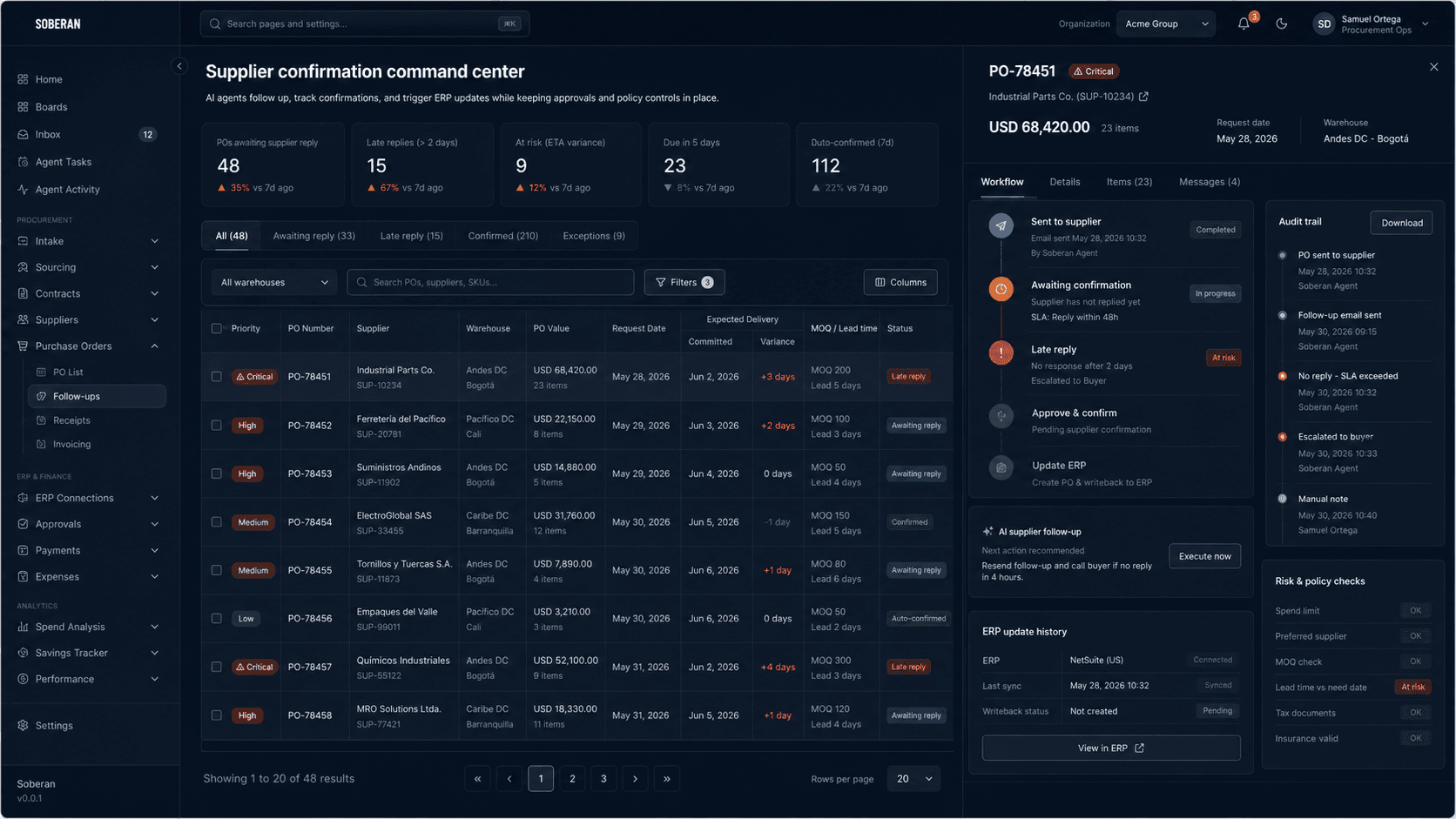
LIVEAI purchase order tracking system
SOBERAN agents monitor open POs, interpret supplier communications, detect date and quantity changes, and prepare governed updates or escalations for the right owner.
01 / Why AI belongs here
A rules-only tracker can read an ERP status field. It cannot reliably interpret “we can ship 60 now and the balance Friday,” connect that answer to the correct line, compare it with the current promise, and decide whether a buyer must approve the change.
02 / Visible lifecycle
The agent connects unstructured supplier signals to structured PO records, then stays inside explicit write and approval boundaries.
Read open POs, aging, supplier, line, and receipt state from the ERP
Capture replies, confirmations, PDFs, spreadsheets, and portal updates
Extract promised date, quantity, shipment, and discrepancy signals
Associate each signal with the correct PO, supplier, and line
Apply confidence, policy, impact, and approval rules
Follow up, escalate, or write an approved update back to the ERP
Need the complete lifecycle definition? Open glossary →
03 / Decision matrix
The goal is not autonomous purchasing. It is faster, better-governed exception handling.
04 / Operating system
Read confirmations from email bodies, PDF acknowledgments, spreadsheets, WhatsApp, and supplier portals without forcing one supplier template.
Compare confirmed dates and quantities with the current PO and isolate the lines that actually changed.
Route an exception with the relevant SKU, warehouse, inventory exposure, message history, and proposed next step.
Keep the source message, extracted values, confidence, policy result, approval, writeback, owner, and timestamp together.
05 / Choose the focus
06 / FAQ
AI interprets unstructured supplier communications, connects them to structured PO records, detects changes, and prepares a response. Traditional tracking usually depends on people manually updating status fields.
Only inside configured boundaries. Low-risk confirmations can be recorded automatically, while date, quantity, price, or other material changes can require human approval before ERP writeback.
It uses PO numbers, supplier identity, line details, dates, quantities, attachments, and conversation context, then applies a confidence threshold before suggesting or making an association.
The status remains unresolved, the evidence is shown to the buyer, and the system can draft a clarification instead of inventing a confirmation.
Review one workflow with our team — 30 minutes, no commitment.
Book a demo