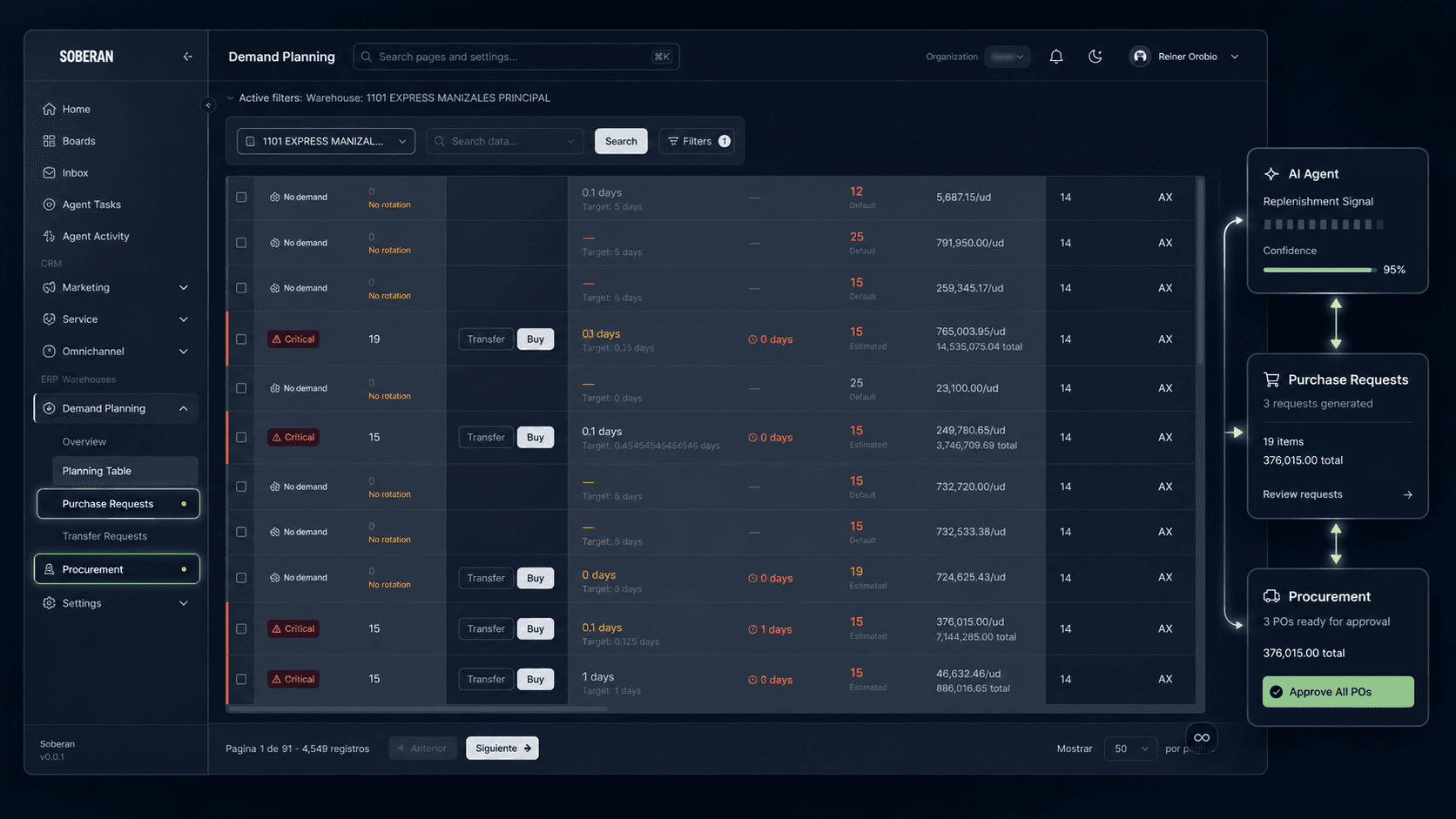
The answer: automate the purchase decision packet, not only the PO
The strongest procurement automation use case from the SOBERAN automate page is not a bot that creates purchase orders faster. It is an agent that builds the decision packet behind the purchase order: what triggered the need, which supplier is preferred, whether budget exists, which policy applies, who must approve, and what the supplier must confirm.
This matters because procurement teams are under pressure to reduce cycle time without losing spend control. McKinsey procurement research points to agentic AI across source-to-pay, while Accenture frames supply chains as moving from automation toward autonomy. The buyer question is practical: can the agent create a clean PO only when the context and approval boundary are clear?
High-intent use cases to automate first
- Purchase request intake: capture requester, SKU or service, location, budget owner, supplier, urgency, and required documents.
- Replenishment-to-PO: turn approved inventory signals into draft purchase orders with quantity, lead time, MOQ, and supplier constraints.
- Supplier follow-up: ask for confirmation, revised delivery dates, missing tax documents, shipment proof, or invoice corrections.
- Approval routing: apply spend thresholds, margin impact, preferred supplier rules, budget limits, and exception owners.
- PO writeback: create the PO, attach evidence, store approval history, and record supplier response inside ERP or procurement systems.
- Exception packets: route missing receipts, price variance, duplicate supplier, unusual terms, or low-confidence data to a human owner.
Competitor landscape
- 01
Zip
Procurement orchestrationZip positions AI procurement orchestration around intake-to-procure, procure-to-pay, supplier onboarding, sourcing, risk orchestration, and AI procurement concierge workflows.
- Best for
- Large teams standardizing intake, approval routing, and procurement front-door adoption.
- Note
- The gap for operators is often downstream execution: turning approved requests into ERP actions, supplier follow-up, and exception closure.
- 02
Coupa Navi
AI spend managementCoupa describes Navi as an intelligent agent for spend management across sourcing, procurement, invoicing, payments, expenses, and source-to-pay work.
- Best for
- Enterprise spend management teams already standardized on Coupa.
- Note
- Buyers should still test how well the agent works with local ERP data, supplier communication, and approval evidence.
- 03
GEP Quantum Intelligence
Agentic procurement and supply chain orchestrationGEP describes autonomous AI agents for intake, sourcing events, supplier discovery, bid analysis, and award scenario modeling.
- Best for
- Procurement groups looking for a broad source-to-pay and supply chain platform.
- Note
- Mid-market teams should evaluate setup effort and whether the first workflow can ship without a full platform replacement.
Governance checklist for AI procurement automation
- Keep automatic actions narrow: draft requests, enrich supplier context, prepare approval packets, and follow up on missing data before granting PO creation rights.
- Require approval for spend thresholds, new suppliers, unusual payment terms, price variance, low-margin buys, and supplier risk flags.
- Show every source used by the agent: demand signal, inventory level, open PO, supplier lead time, contract, budget, approval policy, and requester note.
- Write back structured fields, not only chat summaries: supplier, PO number, amount, promised date, approval owner, exception reason, and next action.
- Measure cycle time, compliant spend, supplier response time, PO rework, stockout-causing delays, and audit completeness.
How SOBERAN fits
SOBERAN connects procurement automation to ERP, demand planning, inventory, supplier communication, approvals, and SOBERAN Agent. That makes it useful for the practical edge case: a purchase need appears, the agent gathers context, prepares or creates the PO inside policy, and escalates anything risky with a complete packet.
A serious demo should start with a replenishment or requester signal and end with either an approved purchase order or a routed exception that includes source records, policy result, approver, and supplier next step.
Sources and trend signals
- McKinsey on agentic AI in procurement2026 analysis on AI across source-to-pay, supplier collaboration, invoice-to-contract compliance, and procurement value creation.
- McKinsey on procurement value leakage and gen AI2025 view on using generative AI to reduce leakage across source-to-pay improvement areas.
- Accenture on autonomous supply chainsTrend signal for supply chains moving from automation toward autonomous operating systems powered by generative AI.
- SOBERAN procurement automationSOBERAN use case page for request intake, purchase order creation, supplier follow-up, and spend controls.