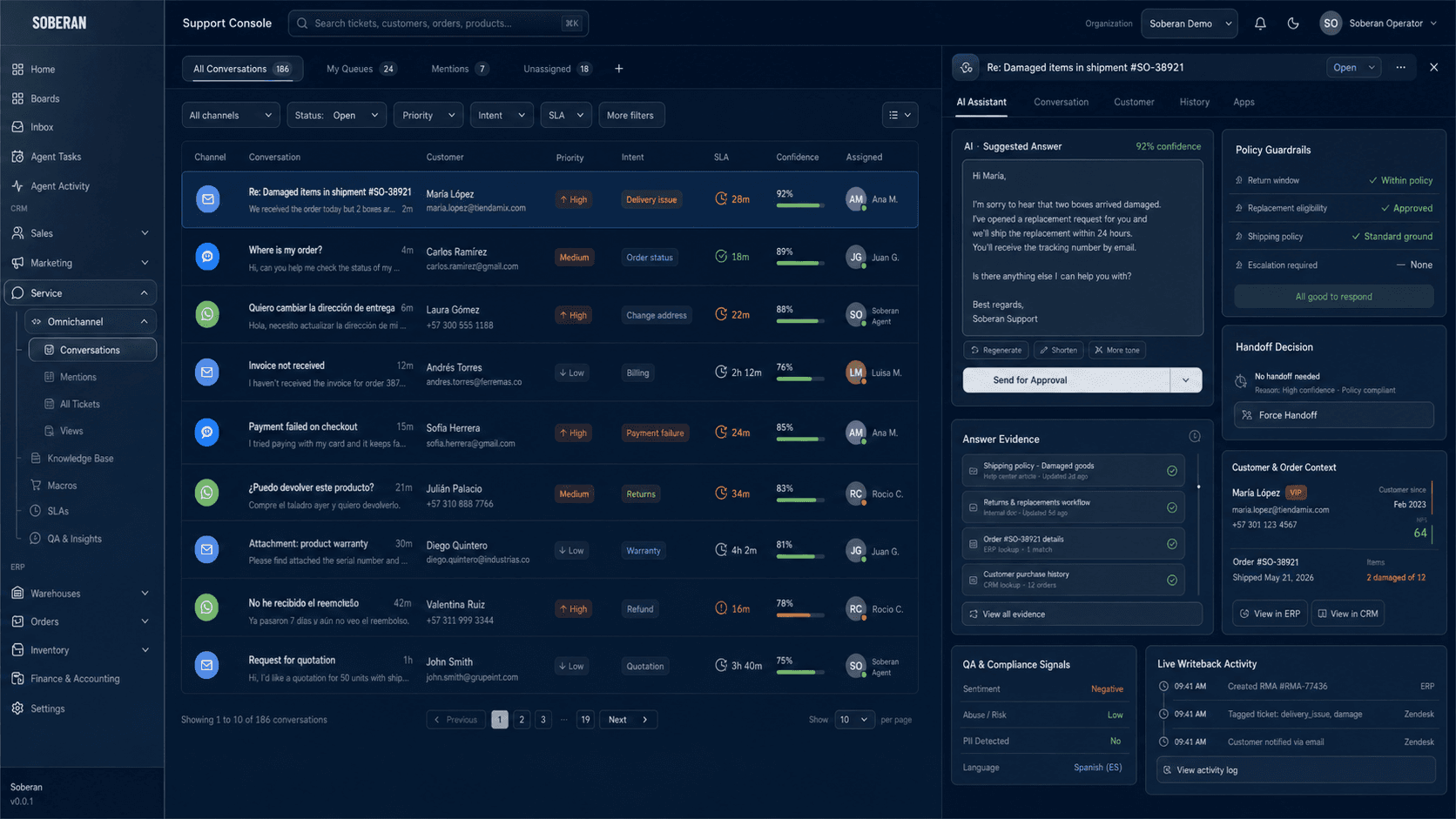
The answer: automate resolution with evidence and handoff controls
AI support automation should classify the request, retrieve customer and order context, ground the response in approved knowledge and system data, decide whether an action is allowed, update the right record, and escalate with a complete evidence packet when confidence or policy fails.
Buyer intent is service-oriented: support leaders, operations teams, and CX owners want faster first response, lower backlog, consistent answers, and fewer customers forced to repeat themselves across chat, email, WhatsApp, and human agents.
Concrete workflow to implement first
- Classify inbound chat and email by intent, urgency, customer tier, language, sentiment, SLA, product, order, invoice, and whether the message includes attachments.
- Retrieve CRM, ERP, order, invoice, warranty, shipment, policy, and knowledge-base context before drafting an answer.
- Resolve approved low-risk requests such as order status, basic returns, invoice copies, address confirmation, appointment reminders, and knowledge-base answers.
- Escalate disputes, regulated claims, refunds outside policy, high-value customers, abusive language, low confidence, and missing system evidence.
- Write back ticket status, answer source, disposition, customer promise, internal note, escalation reason, and next task.
Competitor landscape
- 01
Zendesk AI Agents
AI service agents in the support platformZendesk positions AI agents around resolving multi-step workflows across channels and connecting to business systems.
- Best for
- Support organizations already standardized on Zendesk and looking to automate ticket resolution inside that workspace.
- Note
- Validate governance for ERP actions, finance-sensitive answers, and cross-system audit trails.
- 02
Intercom Fin
AI agent for chat and emailIntercom documents Fin over email with audience rules, answer behavior, escalation, ratings, and analysis workflows.
- Best for
- Digital support teams using Intercom Messenger and email as the main service surface.
- Note
- Check whether operational actions beyond the helpdesk are governed and written back to ERP or CRM.
- 03
SOBERAN
AI support agent with CRM and ERP contextSOBERAN focuses on classifying support work, grounding responses in operational evidence, executing safe updates, and escalating with context.
- Best for
- Teams that need chat and email support to touch orders, invoices, inventory, customer records, and human approvals.
- Note
- The differentiator is resolution across operational systems, not only answer generation inside the inbox.
Operating model, governance, and metrics
- Operating model: support operations owns intent taxonomy and SLAs, knowledge owners maintain approved content, system owners define allowed actions, and the AI agent owns triage, answer drafting, resolution, and evidence logging.
- Governance: require disclosure, source citations, confidence thresholds, policy checks, PII handling, human takeover, and review queues for refunds, legal issues, safety, billing disputes, and angry customers.
- Metrics: first response time, backlog, containment with confirmed resolution, escalation quality, reopened ticket rate, CSAT, SLA breach rate, answer source coverage, and writeback completeness.
- How SOBERAN fits: SOBERAN can connect chat, email, WhatsApp, CRM, ERP, knowledge, and approval workflows so support automation becomes a governed operating loop rather than blind deflection.
Sources and trend signals
- Gartner - customer service technology trendsTrend signal on digital-first service, live chat, self-service, agent assist, and caution around agent-washing.
- McKinsey - The contact center crossroadsAnalyst reference for balancing humans and AI in customer care operating models.
- Zendesk AI AgentsOfficial competitor page for AI service agents and multi-step service workflows.
- Intercom Fin over emailOfficial documentation for deploying an AI agent over email with escalation and analytics.